In 1997, college college student Zhang Hongchao opened a small shaved-ice store in Henan, then one of China’s poorest provinces, with money lent by his grandmother. Nearly 30 years later, Zhang and his brother Hongfu, Mixue’s CEO, are worth some $8.2 billion each. Zhang’s shaved-ice store, now called Mixue Ice Cream & Tea and known for its soft serve and beverages, has more locations globally (53,000) than McDonald’s (43,500). Its IPO in March on the Hong Kong Stock Exchange raised HK$3.45 billion ($450 million)—the fifth largest in Hong Kong in the first half of 2025—and was oversubscribed 5,000 times. Mixue is expected to open its first U.S. location in New York City, having reportedly signed a 10-year lease on Canal Street.
Mixue’s rapid scaling around the world reflects the strength of its supply chain, its growth via a franchise model, and its viral branding, but it also speaks to the remarkable staying power of Zhang’s early decision to win over cost-conscious buyers with an ice cream cone that costs just 15 cents.
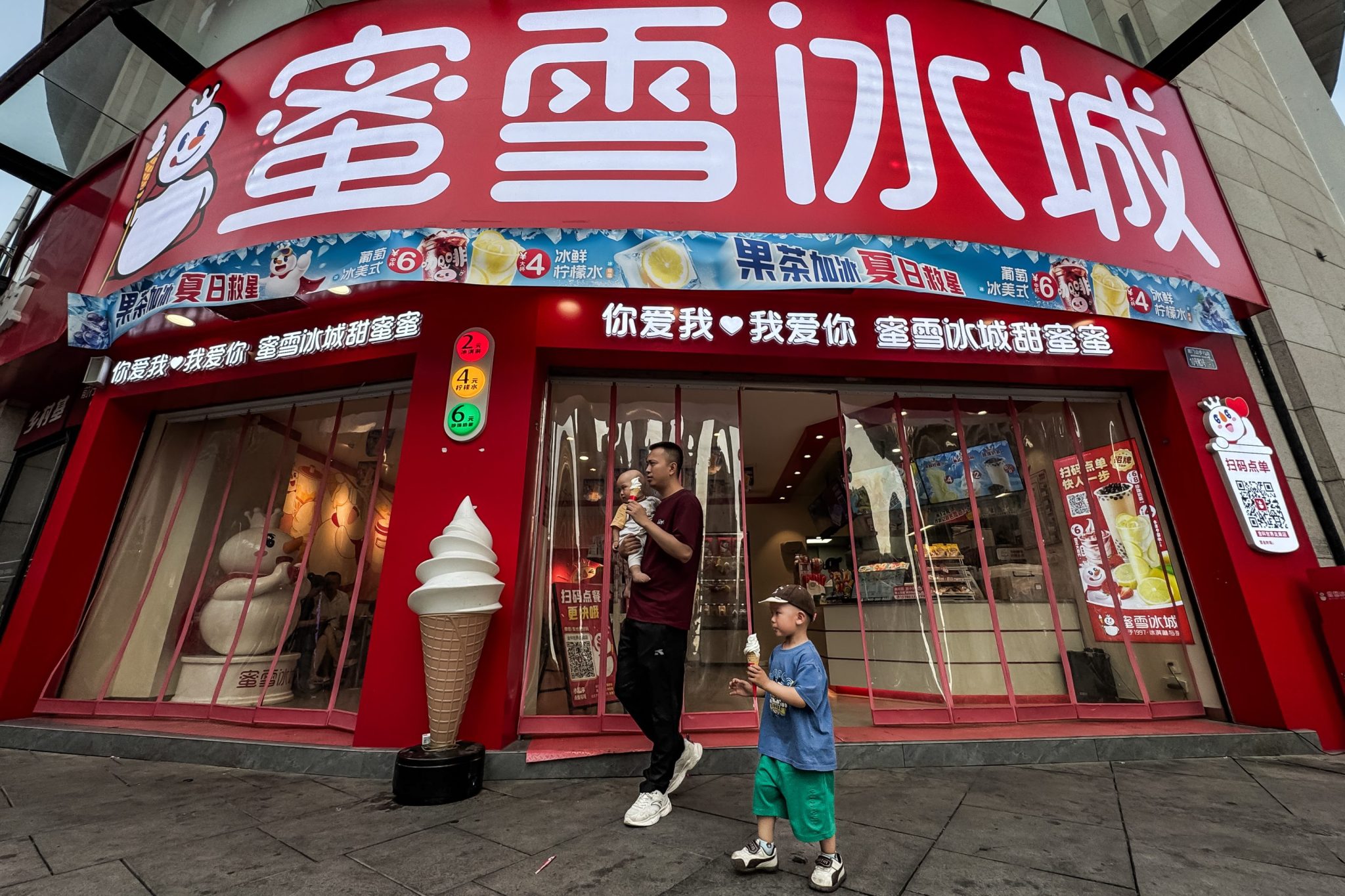
For those in the know, a Mixue store is instantly recognizable. Its glowing logo and signature red interior drew a crowd on a Friday afternoon in November in Hong Kong’s central shopping district. In a city known for its luxury shopping, Mixue’s menu prices also stand out: a juicy grape burst for the equivalent of $1.67, pearl milk tea for $2.06, and soft-serve ice cream for 64 cents, cheaper even than McDonald’s $1.09 Sundae cone. On a poster, the brand’s mascot, Snow King, holds a milk tea and winks. “With Mixue in hand, joy is grand,” it reads.
Mixue’s recent fortunes are grand indeed. In the first half of 2025, Mixue reported 14.9 billion yuan ($2 billion) in revenue, up 40% from the previous year’s period. Its firsthalf profit of 2.7 billion yuan ($370 million) is tiny compared with, say, McDonald’s first-quarter profit of $1.9 billion, but it represents 44% growth from the year prior. (Mixue did not return requests for comment.)
Affordability has always been a draw for Mixue— even if the price of its 15 cent cone has ticked up—but there’s more to the ice cream and beverage chain than cheap treats.
As Mixue expanded, it faced ingredient shortages, which prompted Zhang to start sourcing the chain’s raw materials directly from farmers and producers. In 2012 it established centralized factories and later set up warehouses and coldchain logistics to deliver ingredients like frozen fruit pulps and fresh strawberry and mango cubes to franchisees. (It now has 23,404 worldwide.) That reduces middleman costs, helping Mixue keep its prices low and its products fresh. When Mixue went public in March, it said that approximately 66% of the net proceeds from the offering would be used to widen and deepen its end-to-end supply chains.
Mixue’s close relationship with ingredient manufacturers and suppliers gives it a cost advantage that competitors struggle to replicate. “When they open more outlets, they can immediately send out all these supplies, ingredients…So profit margins are pretty tight, and [food and beverage] brands typically find it challenging to manage this,” says Emil Fazira, Asia Pacific food insight manager at Euromonitor International.
Mixue’s franchise model is also a moneymaker in that it sells equipment and ingredients to its franchisees. It cites such sales as a driver of its 40% year-overyear revenue growth in the first half of this year.
By offering both desserts and drinks, Mixue differentiates itself from competitors that just sell beverages. The sweet treat is one of the fastest growing product categories in Asia Pacific and Southeast Asia, Fazira notes.
While ice cream is usually perceived as a more indulgent treat, Mixue’s more affordable and accessible soft serve, compared with sit-down ice cream parlors, makes it “a bit more unique,” Fazira says.
Just as unique are Mixue’s marketing tactics. In China, stores turned sales receipts into serialized fiction, printing 20 chapters of a compelling narrative featuring its mascot, Snow King, and sparking a nationwide craze.
Abroad, Mixue is engaging consumers with games and gifts. Andrian Lim, a video game streamer based in Malaysia, joined a Mixue Instagram Reel challenge in September to finish a mint lemonade in 45 seconds. The 31-year-old was among dozens who braved stinging brain freeze to win an exclusive Snow King foldable bag.
“I love to challenge myself to the limit, just for the fun of it,” says Lim, who “fell in love” with Mixue’s jasmine tea—and its cheap price.
Looking ahead, Mixue plans to meet the all-day beverage demands of consumers by expanding its stand-alone coffee shops and introducing beer. Mixue’s coffee chain, Lucky Cup, which sells freshly brewed coffee for 6 yuan (90 cents), recently entered Malaysia after establishing a foothold of 8,000 locations in China. In September, Mixue Group acquired 53% equity in Chinese draft beer company Fulu Fresh Beer, helmed by Hongfu’s wife, Tian Haixia.
“[Mixue] is trying to enter new pockets of opportunity…It is interested, or at least keen to understand, that area of product diversification,” Fazira says.
And of course, Mixue’s new beer is likely to be cheap. Fulu Fresh sells for 7.9 yuan or $1.11 a pop.
This article appears in the December 2025/January 2026 issue of Fortune with the headline “Mixue’s hot streak.”
Asia’s booming sweet treat product category is fueling Mixue’s rise
44%
Mixue’s profits soared in the first half of 2025 to reach 2.7 billion Yuan ($370 million).
53,000
Mixue’s sprawling global store count now tops McDonald’s