Summary:
Major banks see Bitcoin’s 2026 outlook shaped by ETF adoption, regulatory clarity and institutional tokenisation, with forecasts clustering firmly in six-figure territory.
–
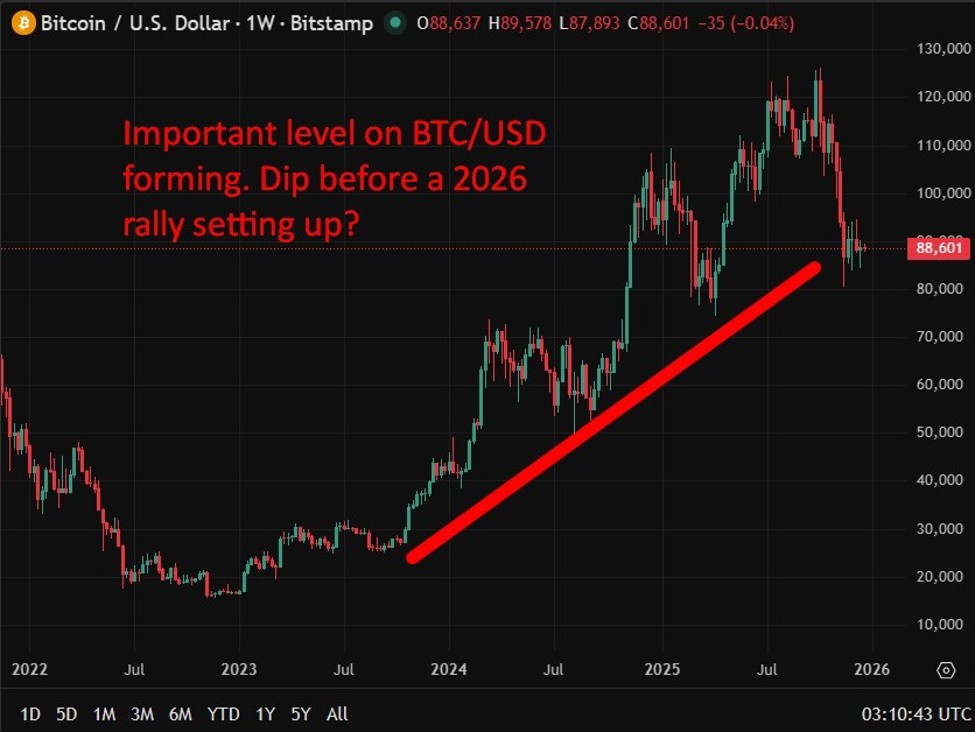
Bitcoin’s long-term investment case is increasingly being framed around institutional adoption rather than retail speculation, with major global banks outlining scenarios that place the cryptocurrency well into six-figure territory by 2026.
Recent media coverage citing Citi Research points to a central forecast that Bitcoin could climb toward $143,000 in 2026, supported by sustained exchange-traded fund inflows and clearer regulatory guardrails. Citi’s analysis incorporates both bullish and bearish scenarios but emphasises that the balance of risks has shifted materially since the launch of spot Bitcoin ETFs, which have lowered barriers to entry for traditional investors.
ETF-driven demand is seen as a structural rather than cyclical tailwind. By enabling pension funds, asset managers and advisers to gain exposure within familiar frameworks, ETFs are viewed as transforming Bitcoin from a fringe allocation into a portfolio diversifier with increasing legitimacy. Citi also highlights regulatory progress in key jurisdictions as a catalyst that could reduce volatility premiums and encourage longer-term capital.
Parallel developments in traditional finance are reinforcing this narrative. JPMorgan Chase has moved further into blockchain-based finance with the launch of a tokenised money-market fund, signalling growing confidence in distributed-ledger infrastructure. While not a direct Bitcoin product, the initiative underscores how large banks are embedding tokenisation into mainstream capital markets. JPM will be watching ETH developments keenly:
Secondary media reports referencing JPMorgan commentary suggest upside scenarios for Bitcoin extending toward $170,000 by 2026, reflecting expectations that tokenisation, regulated custody solutions and improved market plumbing will broaden institutional participation.
Taken together, these forecasts frame 2026 as a potential inflection point for Bitcoin, one defined less by speculative cycles and more by integration into the global financial system.