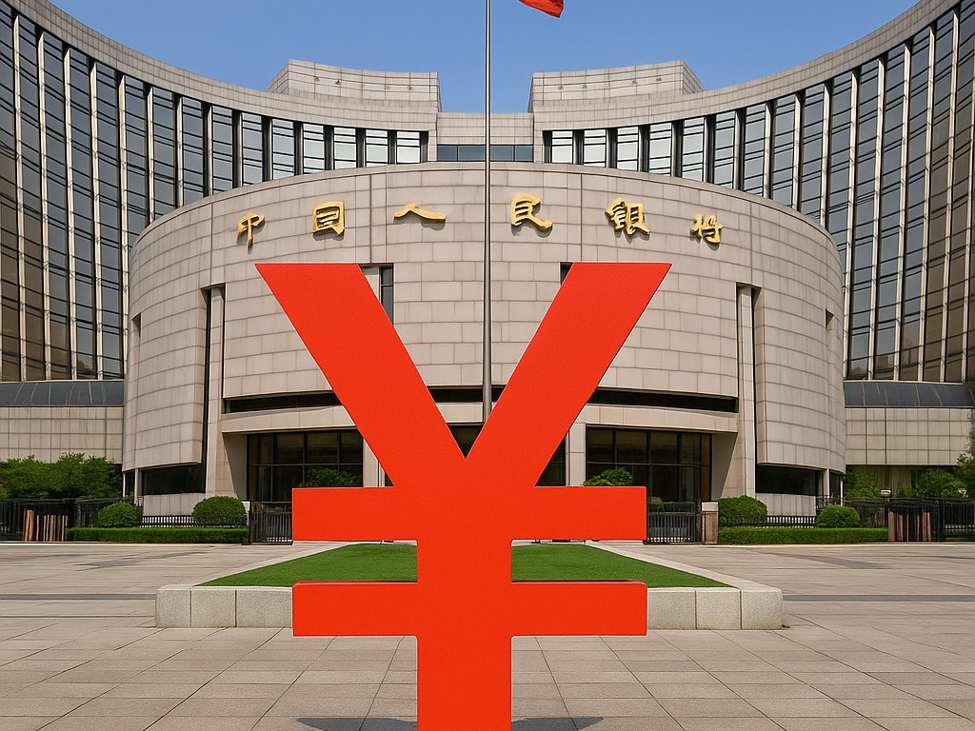
The People’s Bank of China (PBOC), China’s central bank, is responsible for setting the daily midpoint of the yuan (also known as renminbi or RMB). The PBOC follows a managed floating exchange rate system that allows the value of the yuan to fluctuate within a certain range, called a “band,” around a central reference rate, or “midpoint.” It’s currently at +/- 2%.
Earlier:
The daily fixing of this mid-rate is often interpreted as a policy signal rather than just a technical reference point. A higher-than-expected USD/CNY midpoint is typically read as a sign the PBOC is leaning against CNY appreciation pressure, like today.
—
In other news from the People’s Bank of China, China’s Loan Prime Rates remain unchanged again, marking the seventh consecutive month without a change.
PBoC sets 5 year at 3.50% (vs. exp. 3.50% and prior 3.5%)
- 1 year at 3.00% (vs.exp. 3.0% and prior 3.0%)
A look at the past changes in the LPR, since early 2022:
| Date | One-year LPR | Five-year LPR | Change | Notes |
|---|---|---|---|---|
| May 2025 | 3.00% | 3.50% | -10bp | Latest cut; both 1Y and 5Y trimmed. |
| Feb 2024 | 3.45% | 3.95% | -25bp (5Y only) | Big mortgage-linked cut aimed at property sector support. |
| Aug 2023 | 3.45% | 4.20% | -10bp (1Y), -15bp (5Y) | Coordinated easing to counter weak growth. |
| Jun 2023 | 3.55% | 4.20% | -10bp (1Y), -10bp (5Y) | First LPR cut since Aug 2022. |
| Aug 2022 | 3.65% | 4.30% | -5bp (1Y), -15bp (5Y) | Targeted mortgage support. |
| Jan 2022 | 3.70% | 4.60% | -10bp (1Y), -5bp (5Y) | Part of early 2022 easing cycle. |
China’s main policy rate is now the reverse repo rate, currently at 1.4% for the 7-day.
The 7-day rate serves as a key policy benchmark, influencing other lending rates like the Loan Prime Rates (LPRs). The PBOC uses these open market operations to inject or absorb funds, influencing interbank lending rates.