TL;DR summary:
-
Drills include blockade-style operations and joint assault scenarios
-
Exercises involve multi-directional air and naval approaches
-
Rhetoric framed as warning against Taiwan independence
-
Markets watch for signs of escalation beyond scheduled drills
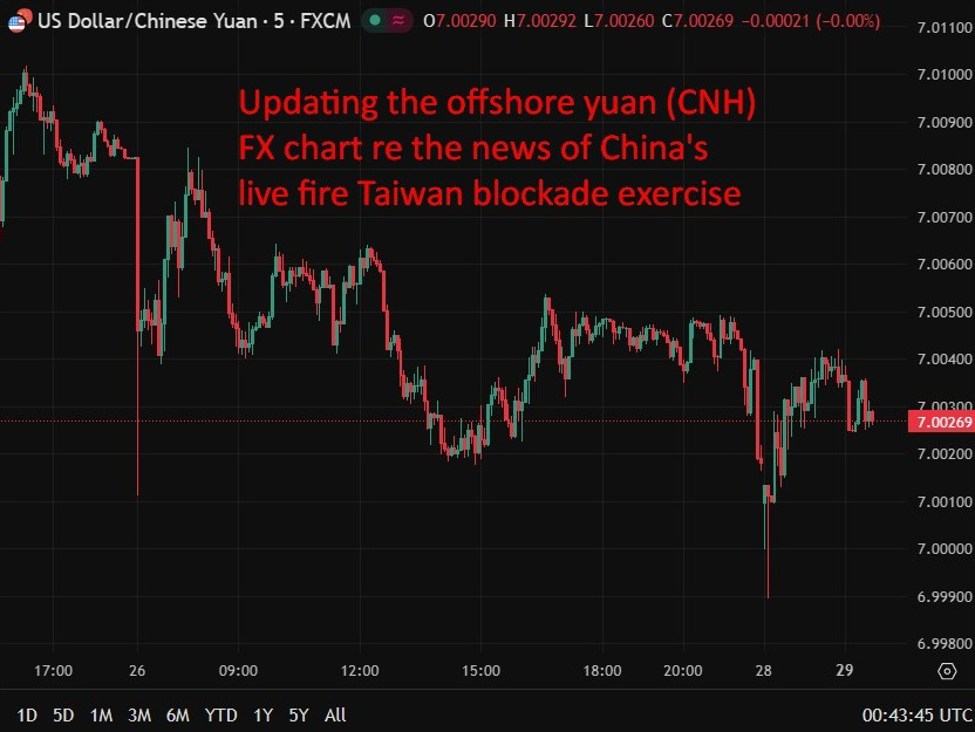
China’s military has announced a new, larger-scale exercise around Taiwan (earlier info: China to conduct live-fire military drills surrounding Taiwan on December 30), intensifying pressure on the island and reinforcing concerns that recent drills are evolving beyond routine signalling into more explicit rehearsal scenarios.
The People’s Liberation Army Eastern Theater Command said it will begin a major exercise later this evening U.S. time, running through Tuesday, under the codename “Justice Mission 2025.” According to the command, the drills will focus on sea–air combat readiness patrols, joint seizure of comprehensive superiority, and the blockade of key ports and areas, language that closely aligns with scenarios designed to isolate Taiwan rather than conduct limited demonstrations.
In a statement, an Eastern Theater Command spokesperson said the exercises will involve vessels and aircraft approaching Taiwan from multiple directions, with forces from different military services conducting joint assault operations. The drills are intended to test joint operational capabilities across domains, a central requirement for sustained high-intensity operations rather than symbolic manoeuvres.
The spokesperson described the operation as a “stern warning” to Taiwan independence forces, calling it a legitimate and necessary action to safeguard China’s sovereignty and national unity. The emphasis on “all-dimensional deterrence outside the island chain” marks a notable escalation in rhetoric, suggesting an intent to project control not only around Taiwan but also across surrounding sea and air corridors.
From a market perspective, the announcement reinforces a shift from episodic drills toward more complex, extended exercises that explicitly reference blockade-style tactics. While similar operations in the past have not disrupted trade flows, the framing raises sensitivity around shipping routes, insurance costs, and technology supply chains, particularly semiconductors, should such exercises become more frequent or prolonged.
Asian markets have historically absorbed Taiwan-related military headlines with limited immediate repricing unless accompanied by operational spillover or political escalation. However, the duration of the exercise, its codename, and its explicit operational objectives may sustain a modest geopolitical risk premium, particularly for regional equities and currencies.
For now, investors are likely to monitor whether the drills remain time-bound and contained, or whether follow-on operations are announced. A transition from scheduled exercises to rolling deployments would mark a more material shift in the regional risk environment.
From the earlier post