Summary:
-
DeepMind CEO says China’s AI models are only months behind U.S. counterparts
-
Rapid progress challenges views that China remains far behind in AI
-
Chinese firms have shown strong catch-up but limited frontier innovation
-
Export controls still constrain China’s access to top-tier AI chips
-
Longer-term divergence may emerge as U.S. infrastructure scales faster
China just months behind US AI models, DeepMind CEO says – via a CNBC report
China’s artificial intelligence models may be far closer to U.S. and Western capabilities than many assume, with the gap now measured in months rather than years, according to comments from Demis Hassabis, chief executive of Google DeepMind.
Speaking to CNBC, Hassabis said Chinese AI developers appear to be only “a matter of months” behind leading U.S. and Western models, a view that challenges the long-held assumption that China remains significantly behind in advanced AI development. He made the remarks on CNBC’s The Tech Download podcast, which launched this week.
Hassabis said Chinese models are closer to the technological frontier than many observers believed a year or two ago, citing rapid progress from both established technology giants and newer AI laboratories. He pointed to last year’s market reaction to a model released by Chinese lab DeepSeek, which impressed investors with strong performance despite being trained on less advanced chips and at lower cost than many U.S. counterparts.
Since then, Chinese tech heavyweights such as Alibaba, alongside startups including Moonshot AI and Zhipu, have continued to roll out increasingly capable large language models. While the initial shock factor has faded, Hassabis said the pace of improvement has remained notable.
However, he drew a clear distinction between catching up and leading. Hassabis said Chinese firms have yet to demonstrate the ability to push beyond the current AI frontier by delivering genuine scientific breakthroughs. In particular, he questioned whether Chinese labs could originate a foundational advance comparable to the transformer architecture developed by Google researchers in 2017, which underpins today’s most powerful AI systems, including ChatGPT and Google’s Gemini.
Other industry leaders have also acknowledged China’s progress. Jensen Huang has previously said the U.S. is “not far ahead” in the AI race, noting China’s strength in infrastructure and models, even as the U.S. maintains a lead in advanced chips.
Still, structural constraints remain. U.S. export controls restrict China’s access to Nvidia’s most advanced semiconductors, forcing domestic firms to rely on less powerful alternatives. Some analysts argue that over time, this hardware gap could cause U.S. models to pull further ahead as superior infrastructure enables faster iteration.
Hassabis, however, suggested the absence of frontier breakthroughs in China may reflect culture rather than capability, arguing that true innovation is far harder than replication — even for teams with world-class engineering talent.
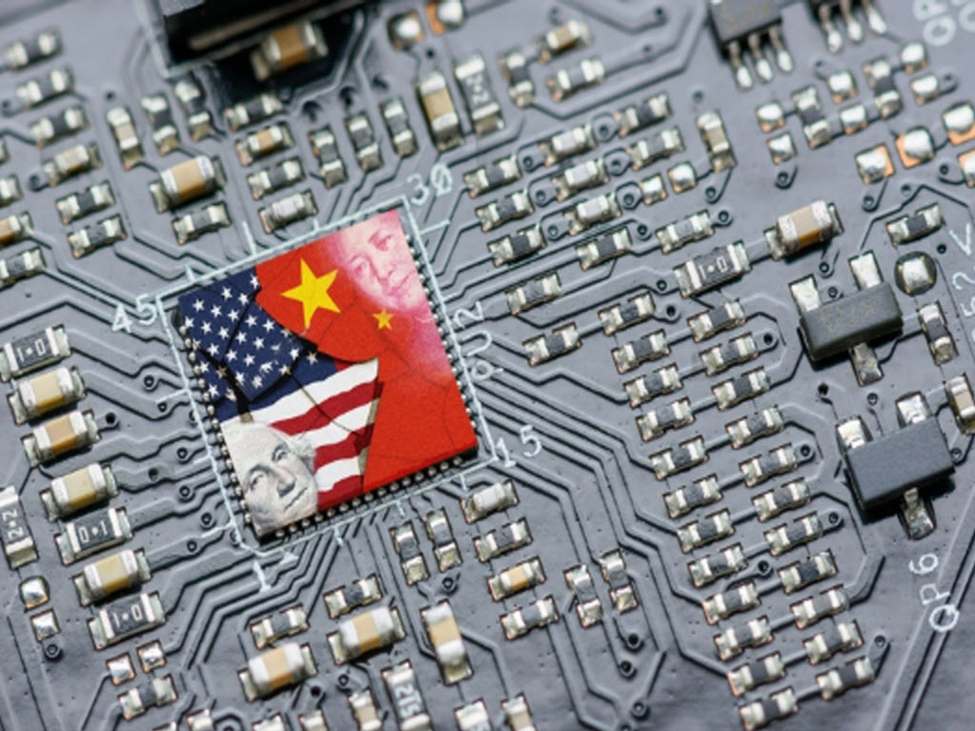
AI image