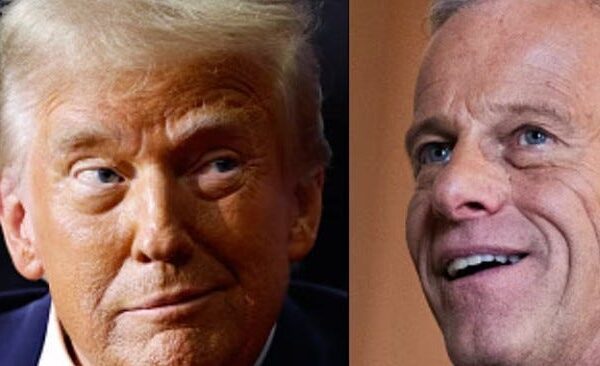

Memes tend to gravitate toward pop stars, politicians and villains. But this week, the internet found a central banker.
Jerome Powell, the 72-year-old chair of the Federal Reserve, is not the kind of guy you’d expect to see flashing across Instagram and Tiktok to the tune of a high-saturated techno remix. Yet, his image has broken containment over the last few days, as Gen Z has turned the famously taciturn technocrat into a symbol of defiance of the second Trump era, clad with reverent edits usually reserved for K-Pop stars.
It’s been quite a development for the central banker that Trump initially chose as the replacement for Janet Yellen, who would go on to become Joe Biden’s Treasury Secretary. Trump was reported back in 2017 to appreciate that Powell had a “central casting” air to him, but the longtime Washingtonian surprised onlookers over the next several years by maintaining and even extending Yellen’s focus on the “full employment” side of the Fed’s dual mandate.
In August 2020, Powell revealed that the Fed had revised its monetary policy framework to emphasize the “broad-based and inclusive goal” of maximum employment, running the economy as hot as it took to get all Americans back to work. Critics soon pounced, warning of the risk of higher inflation, and Powell’s series of aggressive rate hikes in 2022 and 2023 made this policy a close-but-distant memory. Still, during the period known as “the Great Resignation,” when labor had the most leverage to command salary hikes in a generation, Jerome Powell was a millennial-era hero.
It looks like Gen Z is discovering what their older siblings did, half a decade ago.
One manifestation of the trend began with a video made by Democratic strategist and popular YouTuber Keith Edwards. Riffing on the “We are Charlie Kirk” song that conservatives championed after the death of the right-wing activist, Edwards decided to flip the script and make it “We are Jerome Powell.”
“We are Jerome Powell, we carry the line,” the voice of a man wistfully moans. “Not to a man – but to law and time.”
Edwards said he used AI to generate both the lyrics and the video itself.
“I personally believe if you look at the memes from 2016, they were very liberal-coded,” Edwards told Fortune. “I think that’s flipped. Conservative ideas travel faster on the internet now.”
For Edwards, the Powell meme is a tactical necessity in what he describes as a literal “information war.”
“We are at war,” Edwards said. “When you’re in war, you grab the biggest weapon you can and you fire it. I’m going to pull every single grenade I can and throw it.”
In this context, Powell is the “grenade.”
After Powell released a rare video statement confirming that the Justice Department had subpoenaed him over Federal Reserve office renovations, and explicitly framed the inquiry as political pressure tied to his refusal to cut interest rates faster, he emerged online as an unlikely symbol of resistance.
Edwards explained that, to him, Powell represents a vanishing archetype: the technocratic figure who still believes in institutional norms and does things “by the book.” It’s a similar and yet different Powell boomlet to the pandemic “maximum employment” era, when the Georgetown figurehead was arguably woke in his commitment to getting every American back to work.
The internet—or more specifically, Gen Z—decided that Edwards’ video “went hard,” as it were. They’ve now taken to making fancams with videos of Powell looking tough; him posing in a sleek suit, him giving Trump a dirty look as they both stand around in hardware hats. This recalls another #resistance hero who took on an almost Marlboro man-style American toughness in meme world: the former FBI chief and special counsel, Robert Mueller.
According to Aiden Walker, a researcher who specializes in internet culture, the appeal is more that Powell doesn’t look cool. He suggested the “alchemy” lies in the contrast: Powell is both “venerable” and “unassuming,” and placing that persona into a fan cam typically reserved for K-Pop idols or action stars has a “gently subversive irony” to it.
Powell is also very “authentic to himself,” Walker said, and Gen Z loves authenticity (or, like Trump, they love the central casting aspect of the gray-haired politico).
“He’s an old banker, he’s been around the block,” Walker said. As an example, he pointed out the moment of Powell and Trump in their construction hats as they argue over the renovation numbers to the building.
“It’s his posture there,” Walker said. “He’s clearly not a guy who wears construction hats, but that’s what they’re doing, and he’s very true to himself, and I think people online love that in a figure.”
But there is also a deeper shift in how the public relates to the Fed. We are no longer in an era where the Federal Reserve is a black box to everyone but Wall Street. Commission-free apps like Robinhood and the exploding popularity of pandemic-era “meme stocks” and spaces like r/WallStreetBets on Reddit have made something of a culture around retail investing in the 2020s.
The numbers back that up. Prior to the pandemic, retail order flow rarely exceeded 10% of daily U.S. equity trading. By contrast, J.P. Morgan reports that retail activity reached an all-time-high of 36% of total order flow on April 29, 2025.
“There are so many more retail investors today,” Walker noted. “Twenty-somethings own a couple of stocks on Robinhood. They feel much closer to the market.”
The result is a new kind of familiarity with figures like Powell, even among left-leaning Gen-Zers who might otherwise distrust the Federal Reserve.
“There’s a fandom logic now,” Walker said. “And he’s kind of a fun, ironic figure, because he clearly doesn’t want to be famous necessarily. It’s just kind of been forced.”
AI and accelerationism
In 2016–a time on many people’s minds as the internet celebrates the origin of a slower internet culture—a political meme might have taken days or weeks to saturate the culture. In 2026, AI-generated content has compressed that cycle into hours.
“AI generation makes it a lot easier and faster to make your Jerome Powell edit,” Walker said. “You can watch a clip of Powell, and within two hours, have your edit responding to it.” This speed doesn’t just accelerate the meme, but it changes its nature and the nature of its subject, where news events become absurd spectacles of participation.
In postmodern theory, this is what is known as “accelerationism.” By feeding a stodgy institutional figure like Powell into the AI-meme deluge, the internet hijacks the Federal Reserve’s image and accelerates it past the point of professional control. The process of taking a serious person out of their serious context—what French psychoanalysts Gilles Deleuze and Felix Guattari called “deterritorialization”—plugs them into a high-speed digital world where they are fashioned into a particular vibe. In this framework, the meme is what psychoanalysts call a “hyperstition,” a digital fiction that, through the sheer power of speed and repetition, begins to dictate how we perceive the actual stability of our institutions. Philosophers sometimes use the example of cyberspace to explain superstition, pointing to how science-fiction author William Gibson’s imagined cyberpunk world shaped the ethos of what actually became the internet.
Despite the ultimate one-dimensionality or “frivolousness” of the Powell meme, Walker said he is glad that Gen Z is paying attention.
“I’d say there’s a lot of people who probably saw a reel like that, and maybe Googled who he was or what he said,” Walker said. “We are Jerome Powell, it out-ironies the ironic post because it makes it sincere again, because we enjoy him.”
This story was originally featured on Fortune.com