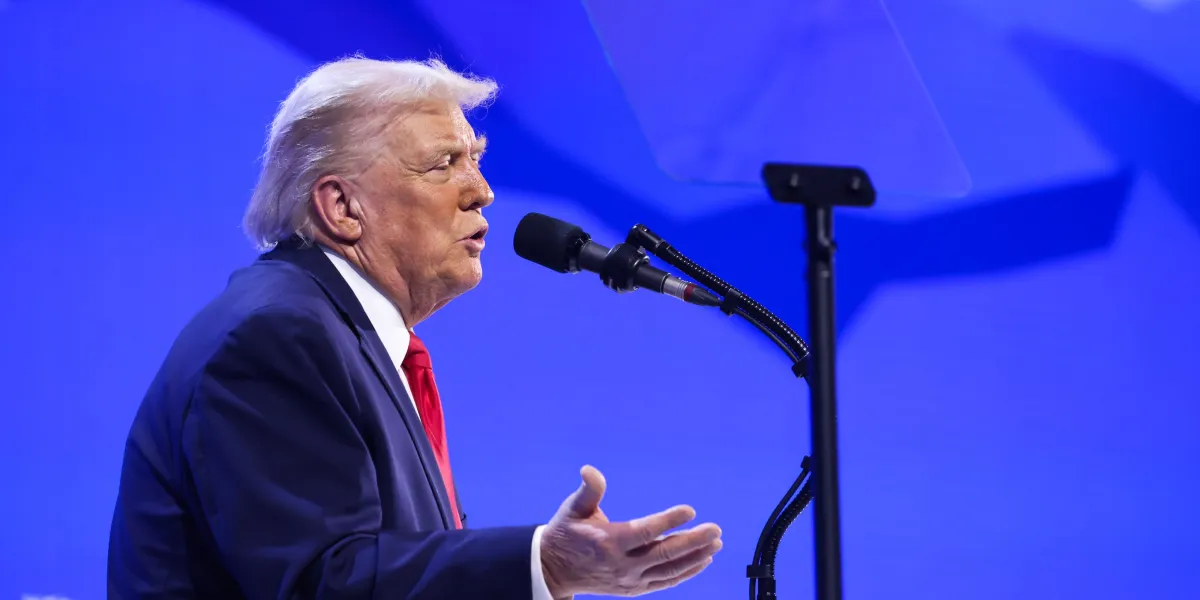
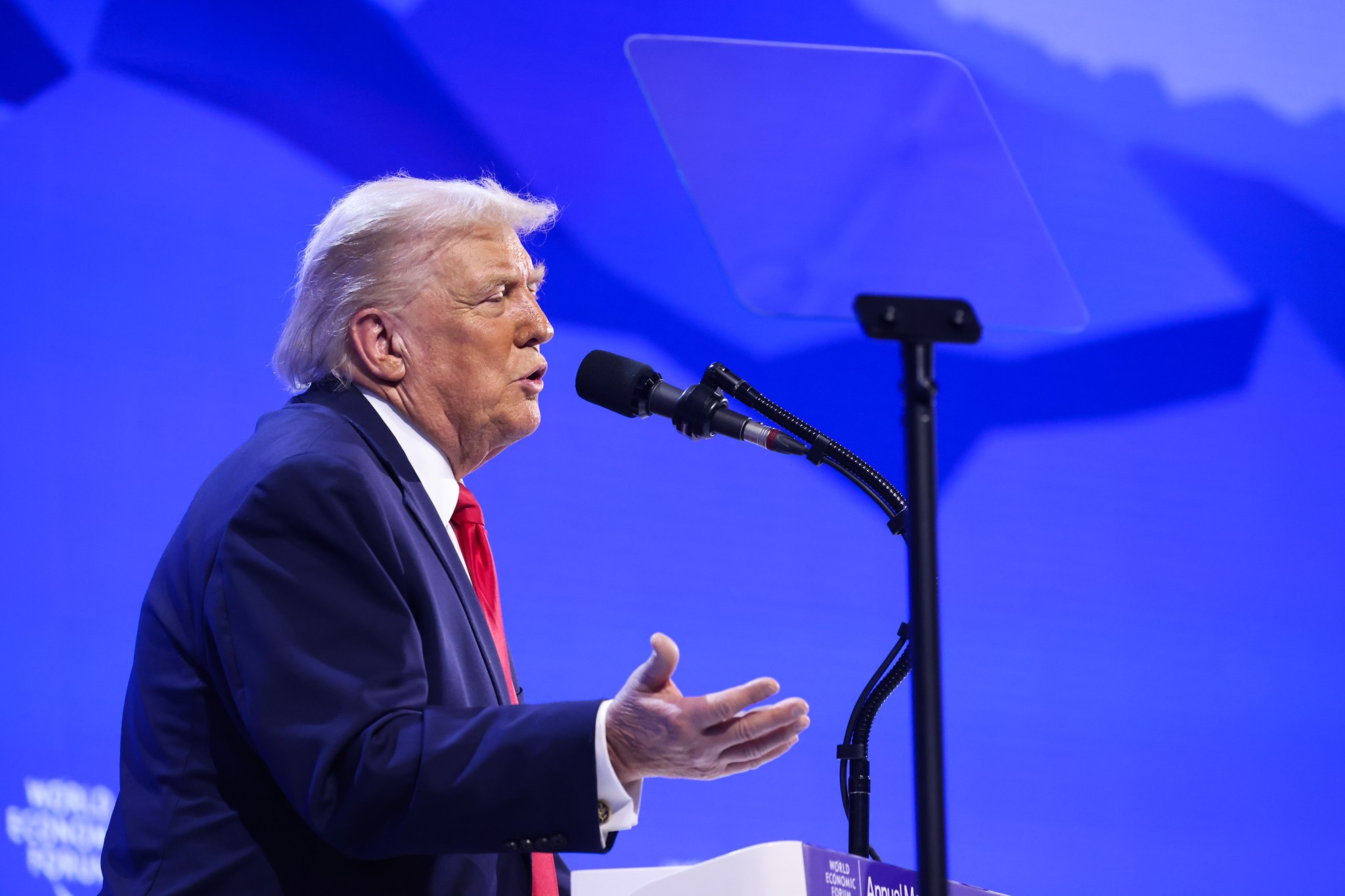
President Trump told those gathered at the World Economic Forum in Davos that he would not use force to take Greenland, and the world breathed a sigh of relief. But he is still pushing tariffs on Europe if Denmark refuses to sell its territory to the U.S.
Trump’s plan has outraged European leaders. “Being a happy vassal is one thing. Being a miserable slave is something else,” Belgian Prime Minister Bart De Wever said. French President Emmanuel Macron said Trump’s “endless accumulation of new tariffs” were “fundamentally unacceptable.” Meanwhile, European Commission President Ursula von der Leyen called for the EU to become “independent” from the U.S. and to make that independence “permanent.”
But does Europe have enough economic weaponry to force the White House to think again?
Maybe, according to Wall Street analysts.
Here are seven ways the E.U. could hurt the U.S. economically if Trump refuses to take “no” for an answer on Greenland, according to research by George Saravelos of Deutsche Bank, Joachim Klement of Panmure Liberum, Macquarie’s Thierry Wizman and Gareth Berry, and Pantheon Macreconomics’ Samuel Tombs and Oliver Allen.
- Reduce the supply of foreign direct investment into U.S. bonds and equities by incentivizing investors to keep their capital assets in Europe.
“European countries own $8 trillion of U.S. bonds and equities, almost twice as much as the rest of the world combined,” Saravelos told clients a few days ago. - Impose the $100 billion in duties on U.S. imports that were proposed and then dropped when the E.U. accepted a tariff deal last year.
- Use the Digital Services Act to further limit how U.S. tech companies operate.
- Implement the “Buy European” act to direct government purchases more toward European vendors.
- Implement the Anti-Coercion Instrument (ACI) to impose tariffs on U.S. services companies and companies linked to the U.S. government.
The ACI would virtually ban U.S. services companies from operating in Europe, while Europe holds a trade surplus with the U.S. in services. This measure is often referred to as Europe’s trade “bazooka.” - “Introduce export taxes on EU products exported to the U.S. that are hard to replace, such as chip-making equipment or specialized machinery,” Macquarie says.
Removing the U.S.’s access to Netherlands-based semiconductor suppliers ASML, which has a virtual monopoly on some technologies, would create logistical challenges for many U.S tech companies. - Place sanctions on U.S. companies operating in Greenland.
“The U.S. has one key weakness: it relies on others to pay its bills via large external deficits. Europe, on the other hand, is America’s largest lender: European countries own $8 trillion of US bonds and equities, almost twice as much as the rest of the world combined. In an environment where the geoeconomic stability of the western alliance is being disrupted existentially, it is not clear why Europeans would be as willing to play this part,” Saravelous told clients in a note that annoyed Treasury Secretary Scott Bessent.
Trump is not likely to take this lying down. Klement wrote on his Substack: “Of course, these actions will trigger an escalation by Trump in the short term, which is why some EU leaders like Friedrich Merz of Germany are currently trying to soften the EU’s response.
“But 2025 also has shown that if countries remain firm, the escalation cycle ends within a couple of weeks and Trump rows back (or should I say ‘chickens out’?) once he realises he can’t bully others into submission.”
At Macquarie, the analysts warned that a comprehensive package of economic sanctions against the U.S. would increase price inflation in America. “The EU has the capacity to retaliate economically, and may do so in the hope that a firm EU retaliation (to threats or military action by the U.S.) will end the escalation cycle after a few weeks, and that this is a risk worth taking. What can the EU do, actually? The EU can do enough to hurt the U.S. economy and U.S. security, and these the trade-related measures would likely be jointly inflationary,” they said.
The ACI “bazooka” won’t hobble the U.S. but it could hurt, Tombs and Allen say. “U.S. services exports to the E.U. were $295bn in 2024, equivalent to 0.9% of U.S. GDP, suggesting the harm could be much greater if the E.U. pulled this relatively new lever at its disposal than if it responded simply with tariffs, though its economy would be hurt more too,” they told clients.