- Prior 52.4
- Manufacturing PMI 49.4 vs 49.1 expected
- Prior 48.8
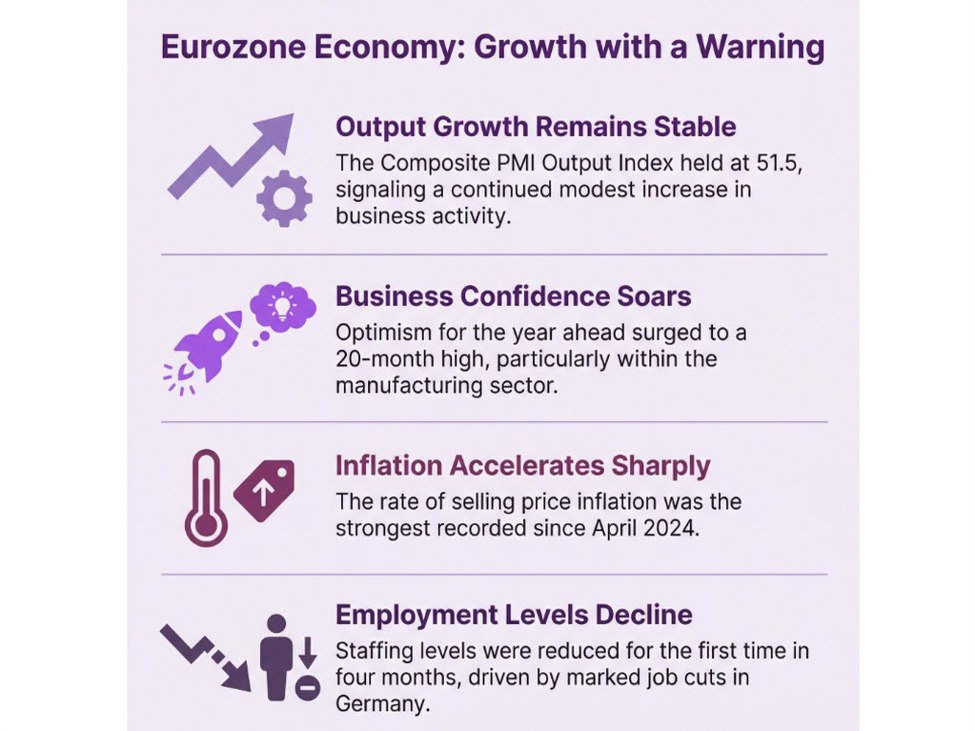
- Composite PMI 51.5 vs 51.8 expected
- Prior 51.5
The end of last year was filled with optimism on the recovery but the start of the year dealt a bit of a reality check. The contrast between France and Germany again is for all to see. The former is facing a stuttering month in terms of business activity while the latter is seen more resilient still. That said, firms reduced their staffing levels for the first time in four months amid marked job cuts in Germany. So, there’s that.
On the inflation front, both input costs and output prices were seen growing faster than in December. So, there are still some things to be mindful about at the balance.
HCOB notes that:
“The recovery still looks rather feeble. In manufacturing, the headline PMI continues to signal weakness, while growth in
services activity is somewhat more moderate than the month before. Overall economic growth remains unchanged. Looking
ahead, the low growth in new orders is certainly no game changer. Instead, the start into the new year points to more of the
same in the months to come.
For the ECB, these results are anything but reassuring. Inflation in the services sector, which the central bank is watching
particularly closely, has increased significantly in terms of sales prices. Input cost inflation remains an issue as well, though it
has accelerated less than sales price inflation. As a result, ECB members are likely to feel validated in holding rates where
they are. Some of the more hawkish members may even argue that the next move should be up rather than down.
Comparing countries, services activity in Germany expanded in January at a fairly robust pace, while in France service
companies slipped into contractionary territory. This may be linked to the political difficulties in finalising the 2026 budget. In
manufacturing, France shows a slightly better performance than Germany, but in both countries output growth is nothing to
write home about. Overall, Germany’s economy started the new year on a growth path, while monthly output in France has
declined.
While the unemployment rate has been roughly stable over the past year, weakening employment figures in services and
ongoing staff cuts in manufacturing point toward a somewhat higher unemployment rate in the coming months. This
suggests that the current weak growth trajectory may not be enough to keep employment steady, especially as companies
continue striving to become leaner, for example by deploying artificial intelligence solutions.”