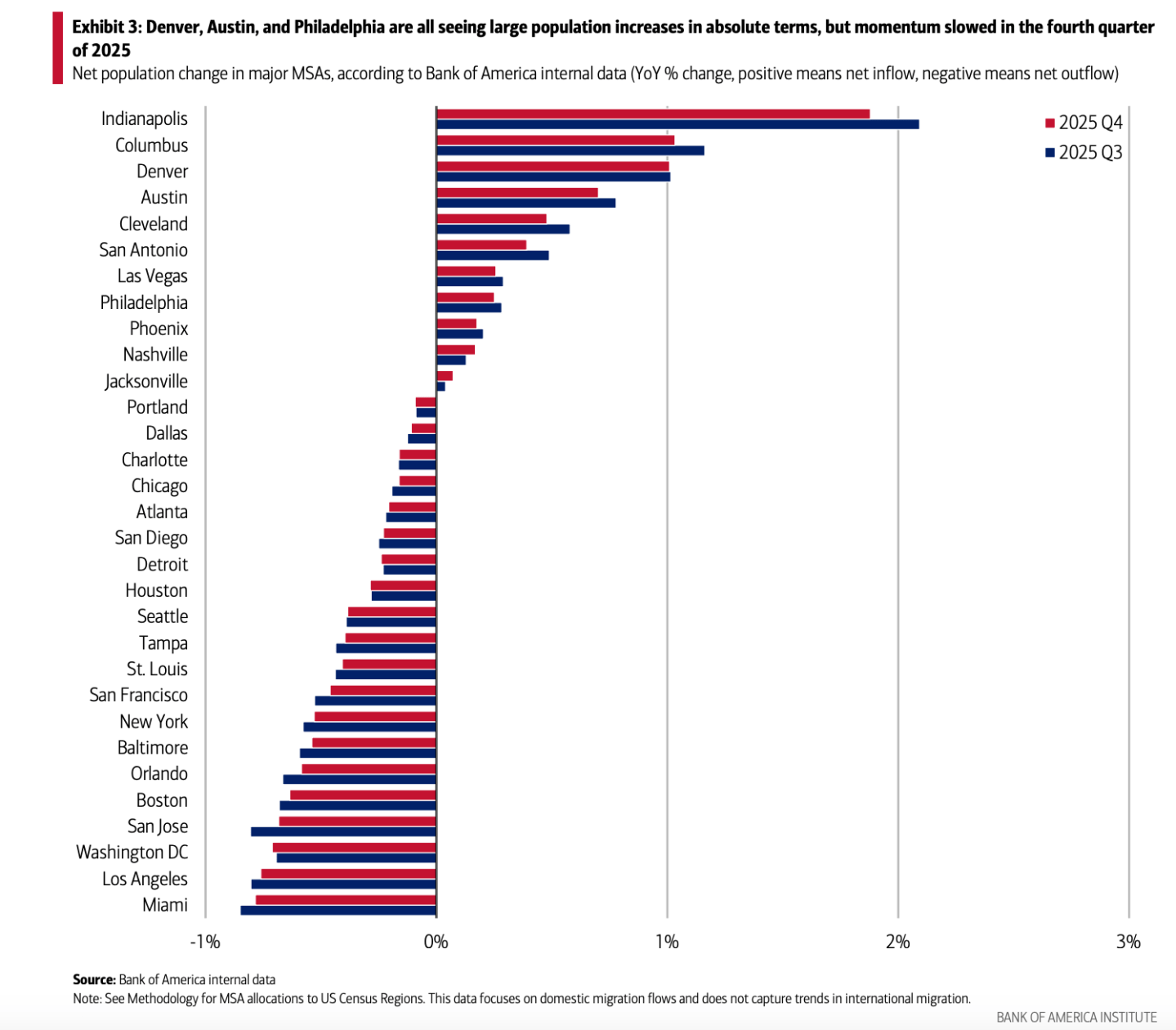
Six years after the pandemic reshaped the American map, the exodus from the nation’s largest coastal cities has not only persisted but also evolved to include a former boomtown. According to a January 2026 report from the Bank of America Institute, Americans are continuing to leave New York and Los Angeles in droves, but they are now fleeing Miami at equally alarming rates.
Data from the fourth quarter of 2025 reveals that Miami and Los Angeles topped the list of major U.S. cities suffering the largest population losses in absolute terms; they also had the largest population losses year-over year. While the early 2020s saw Florida serve as a primary refuge for remote workers, the tide is turning for its main hub, with Miami recording the steepest year-over-year percentage drop in population among major metropolitan areas tracked by the bank.
Miami’s outgoing mayor, Francis Suarez, told Fortune in October that he was concerned about the likely (and now confirmed) election of Zohran Mamdani as New York, and yet he also acknowledged that there was “definitely a gentrification happening” in his city. Two months later, affordability concerns played a key role in Miami electing its first Democratic mayor in nearly 30 years, Eileen Higgins. Miami currently occupies the top spot on UBS Global Wealth Management’s “bubble risk index,” with LA, San Francisco, and New York the only other American cities on the ranking.
Austin, Denver, and Philadelphia topped the list of largest increases in new movers as the affordability crisis gripping the U.S. shows the Sunbelt is no exception. Also, the institute remarked that “the Midwest is still having a moment,” with Indianapolis and Columbus leading in terms of absolute population growth.
Affordability crisis hits the Sunbelt
The primary driver of this shift appears to be the same force that emptied out city centers in 2020: the search for value. “Affordability and climate remain the two biggest magnets—and the two biggest push factors,” the report notes.
While Miami continues to attract wealthy transplants from New York and Boston, these inflows are no longer enough to offset the mass departure of existing residents. “Miami’s migration tells a striking story,” the authors write, losing population even despite continued strong inflows from major cities such as New York and Boston.
Nearly 70% of those leaving Miami in 2025 relocated to other parts of the South, favoring more affordable nearby markets like Orlando, Tampa, and Atlanta. The data suggests that former Miamians are looking for locations that are “somewhat close to home” but less financially straining.
Los Angeles and New York continue to shrink
On the West Coast, the story remains consistent with trends established earlier in the decade. Los Angeles saw a net population decline of 0.8% year over year, as residents scattered to cheaper western hubs.
“Los Angeles’ migration map shows a city in motion—and not in its favor,” the report states. While high costs are the primary friction point, environmental concerns, specifically wildfire risk, are also prompting Angelenos to leave. However, they aren’t going far; moves to Las Vegas, Phoenix, and Seattle comprised a large portion of the outflow, proving that residents are seeking another version of west-coast life that is easier to navigate financially.
New York City posted the second-largest absolute outflow of people in 2025. While the city remains a global hub, nearly 45% of outbound New Yorkers are heading South. Interestingly, Philadelphia has emerged as a major beneficiary of New York’s churn. More than one in four new residents in Philadelphia hailed from NYC, as movers sought a lower cost of living within a short train ride of their former home.
“Philadelphia tells an interesting story,” the authors write, boasting the third-largest inflow for the fourth quarter of 2025, with more than one in four new residents saying “farewell to all that” and leaving New York. The city of brotherly love is drawing in many residents from across the Northeast, too, showing that it continues to function as a “regional magnet for affordability-minded movers while remaining a relatively short drive from neighboring big cities.” At the same, nearly a third of inbound migrants were from the south, versus 40% of Philadelphians moving farther south in search of warmer climates and lower costs.
The Era of the “Regional Shuffle”
The broader takeaway from the 2026 data is that the “Great Reshuffle” has slowed down and become more localized. The total number of Americans moving has more than halved since 2021.
“The big story isn’t a national reshuffle – it’s people trading one nearby city for another that fits their budget and lifestyle a little better,” the report concludes.
Even popular growth engines like Austin and Denver are showing signs of this maturation. While Austin continues to grow, attracting talent from across the country, it is also seeing outflows to smaller cities in the South, suggesting it is no longer immune to the affordability concerns plaguing the coasts.
Six years post-pandemic, the data indicates that Americans are no longer abandoning entire regions. Instead, they are “reshaping their lives within them,” hunting for value without sacrificing familiarity, but the big coastal hubs are more likely to be abandoned than embraced.
For this story, Fortune journalists used generative AI as a research tool. An editor verified the accuracy of the information before publishing.