For the past 12 months, investors and consumers had settled into the idea of a ‘K-shaped economy.’ Be it jobs or spending, the K-shape illustrated a growing divide between the fortunes of the wealthy and everyone else. Those at the top of the pile trended higher, while those already struggling pushed lower.
But new analysis from Bank of America suggests the trajectory of middle-class consumers is now pulling away from those on the lower end of the income spectrum: These consumers aren’t doing as well as wealthy people, but their spending power isn’t as diminished as poorer consumers.
A look at BofA’s data shows the shape is no longer a K. If we’re sticking with the alphabet theme, one might suggest an ‘E’ is emerging.
In a note published yesterday by six BofA economists, the group wrote that “income‑based divergence in spending and wage growth persists, and we are concerned that a ‘K’ shape is opening up between higher-income households and middle-income households, alongside the existing gap with lower-income households.”
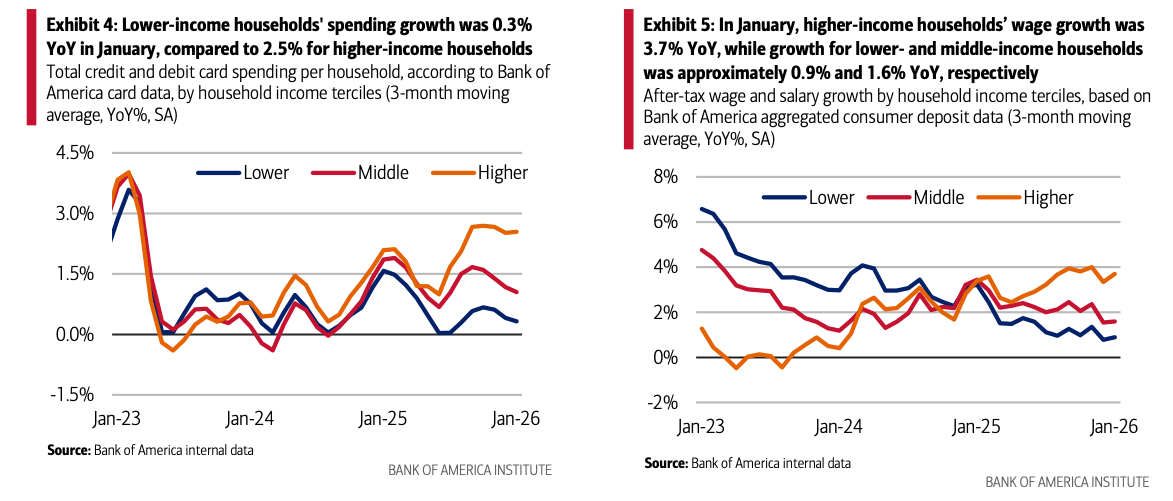
Citing internal data, the group said that in January the spending growth between higher-income households and all others was at its largest since mid-2022, the height of the COVID-era spending boom. Year-on-year in January, higher-income consumers’ spending growth on credit and debit cards grew 2.5%. Lower-income households grew just 0.3% while middle-income was relatively flat at 1%.
“A similar pattern is emerging in after-tax wage growth, with the gap between higher- and middle-income households at its largest in nearly five years,” the BofA team added. “While higher-income households’ wage growth was 3.7% YoY in January, a solid improvement from the 3.3% YoY in December, middle-income families’ wage growth saw only a marginal improvement, increasing to just under 1.6% YoY in January from over 1.5% in December.”
While talk of K-shaped economies has become more prevelant during a recent surge in debate about affordability (and how recessionary the real economy feels, as opposed to growth in concentrated sectors like technology) echoes of a growing divide can be traced back over decades: The Fed began monitoring the distribution of household wealth in Q3 2010, and reported that total wealth equaled $60.76 trillion. Of that, the top 0.1% owned $6.53 trillion, and those in the top 99% to 99.9% percentiles owned $10.75 trillion. By contrast, the bottom 50% shared only $330 billion.
Fast-forward to Q3 2025: The wealth of the bottom 50% has grown by 1,189% to $4.25 trillion—though still significantly behind the wealth held by the top 0.1% even some 15 years prior. The top 0.1% saw their wealth grow 281% to $24.89 trillion, nearly six times the wealth held by the bottom 50% combined.
Savvier consumers
Since the end of the pandemic, Wall Street has been delighted and surprised by the resilience of the U.S. consumer, particularly amid elevated interest rates and higher costs of living.
When it comes to debt, those at the sharpest end of the economy are struggling: The New York Fed reported this week that while delinquency rates for mortgages are near historically normal levels, deterioration is concentrated in areas that are both lower-income and have declining home prices. That said, while transitions into early delinquency came from mortgages and student loans, all other debt types held were steady.
BofA’s data tells a similar story: The share of households paying off their full credit card balance each month has risen across all incomes and generations compared to 2019. For example, taking an average index reading of 100 for 2019, lower-income young people as of January 2026 resulted in a near-20 point increase. The trajectory is the same, though less pronounced, among Gen X and older generations (baby boomers and traditionalists).
Consumers’ bank balances have been bolstered by factors such as wage growth and lower gas prices, offsetting other inflation. But BofA said shoppers are also being savvier, the “trading-down” phenomenon. The report said: “Households’ spending growth was much higher at value grocers than at premium grocery stores from 2022 until the beginning of 2025. And while middle- and higher-income households’ spending growth have converged somewhat over the last year, lower-income households’ growth at value grocers has outpaced that at premium grocery stores by around five percentage points for the past three years.”