When Silicon Valley executives and federal lawmakers gathered at the Hill and Valley Forum on Tuesday,, a conference designed to bridge the gap between Big Tech and Washington, artificial intelligence dominated the whole event.
Despite their historically rocky relationship over tech regulation, executives and lawmakers were aligned that the AI race has become an existential battle, and one source of anxiety came up in nearly every session: China.
Sen. Rick Scott (R-FL), who spoke during the session “The Operating System for
Institutions: Money, Workflows, and AI,” framed winning the race as a matter of life and death.
“We are competing against China. The government of China wants to destroy our way of life. When they wake up every day [they think], ‘how can the American way of life be destroyed?’” Scott said, adding he believes that Iran and Russia think the same way. “We got to put ourselves in a position that we can outcompete, especially China, with regard to AI.”
Beneath the seemingly unified anti-China front, however, revealed an underlying tension between lawmakers and Silicon Valley: should U.S.-based companies keep their most advanced technology at home? The unnamed culprit throughout the conference was Nvidia, which recently got approval from both governments to sell advanced AI chips to China.
Exports are only part of the problem: there are now smugglers who have stolen Nvidia’s technology to sell to China through backchannels. Last week, the co-founder of hardware manufacturer Supermicro was charged with allegedly orchestrating a scheme to smuggle $2.5 billion worth of Nvidia microchips to China. In November-, a group of four men, comprised of two U.S. citizens and two Chinese citizens, were arrested for shipping Nvidia chips to China through a multi-national smuggling ring.
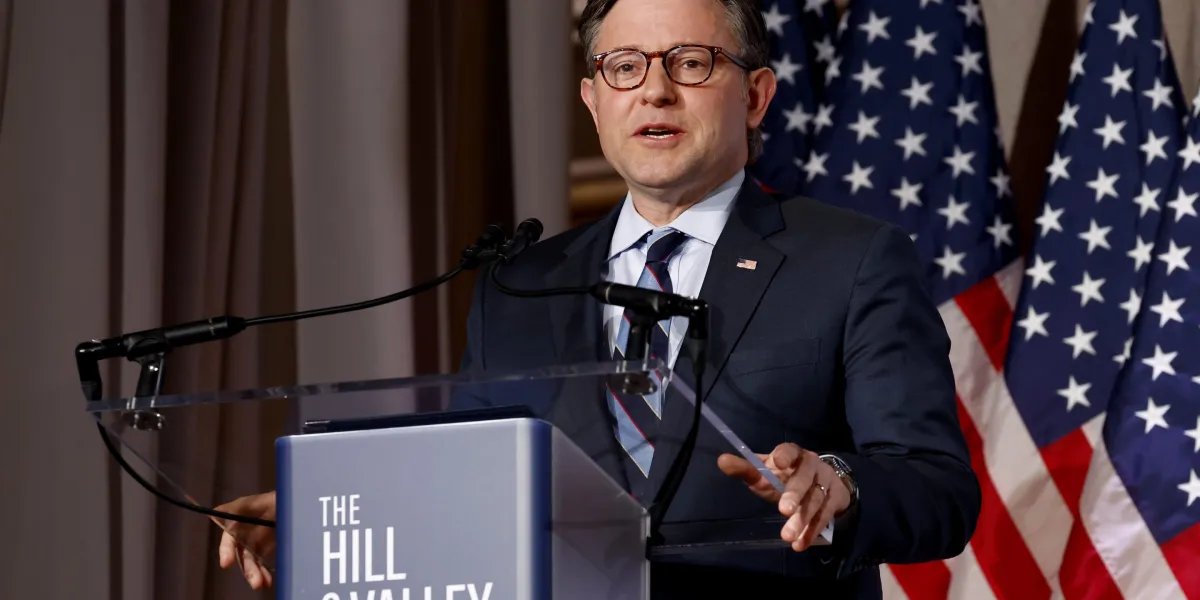
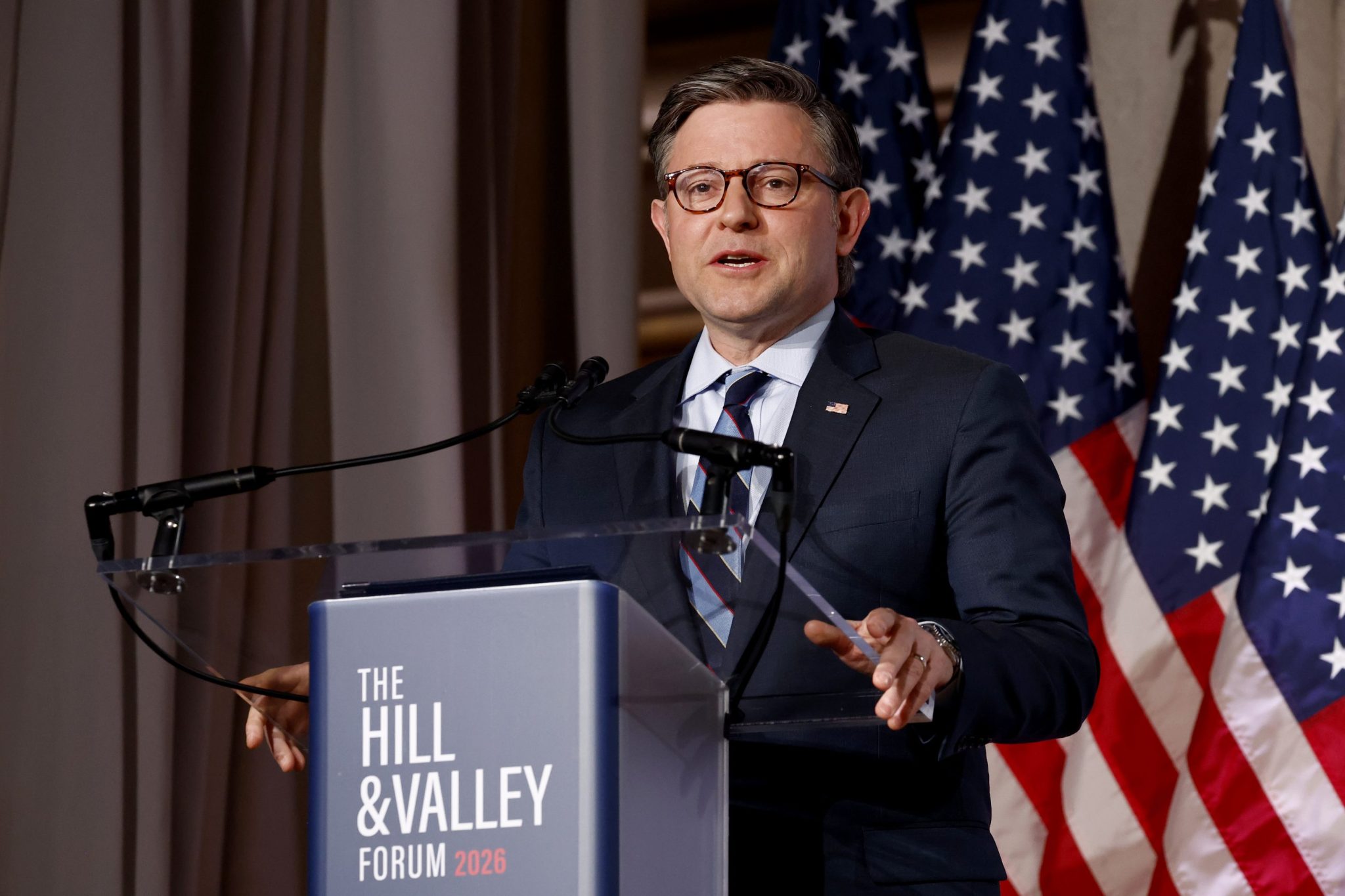
Speaker of the House Rep. Mike Johnson (R-LA), the event’s keynote speaker, didn’t call out China directly, but kept asking the audience of technology executives “to keep American technology American.” He then urged the companies to keep their data centers, chips, and infrastructure within the U.S. and “out of the hands of America’s adversaries and rivals.”
“We’re asking you, our builders and innovators, to accept some minor constraints, relative to competitors in foreign countries, but I’ve always believed that some minor friction from high standards is at the heart of operating in a nation that is built upon the highest principles,” Johnson said.
Johnson’s keynote reflected the concerns of other lawmakers and tech executives, who alternated between unnamed enemies of the U.S. to explicit warnings about China.
‘AI is an American birthright’
“This isn’t just a technological race, a fight over who’s going to get the best technology and win the AI race first, this is a moral fight,” said Sen. Jim Banks (R-IN) in a conversation with Palantir CTO Shyam Sankar entitled “Scale, Security, and
Sovereignty: Competing with China’s Defense-Industrial Model. “We know that the PRC (People’s Republic of China) is going to lie, steal, and cheat.”
Banks sponsored the bipartisan Guaranteeing Access and Innovation for National Artificial Intelligence (GAIN AI) Act, which would force U.S. companies to certify that they gave domestic customers the opportunity to buy advanced AI chips before exporting them. Under the Act, companies would also need to obtain a license to export advanced AI chips to “countries of concern.”
Sankar agreed with the defensive approach, but said the U.S. also needs to “play offense.”
“By and large, AI is an American birthright. It came from the US. The Chinese only have it from distillation attacks,” Sankar said, referring to the technique of training a model on the outputs of a more advanced model to replicate its success. “The one place they have a marginal advantage is they’re a little bit more practical about what they’re trying to do with it. They view it as something to implement for economic advantage, while our labs are obsessed with this pursuit of AGI, which I’m glad we have an aspirational goal, like getting to Mars. But you know, there are places where this becomes a pathology.” He cited AI doomerism about mass employment is one example of that pathology.
In a separate session, Keith Rabois, the managing director of Khosla Ventures, argued that the role of American businesspeople is to support the U.S. He said that Khosla Ventures invests in companies that will have a “positive impact” on American society.
“We will not invest in things that would help our rivals. We don’t invest in China. We wouldn’t consider investing in China, because we are in an existential AI race, and whoever is the most successful with AI will dominate the economic future of the globe,” he said.
Partnership across sectors
In a speech titled “Broken Bureaucracies vs. The Tyranny of Technologists: Who Will Save The West?,” Trae Stephens, co-founder of defense tech company Anduril Industries, warned if Washington and Silicon Valley can’t figure out how to work together, the country’s future will be decided by China. He argued that neither government overregulation nor a “blank check” to Silicon Valley is the answer.
“These days, the government isn’t legislating much of anything at all,” Stephens said.
He invoked President Franklin D. Roosevelt enlisting Ford to build more than 18,000 B-24 bombers during World War II, or the Defense Advanced Research Projects Agency developing the direct precursor to the internet.
“We’re playing catch-up here,” Stephens said. “In the early 2010s, when Chinese military documents first started talking about AI weapons, and CCP factionalists started posting about the idea of an industrial party, we were arguing about whether or not tech wanted to work with the Pentagon at all.
He called on founders to ask if their products “strengthen the country that is making this success possible,” and urged government officials to consider how to leverage technology, not control it.