

Bitcoin is struggling to maintain stability around the $70,000 level as persistent selling pressure continues to weigh on market sentiment. Repeated rejection near this psychological threshold has reinforced a cautious environment, with volatility elevated and traders closely monitoring liquidity conditions and macro signals. While consolidation above key support levels can sometimes indicate resilience, the current price structure suggests a market still searching for direction after months of corrective momentum.
Recent on-chain analysis from Darkfost offers additional context regarding whale activity. The report notes that although inflows from large holders to exchanges have increased in recent weeks — often a sign of potential short-term selling pressure — total whale-held supply has continued to expand overall. This distinction is important when evaluating broader market structure.
Exchange inflows typically capture immediate positioning behavior and can precede temporary price weakness. However, the chart referenced in the analysis focuses on the medium-term evolution of whale-held supply using a monthly average, providing a more structural perspective. From this viewpoint, the continued growth in holdings suggests that larger investors may still be accumulating despite ongoing volatility.
Whale Accumulation Returns As Large Holders Rebuild Bitcoin Positions
According to Darkfost, recent on-chain data suggests a notable shift in Bitcoin whale behavior following the sharp contraction observed late last year. After the monthly average of whale-held supply dropped to nearly -7% on December 15, accumulation appears to have resumed. Over the past month, holdings attributed to large investors have increased by roughly 3.4%, signaling renewed positioning despite ongoing market uncertainty.

This rebound translates into a rise in whale-controlled supply from approximately 2.9 million BTC to more than 3.1 million BTC. In absolute terms, that represents an accumulation exceeding 200,000 BTC within a relatively short period. Historically, movements of this magnitude have tended to coincide with transitional phases rather than immediate trend reversals.
A comparable accumulation wave occurred during the April 2025 correction, when sustained whale buying helped absorb selling pressure and contributed to Bitcoin’s subsequent rally from about $76,000 to $126,000. While past patterns do not guarantee repetition, the parallel provides useful context for interpreting current flows.
With Bitcoin still consolidating roughly 46% below its most recent all-time high, current price levels may be perceived by large holders as relatively attractive. However, Darkfost cautions that persistent selling pressure remains a dominant factor, meaning accumulation alone may not yet be sufficient to drive a decisive recovery.
Bitcoin price action on the weekly timeframe continues to reflect a structurally corrective phase following the rejection from the late-2025 highs near $125,000. The chart shows a clear transition from bullish trend continuation into a sustained downtrend, with lower highs forming since November, and the price recently breaking decisively below the 100-week moving average. This breakdown typically signals weakening medium-term momentum and often precedes extended consolidation or further downside exploration.
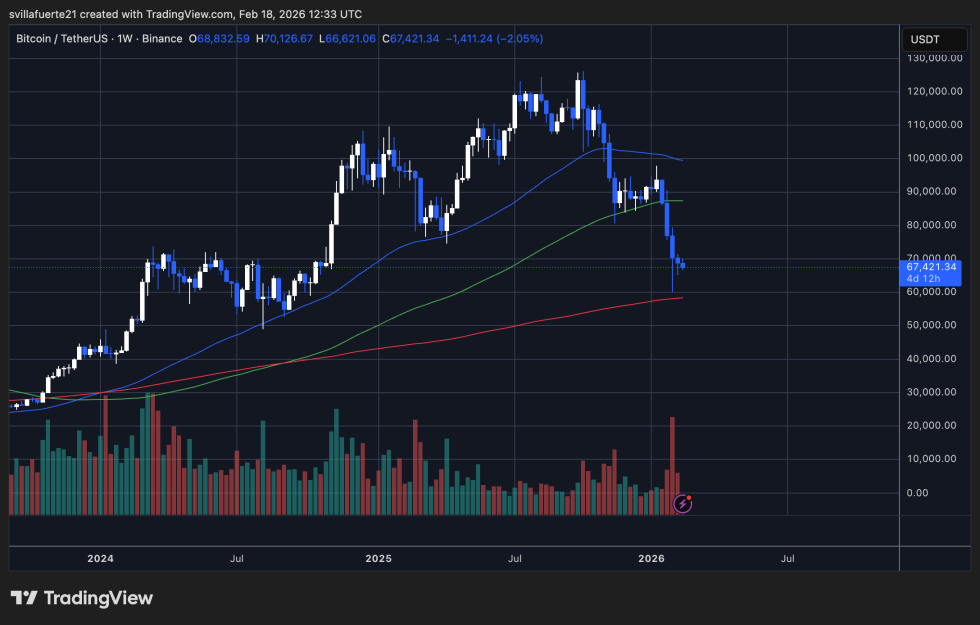
Currently, BTC is trading around the $67,000 area, which appears to be acting as a tentative stabilization zone after the sharp decline from the $90,000–$95,000 range earlier this year. The 50-week moving average has rolled over and now acts as dynamic resistance, while the 200-week moving average near the mid-$50,000 region remains the primary structural support level if selling pressure intensifies.
Volume spikes during the recent decline suggest forced deleveraging and defensive repositioning rather than gradual distribution. Historically, similar patterns have marked transitional phases between late bull cycles and early accumulation periods.
Featured image from ChatGPT, chart from TradingView.com
Editorial Process for bitcoinist is centered on delivering thoroughly researched, accurate, and unbiased content. We uphold strict sourcing standards, and each page undergoes diligent review by our team of top technology experts and seasoned editors. This process ensures the integrity, relevance, and value of our content for our readers.