
Thirty years ago today, roughly 4,000 people packed into America West Arena in downtown Phoenix to see the Stanley Cup, hear the name of their new hockey team, and get their first look at a logo that, depending on who you asked, was either one of the most creative designs in sports or looked like ancient graffiti scrawled on the tomb of an Egyptian pharaoh.
The franchise that introduced that logo is currently inactive, its players and staff having left for Salt Lake City in 2024. But the logo, a hockey-masked coyote styled after the kachina figures of Arizona’s Hopi people, has outlived every version of the team that wore it.
The Winnipeg Jets had been in the NHL since 1979, arriving as part of the WHA-NHL merger after seven seasons that produced three Avco Cup championships. Sixteen years later, the franchise was in trouble. A weak Canadian dollar, escalating salaries, and a dated arena had pushed the club to the financial brink. A potential move to Minneapolis fell apart in mid-1995 over financing concerns. By October, the franchise had been sold to American businessmen Richard Burke and Steven Gluckstern, who confirmed Phoenix as the destination that December.

A name-the-team contest followed, drawing more than 10,000 entries. Fans were given eight options on the ballot, among them Coyotes, Scorpions, Jets, and Mustangs, along with a write-in field that produced entries like Dry Ice and Phreeze. Chief operating officer Shawn Hunter revealed the winner at the April 8 event: the Phoenix Coyotes. Scorpions had been the runner-up. A 17-year-old named Brett Thornton won the grand prize of two lifetime season tickets for submitting the winning name.
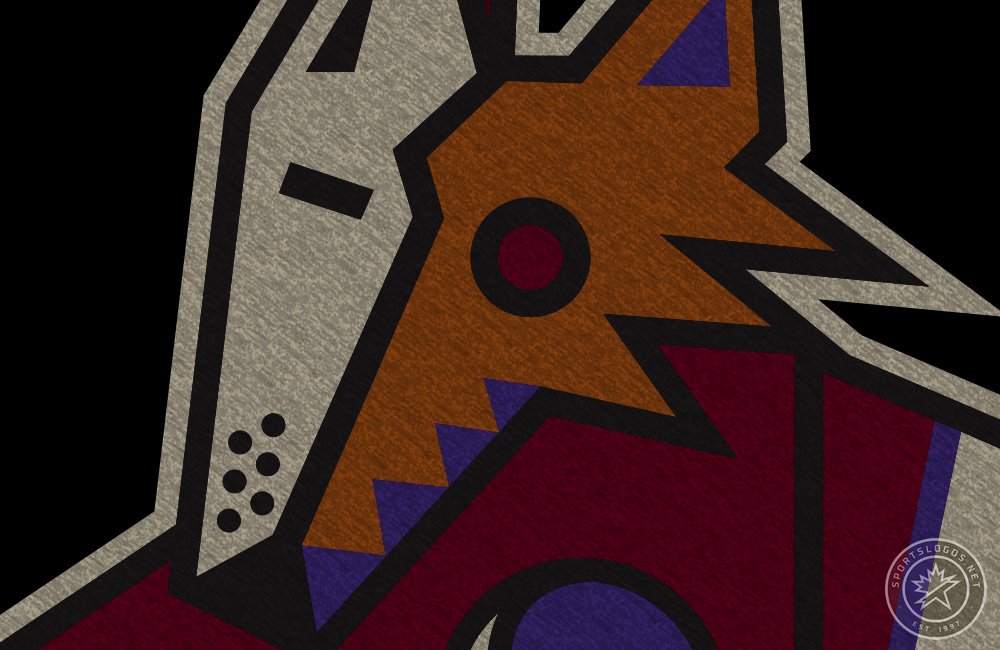
The logo Hunter unveiled alongside the name was something else entirely. It came from Campbell Fisher Ditko, a Phoenix design firm also responsible for the Arizona Diamondbacks logo. The central figure was a coyote standing upright in a goaltender’s mask, drawn in the geometric, angular style of a Hopi kachina doll, a sharp departure from the realistic animal logos that were flooding pro sports at the time. The colours, dark green, brick red, purple, sand, and black, were pulled from the Arizona desert. A crescent moon doubling as the letter “C” served as the secondary mark.
Hunter called it “Coyoteman.”
“We think the logo is made with incredible distinction and sophistication,” he said at the time. “Not only does it capture the Southwest colours that we have, but it also weaves in the ice hockey message.” The logo, Hunter added, had an immediate internal impact. “It screamed, ‘This is the one.’ We pursued a lot of different directions, but when we arrived at this, everybody started to feel comfortable.”

The NHL’s leadership, however, needed some convincing. Greg Fisher of Campbell Fisher Ditko later explained that the league had been explicit about what it didn’t want. “There were so many angry animals coming on board at that time that they were like, ‘do not do an angry animal logo because we’ll never say yes,’” Fisher told foxsports.com in 2015. The kachina concept offered a way around that restriction, a coyote, yes, but one rooted in the art and mythology of the region rather than the snarling-mascot trend sweeping through pro sports in the mid-1990s.
Co-owner Richard Burke said the NHL’s conservative leadership “were not too keen on the look” at first, but came around. He tested the logo at home before the unveiling. “I tested it on two really good fans in my home, ages 10 and 15,” Burke told the Arizona Republic. “The first day, they were looking at it like, ‘What is it?’ The second day, they were screaming about wanting to show their friends.”
Tucson Citizen reporter Corky Simpson, on the other hand, said the logo “looks like a two-headed dog playing hockey.” Fisher, the designer, was unbothered. “The final character is aggressive, witty, and attractive to sports fans of all ages,” he told reporters. “Its personality will be fully realized through animation.”

The uniforms arrived a few months later, unveiled on August 26, 1996, at the Hard Rock Café in Phoenix. Winger Kris King modelled the home whites while Mike Gartner wore the black road set. King had a simple review: “The logo itself on a piece of paper doesn’t do it justice. Wait until it gets on a jersey, and you really see what it’s all about.”
The Coyotes only wore the kachina for seven seasons. By 2003, the team was preparing to leave America West Arena for a new home in suburban Glendale, and a rebrand was coming with it.
The Coyotes ranked 27th out of 30 NHL teams in U.S. merchandise sales at the time. They had reportedly lost $68 million over the previous three seasons, owing largely to a lack of major revenue streams as tenants in an arena they didn’t own. Brett Rogers, the team’s vice-president of marketing, was direct about the goal: “Our hope is this will get us in the top third.”
After phone surveys and several focus groups over the previous year, the team was made clear that fans wanted a look that showed strength and was easy to understand. They said the old logo was too cartoonish and didn’t represent power.
The new identity was the work of Denver-based Adrenalin Design Group and had been in development for a year and a half. It was unveiled on September 3, 2003, at a fashion show inside the Arizona Mills Mall in Tempe in front of more than 1,000 people. Gone were the greens, purples, and the kachina figure. In their place: a naturalistic howling coyote rendered in brick red, desert sand, and black, paired with traditional-style jerseys featuring a lace-up collar on the home set. The team took out newspaper ads headlined “A New Breed Has Evolved.”

Hall of Famer Wayne Gretzky, the team’s managing partner, who was widely understood to be no fan of the kachina look, framed the change as a move toward the mainstream. “The last uniform was unique, and it was so different from any other team in the National Hockey League,” he told the Arizona Republic. “But this one is very much of a classic look. We wanted to make it something kids would want to wear and minor league hockey teams across North America would want to wear.”
Sports marketing consultant David M. Carter summed it up: “They can couch it in a lot of ways, but it’s ultimately about money. It’s a natural time and an opportune time.”
Forward Shane Doan, who had worn the kachina since the franchise’s arrival in Phoenix, offered a measured take. “It’s more of a coyote. It’s not a fake drawing of one,” he said of the new logo. “I like the old jerseys, they were different than any other jersey in the league, but change isn’t bad.”

Like most logos misunderstood in their time, a future generation began to look back fondly on the Kachina logo.
Fifteen years after the 2003 switch, the Coyotes brought it back as a third jersey in 2018. Shortly after, it was reintroduced as the (now) Arizona Coyotes’ primary logo and uniform set, where it remained, now loved by the hockey world. A return to the classic branding, however, wasn’t enough to save the Coyotes; it remained the face of the team until the franchise stopped play in 2024.
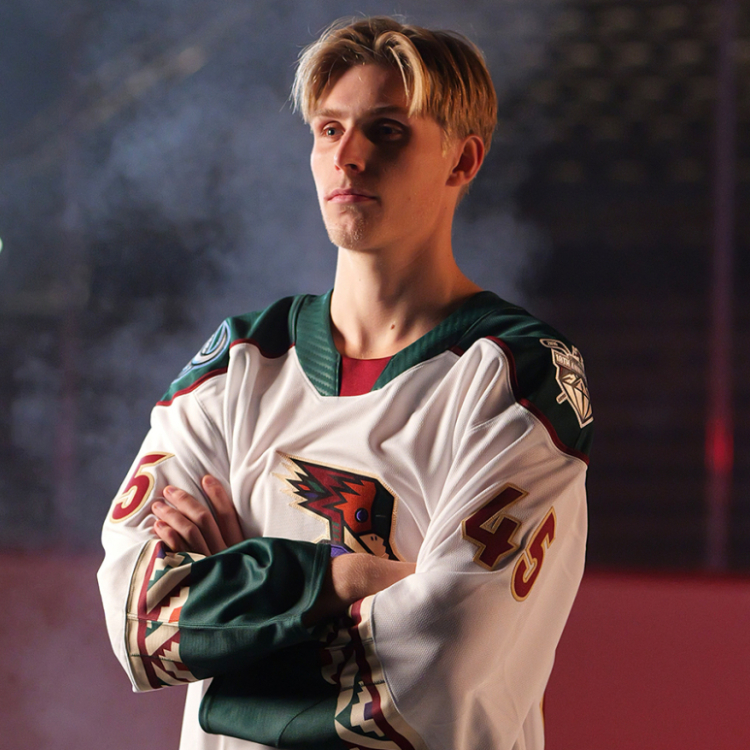
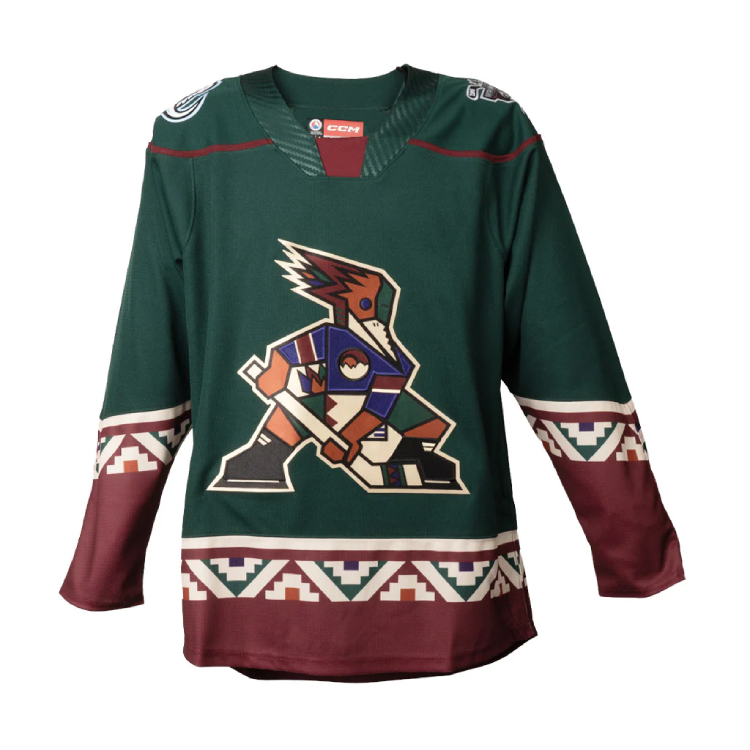
A logo once mocked as a two-headed dog playing hockey, replaced in the name of merchandise revenue and traditional hockey aesthetics, had become one of the most requested throwbacks in the league. And while the team no longer exists, that logo lives on in Arizona’s highest-level pro hockey team, the AHL’s Tucson Roadrunners, whose logo features a Kachina-style roadrunner in place of the original coyote.
Today, thirty years after it was first introduced to the world, it’s clear that there’s no end in sight to the spirit of “Coyoteman.”