

Bitcoin is holding above $76,000 as the market pushes against resistance and bulls attempt to build the momentum needed for the next leg higher. The price is constructive but not yet decisive, and an Arab Chain report has just identified a behavioral shift among Bitcoin’s most structurally significant sellers that changes the supply picture behind the current consolidation.
The number of miner deposit transactions on exchanges has fallen to approximately 8,138 — one of the lowest readings on record. To understand why that matters, it helps to recall what the data looked like just months ago.
In late 2025, deposit transactions surged above 100,000 at times — a level of activity that reflected miners actively moving Bitcoin to exchanges, behavior historically associated with selling intent and profit-taking. Every spike above that threshold represented freshly mined coins entering the liquid market and adding to the sell-side overhead that recovering prices must absorb.

That dynamic has fundamentally changed. Since the beginning of 2026, the trend has moved persistently lower. The sharp spikes have disappeared. The peaks have flattened. The miners who were flooding exchanges with deposits just months ago have pulled back to a pace that barely registers against where they were.
Bitcoin, attempting to clear resistance above $76,000, is doing so in a market where the group that supplied the most consistent overhead pressure has nearly gone silent.
The Miners Have Stepped Back. The Question Is Whether They Stay Back.
The Arab Chain report connects the transaction decline directly to the current price environment. With Bitcoin trading around $77,000, the data is describing a market where one of its most consistent historical sources of sell-side pressure has effectively withdrawn. Miners are not just depositing less frequently — they are transferring smaller amounts when they do move, reflecting a behavioral shift that goes beyond routine portfolio adjustments into something closer to a deliberate change in strategy.
The report identifies two possible explanations for that shift, and both carry different implications for how long it persists. The first is expectation-driven: miners believe prices will move higher and are holding current production in anticipation of selling at better levels. The second is conviction-driven: miners have reduced their selling intent structurally and are accumulating rather than distributing, regardless of short-term price movements.
Either explanation produces the same near-term consequence. With miner deposit transactions at record lows, the overhead supply that recovering Bitcoin prices typically must fight through is significantly reduced. The path from $77,000 toward the $82,200 short-term holder cost basis — the breakeven zone for recent buyers — faces less resistance from this particular source than it has at any comparable point in recent memory.
The constructive framing the report offers is measured and conditional. Reduced miner selling pressure is a positive structural factor in the short term — but its durability depends on whether market demand holds at current levels or continues to grow. If demand weakens, the reduced miner activity offers support. If demand strengthens, the combination of reduced overhead and growing inflows creates the conditions the market has been building toward.
Bitcoin Holds Breakout Level as Price Tests Short-Term Strength
Bitcoin is consolidating near $76,500 after recently breaking above the $73,000–$74,000 resistance zone, which had capped price throughout March. That level now acts as support, marking a clear structural shift from range-bound compression to early-stage recovery. The breakout was clean, but follow-through is beginning to stall as price approaches the $78,000–$80,000 supply region.
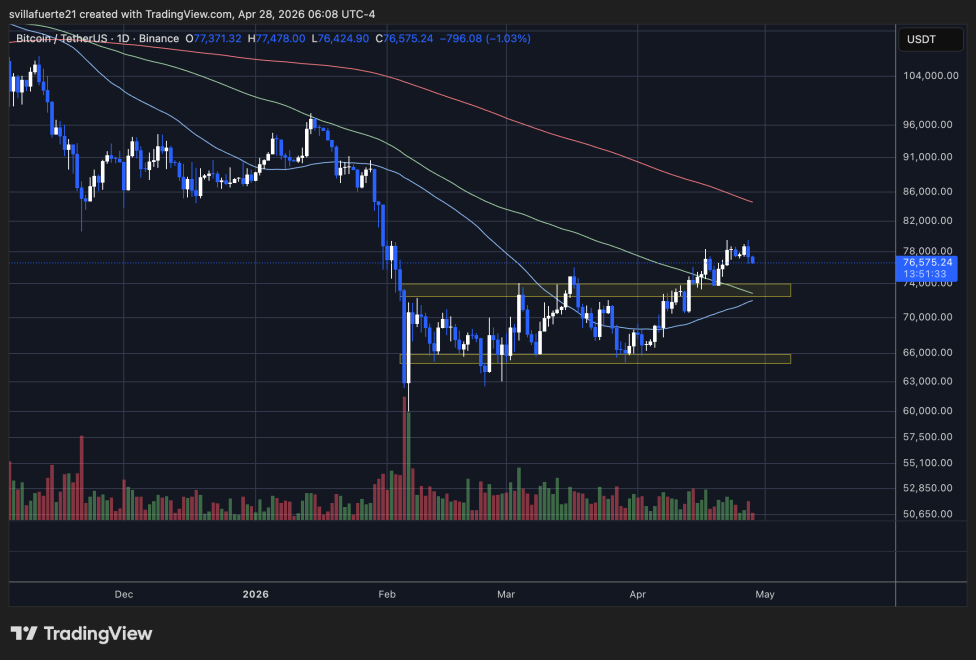
The 50-day moving average has turned upward and is providing dynamic support below the current price, reinforcing the short-term uptrend. Meanwhile, the 100-day moving average sits just above and is beginning to flatten, acting as immediate resistance. The 200-day moving average remains downward sloping overhead, indicating that the broader trend has not fully transitioned back to bullish.
Price structure shows higher lows since the February capitulation near $63,000, confirming steady accumulation. However, recent candles reflect hesitation, with smaller bodies and wicks forming near resistance — a sign of balance between buyers and sellers.
Volume supports this interpretation. The recovery phase has occurred on moderate participation compared to the capitulation spike, suggesting controlled accumulation rather than aggressive expansion.
A break above $78,000 would open the path toward $82,000, where previous breakdown pressure originated. Failure to hold above $74,000 risks a return to the mid-range structure.
Featured image from ChatGPT, chart from TradingView.com
Editorial Process for bitcoinist is centered on delivering thoroughly researched, accurate, and unbiased content. We uphold strict sourcing standards, and each page undergoes diligent review by our team of top technology experts and seasoned editors. This process ensures the integrity, relevance, and value of our content for our readers.