Oil prices surged to a new wartime high on Wednesday as the disruption to Persian Gulf energy supplies persisted. The effects are being felt far beyond the region, with the average price of U.S. gasoline also at a record high since the start of the war in Iran.
The main international oil price, known as Brent crude, jumped nearly 8 percent, largely because investors were worried that the impasse in U.S.-Iran talks could last for a while. That could keep Persian Gulf energy products from reaching the rest of the world for weeks or, in a worst-case scenario, months.
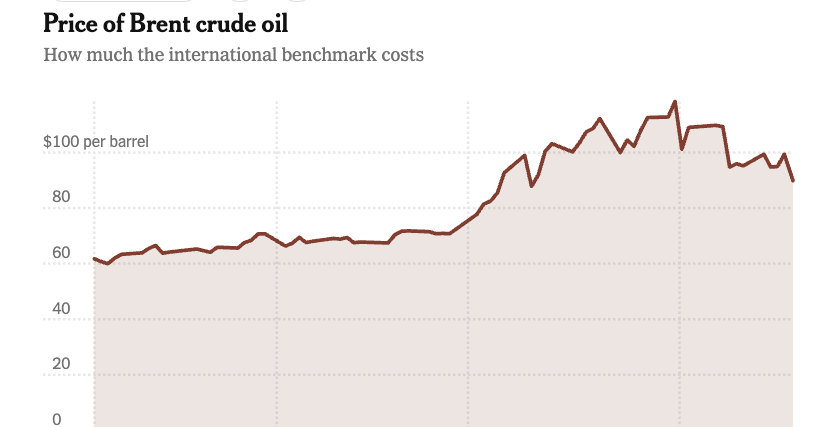
The price of Brent crude for June delivery, a soon-to-expire contract that investors trade based on their expectations for where prices are headed in the near future, rose to nearly $120 a barrel, setting a fresh high since the first U.S.-Israeli strikes in Iran. This contract traded for about $95 a barrel two weeks ago and $72 just before the war started.
The sudden spike, analysts said, could be because President Trump has been “signaling no end in sight” to restrictions on the flow of energy from the Middle East, said Bob McNally, president of Rapidan Energy, a research and consulting firm. There are also signs that a lack of supply is hitting the United States more meaningfully.
“The market’s optimism in a near-term opening is dwindling, and you’re starting to see in the data that this is really starting to come home,” Mr. McNally said. “This oil price rise that many of us expect — and we certainly have — is now getting underway.”
U.S. gasoline prices, which tend to track the price of crude oil but with a lag, rose again on Wednesday, jumping to a national average of $4.23 a gallon, a fresh high since the start of the war in Iran. The increase has raised the cost for drivers by 42 percent, according to the AAA motor club.
Diesel prices have increased even more quickly and stood at $5.64 on Wednesday, up 50 percent since the start of the war.
“There may be capacity for some to ‘ride out’ a gasoline shock by relying more on credit card borrowing,” analysts at Bank of America noted, but “this appears somewhat limited — particularly for lower-income households.” Across income levels, savings and deposits have been running historically high, the analysts said, and bigger tax refunds may provide an extra cushion. “Higher refunds could cover rising gasoline bills for at least five months,” they wrote.
Few ships carrying oil, natural gas and petroleum products have moved through the Strait of Hormuz, the narrow waterway on Iran’s southern coast, since the war’s early days. Shipping traffic fell further after Mr. Trump blockaded Iranian ports this month to prevent tankers linked to Iran from exporting oil in order to deprive the country of revenue.
Brent prices also appear to be elevated because the contract for June delivery of oil expires on Thursday. Trading of commodity futures tends to be more volatile and exaggerated just before contracts end as investors seek to make final changes to their bets. The prices for futures contracts tracking deliveries in July and later months also jumped, suggesting broad-based expectations that energy costs will remain elevated.
“The financial markets are waking up to the physical markets,” said Joe DeLaura, a global energy strategist at Rabobank.
The rise in energy costs is a concern for investors, but stock markets have been buoyed by solid corporate earnings. The S&P 500 was unchanged on Wednesday, with traders waiting for a welter of financial reports from some of the country’s biggest companies — Alphabet, Amazon, Meta and Microsoft — after the close of trading. Traders are also looking to officials at the Federal Reserve, who kept interest rates steady on Wednesday, for guidance on the outlook for inflation and economic growth.