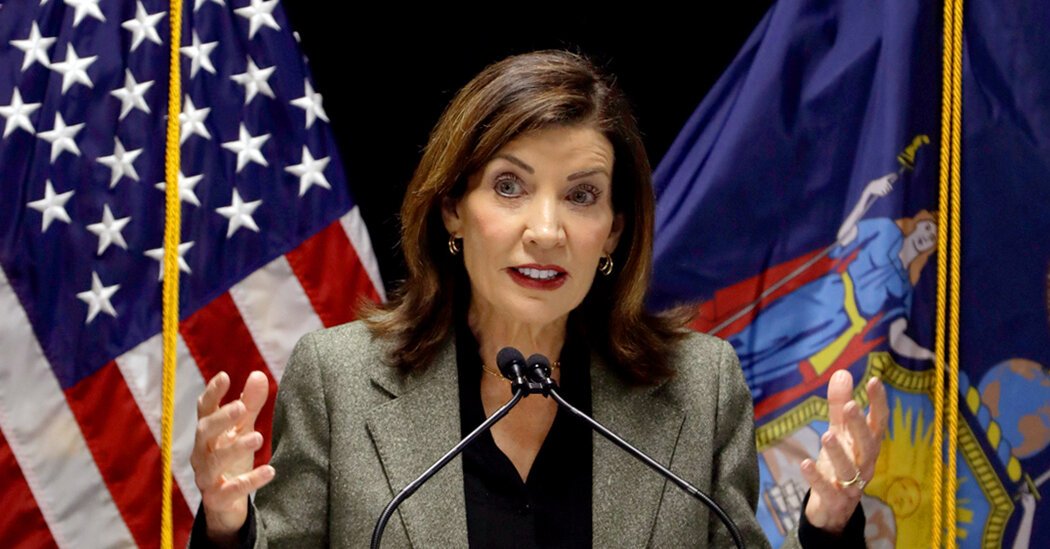
New York State leaders have agreed to the framework of a $268 billion budget that will include funding to expand child care and a new tax on multimillion-dollar second homes in New York City, Gov. Kathy Hochul announced on Thursday.
The spending plan will also include a raft of measures intended to push back against the Trump administration’s immigration crackdown, including one barring Immigration and Customs Enforcement agents from wearing masks.
Other major policy initiatives shoehorned into the budget, which is now more than five weeks overdue, include a delay in the state’s climate deadlines and a cap on auto insurance payouts.
“The negotiations were not easy,” Ms. Hochul said on Thursday. “There were very substantive disagreements, tough choices and powerful special interests trying to influence the outcome.”
But legislative leaders cautioned that many issues, including the size of the final budget, still needed to be worked out.
Speaking shortly after Ms. Hochul, the Assembly speaker, Carl E. Heastie, said it had been “very premature” of the governor to announce a deal when he had agreed only that she could say they were close to an agreement on major policy items.
“There is no budget deal,” he said, adding that he did not care if the budget “doesn’t get passed for six months.”
Mike Murphy, a spokesman for the Senate Democratic majority, said that leaders had agreed to “big concepts,” but that no overall deal had been reached.
Ms. Hochul acknowledged that many things needed to be resolved before the Senate and Assembly could begin voting on the budget bills.
At the top of the to-do list is ironing out how the new tax on multimillion-dollar second homes in New York City will work.
For years, efforts by the Senate and Assembly to raise taxes on the wealthy have been stonewalled by Ms. Hochul, who has expressed concern that higher taxes would prompt some businesses and wealthy residents to flee the state. But amid the economic populism generated by Zohran Mamdani’s mayoral victory last year and the expectation of more cuts to federal funding, Ms. Hochul’s political calculus shifted.
With the proposed tax on second homes, Ms. Hochul sought to target the city’s richest property owners whose primary residences are outside New York City. The governor has still not released details of the new tax, including how many second homes will be subject to it and what the new rates will be. The goal is to raise $500 million each year, which will go toward closing the city’s estimated $5.4 billion budget deficit.
“I’ll have more to say on that soon,” she said.
The tax on so-called pieds-à-terre comes as Democrats across the country are increasingly looking to increase taxes on the wealthy as a means of addressing voters’ affordability concerns ahead of the midterm elections.
But the new tax revenue — combined with $1.5 billion in additional state aid for the city and proposed delays in certain pension payments — will not completely alleviate the city’s budget woes. Ms. Hochul has been adamant that Mr. Mamdani and other city officials must find more budget cuts.
The budget also includes about $4.5 billion to expand child-care offerings across the state. The funding helps Mr. Mamdani move toward fulfilling his campaign promise to make prekindergarten and 3-K universal in New York City and allow a handful of pilot programs for 2-year-olds to get underway. The investments were a cornerstone of the unlikely political alliance between the moderate Ms. Hochul and the progressive Mr. Mamdani.
“We’ve been asked to do a lot for the city,” the governor said on Thursday. “We have given unprecedented amounts of support.”
In response, Mr. Mamdani said only that he was “feeling hopeful about the direction of those negotiations,” and thanked leaders in Albany.
The budget announcement gave Ms. Hochul, who is seeking re-election in November, an opportunity to highlight her priorities and argue that she is delivering on them. She promoted a package of measures that she says will help address the state’s sky-high cost of living by bolstering housing production and lowering car insurance premiums.
Echoing tax changes enacted by the Trump administration, the state will not collect taxes on up to $25,000 in tips for single filers earning up to $150,000 and joint filers earning up to $300,000 through the end of the 2028 tax year. The state will also distribute $1 billion in utility bill rebates, Ms. Hochul said, while maintaining $15 billion in reserves.
One of the most controversial elements of the budget was Ms. Hochul’s push to weaken the Legislature’s signature 2019 Climate Leadership and Community Protection Act. She argued that instituting the law’s ambitious regulations would send bills even higher.
Under Ms. Hochul, the state has struggled to meet its climate goals: Renewables projects have faltered under a combination of economic and political headwinds out of Washington. At the same time, the closure of the Indian Point nuclear plant under former Gov. Andrew M. Cuomo has led the state to consume more fossil fuels than it would have otherwise.
New York planned to reach those goals through a program called Cap and Invest, which would raise money for renewable and efficiency projects by charging polluters. But the Hochul administration has been slow to issue those regulations, which are now more than two years late.
Lawmakers have now agreed to push back implementation until 2028. They have also accepted a change to the way that methane is calculated, which would make emission reduction targets easier to reach.
While environmentalists called the budget deal an abdication of leadership, Ms. Hochul defended the changes as a necessary evil.
“This is what leadership looks like when you’re the one person in the state who looks at the reality of the world as it is, and not looking at it through these rose-colored glasses,” she said.
The deal will also include significant changes to an environmental review law that has been on the books for half a century. The change aims to make it easier to build housing in and around cities by expediting the approval and permitting process.
Ms. Hochul also expended considerable political capital in recent months seeking changes to how auto insurance works, framing her proposals as an effort to help New York drivers, who pay some of the highest rates in the country. Companies like Uber plowed millions of dollars into a lobbying and advocacy campaign to back Ms. Hochul’s plan. But the proposal was met with great skepticism by lawmakers, who worried the changes would deprive crash victims of compensation for their injuries without meaningfully lowering rates for drivers.
The State’s Trial Lawyers Association pushed back as well, leading to a messy public battle between the lobbying group and the governor.
“Uber and Big Insurance waged the most expensive legislative attack in New York history, attempting to strip key protections through a budget deal that bypassed the normal legislative process and public scrutiny,” Andrew Finkelstein, president of the Trial Lawyers Association, said in a statement.
In the end, the agreement Ms. Hochul announced did not have everything she had wanted. Still, it includes caps on damages for victims of car crashes who were uninsured, impaired or committing a felony, limiting payouts for pain, suffering and emotional distress to $100,000. She was also able to narrow the categories that allow a victim to meet the legal definition of “serious injury.”
The budget also included legislation that will give New York City a new tool against so-called super-speeders. The bill, long sought by safe-streets advocates, will permit city officials to install speed-limiting devices in the vehicles of drivers who are caught speeding in school zones 16 or more times in a year. Less than 1 percent of drivers in New York City, or about 14,600 vehicles, would be required to install the devices.
A version of the technology is already in use by the city government. Nearly 1,000 city-owned vehicles currently have the devices installed, and it will come standard on future purchases, according to the Department of Citywide Administrative Services.
The immigration package in the budget forbids local law enforcement from entering formal cooperation agreements with ICE, and prohibits agents from searching New Yorkers’ homes, hospitals, churches and schools without a warrant signed by a judge. It will not affect the ability of law enforcement to coordinate on criminal issues, Ms. Hochul said.
Bruce Blakeman, the Nassau County executive who will be Ms. Hochul’s Republican challenger this fall, has supported ICE’s efforts. On Thursday, he attacked the governor’s budget as a “triple threat to your wallet: more taxes, record spending, and a utility bill crisis with no end in sight.
“In fact, it should be labeled hazardous for your bank account,” he continued.
Stefanos Chen and Dana Rubinstein contributed reporting.