As mind-boggling as that prospect might seem, however, it doesn’t come out of nowhere. Other than the steep tariffs he imposed (and then lowered), Mr. Trump’s approach to China has frequently put him at odds with his own administration. The White House’s high-level National Security Strategy seeks merely to “rebalance America’s economic relationship with China.” When the Pentagon’s draft of the more detailed National Defense Strategy described China as the top security threat, the president sent the authors back to the drawing board.
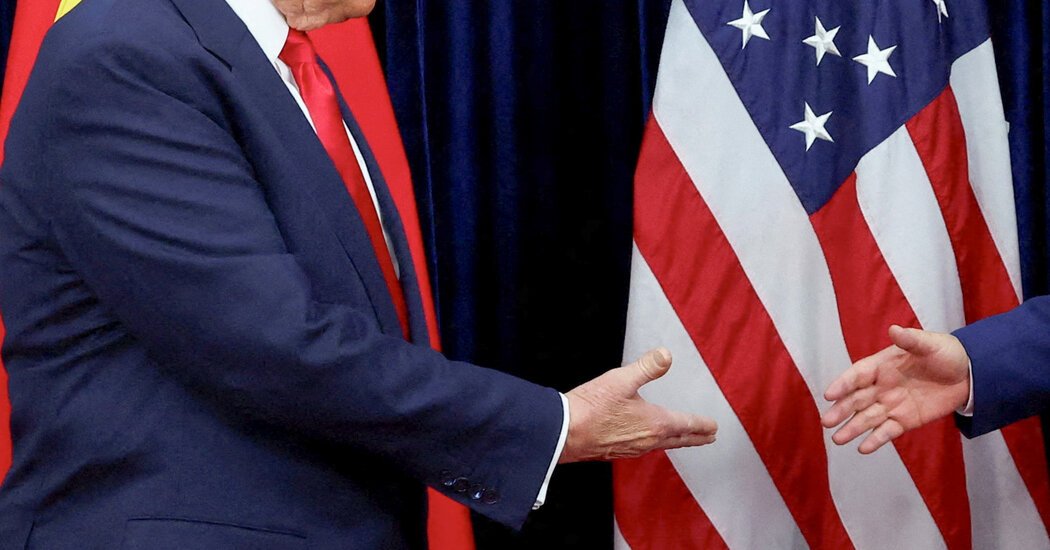
After Mr. Trump reached a “trade truce” with Mr. Xi at their October summit in South Korea, he directed Stephen Miller, a White House deputy chief of staff, to limit any agency actions that might antagonize China. He made the case for granting 600,000 Chinese student visas. And he pushed to allow China access to advanced A.I. chips — even though his administration’s own A.I. Action Plan states: “Denying our foreign adversaries access to this resource” is “a matter of both geostrategic competition and national security.”
What is going on?
The answer is that Mr. Trump sees the problem with China as simply a bad deal. And what’s the remedy for a bad deal? Why, a better deal, of course. End the rip-off and all is forgiven. “I don’t blame China,” he told business leaders in Beijing in 2017. “After all, who can blame a country for being able to take advantage of another country for the benefit of its citizens? I give China great credit.” Campaigning in 2024, he said he would welcome the arrival of Chinese automakers, a position he reiterated this past January in Detroit: “If they want to come in and build the plant and hire you and hire your friends and your neighbors, that’s great. I love that. Let China come in.” Indeed, he may even view such investment as a prize worthy of concessions.
A trillion-dollar infusion of capital would exceed the total direct investment in the United States made by any other country since the Declaration of Independence. Even a fraction of that amount would blow apart what remains of our economic defenses, weakening national security and supply-chain resilience, handing the Chinese Communist Party a powerful tool with which to subvert our market, undermining the basic logic of the president’s own trade agenda and kneecapping our efforts at rebuilding domestic industry.
In recent weeks, Mr. Greer and Howard Lutnik, the commerce secretary, have both cast doubt on accepting Chinese investment. With Mr. Trump, though, it’s always hard to know what’s a firm no and what’s a negotiating posture. If he continues on his current course, the president who did more than anyone else to call out the danger of the China relationship could become the one to embed that relationship, and that danger, into the foundation of the nation’s economy.