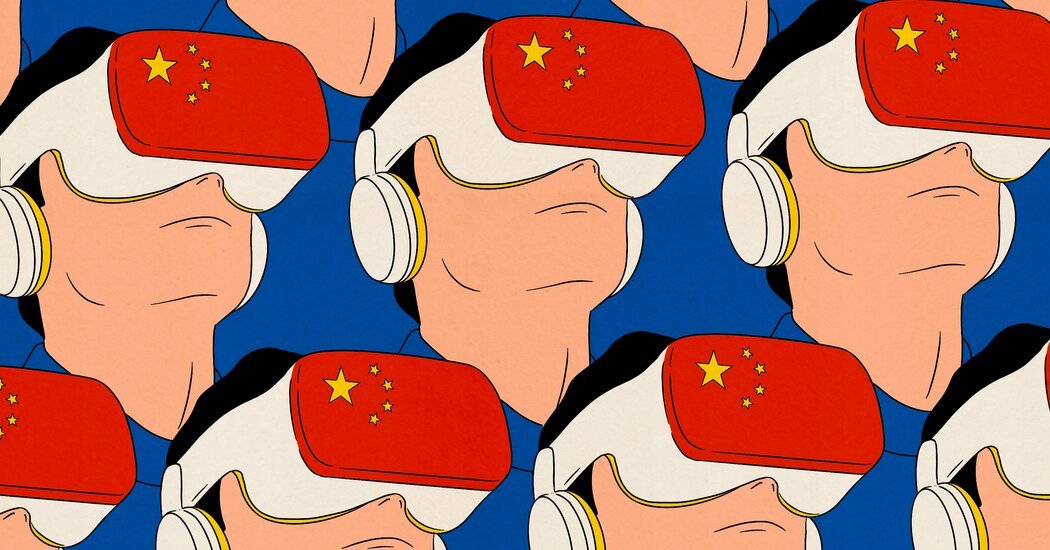
One of the most widely shared viral memes on Chinese social media today is “the American kill line.”
Borrowed from video game slang for the threshold at which a weakened character can be easily finished off, it refers to the widely held notion in China that millions of American families are teetering on a precipice — one lost job, illness or unexpected expense away from ruin. It has become the prevailing Chinese metaphor for an America seen as mired in economic decay, violent crime and irreversible decline.
This is, of course, false. Violent crime rates in the United States are the lowest in decades, the country retains unmatched geopolitical and financial power and its economy remains vibrant and more than 50 percent larger than China’s.
Yet as Beijing prepares for President Trump’s visit this week, I see a dangerous new overconfidence taking hold in my native country based on misplaced notions of American decline. I fear it is fueling a sense of intransigence that is making Chinese leaders more willing to weaponize their nation’s power and less likely to back down in future confrontations with the United States.
Traveling across China this spring, I am hearing this narrative everywhere. After one particularly gruesome variation on the “kill line” meme made the rounds recently, my family members in China said they feared for the safety of our relatives in the United States. I hear about students who once dreamed of studying in America now enrolling elsewhere, worried about U.S. crime and poor job prospects.
Views of the United States have soured over the past decade due in large part to the erratic, weakened America that Mr. Trump appears to represent. A survey in December found that nearly half of Chinese respondents believe U.S. global influence is waning.
This belief is partly a defense mechanism to help Chinese people cope with their own problems: a slowing economy, a collapsing property market, high unemployment and a widespread sense of uncertainty. A Beijing taxi driver captured this uneasy mix of anxiety and swagger last month. After venting to me about the problems China’s people face, he added, “At least we have a minimum safety net here. Better than falling below the kill line in America.”
Insular, nationalist voices are amplified more than ever. Zhang Weiwei, a university professor who served as Deng Xiaoping’s interpreter and has millions of online followers, absurdly claimed in a viral video in January that China is the only country in the world whose people eat well.
Communist Party rhetoric reinforces this. One need only watch China’s state-run nightly news: Most of the half-hour broadcast celebrates domestic successes before usually signing off with a few minutes on U.S. dysfunction, dominated lately by the global chaos unleashed by Mr. Trump’s war on Iran.
The government also has in the past few years pushed to purge academia of “erroneous” Western intellectual frameworks — such as judicial independence and separation of powers — and replace them with concepts that stress patriotism, party ideology and national security.
The theme of U.S. decline is repeatedly reaffirmed in policy documents, speeches by political leaders and influential Communist Party journals and is now voiced even by some mainstream scholars. In the past, many ordinary Chinese shrugged off such rhetoric as propaganda. But recent surveys and studies suggest more people, especially younger Chinese, may be increasingly buying into the narrative.
I came of age in China in the 1980s when the country was opening up to the world. We were optimistic about someday rejoining the ranks of great powers. But there was also a palpable humility, a desire to fit into the existing global order. Today, I see a far more prosperous and powerful China than we dared to imagine, self-assured and inclined to play by its own rules.
Chinese leaders no longer seem to view U.S. pressure on trade and technology as existential threats demanding compromise, but as something easily parried by wielding China’s own strengths, as President Xi Jinping did last year when his threat to halt exports of rare earths and other critical minerals forced Mr. Trump to back down on tariffs. Such leverage is a major reason China continues to push aggressively for dominance in sectors like critical minerals, as well as clean energy technologies such as electric vehicles and solar panels, and the raw pharmaceutical ingredients that make up much of the world’s drug supply. These are now nuclear options for China in future trade negotiations or a geopolitical confrontation.
As the Chinese public’s hubris rises, it raises the political cost for the country’s leaders to show any restraint in potential crises over the South China Sea or Taiwan. Game-theory research last year showed that even modest increases in nationalism measurably raise the probability that both China and the United States will adopt more hawkish stances in a standoff.
This arc is not irreversible. U.S. policy toward China should be refocused on a combination of deterrence — such as strengthening America’s resilience in critical supply chains and its geopolitical presence in Asia — and restoring the human connections that once helped hold the relationship together and prevented each side retreating into its own information cocoon.
A simple but potentially effective starting point would be for Washington to ease visa and security barriers for Chinese students and scholars and to expand fading exchanges in tourism, academia and business.
It’s been nearly nine years since an American president visited China (Mr. Trump, in his first term). That sort of gap is untenable. Sustained, cleareyed and firm U.S. engagement may be the best way to reverse Chinese misperceptions and reset the world’s most consequential relationship.