Houston geothermal startup Fervo scored Wall Street’s biggest clean energy IPO ever, and its stock opened 35% higher on May 13 for a market cap above $10 billion.
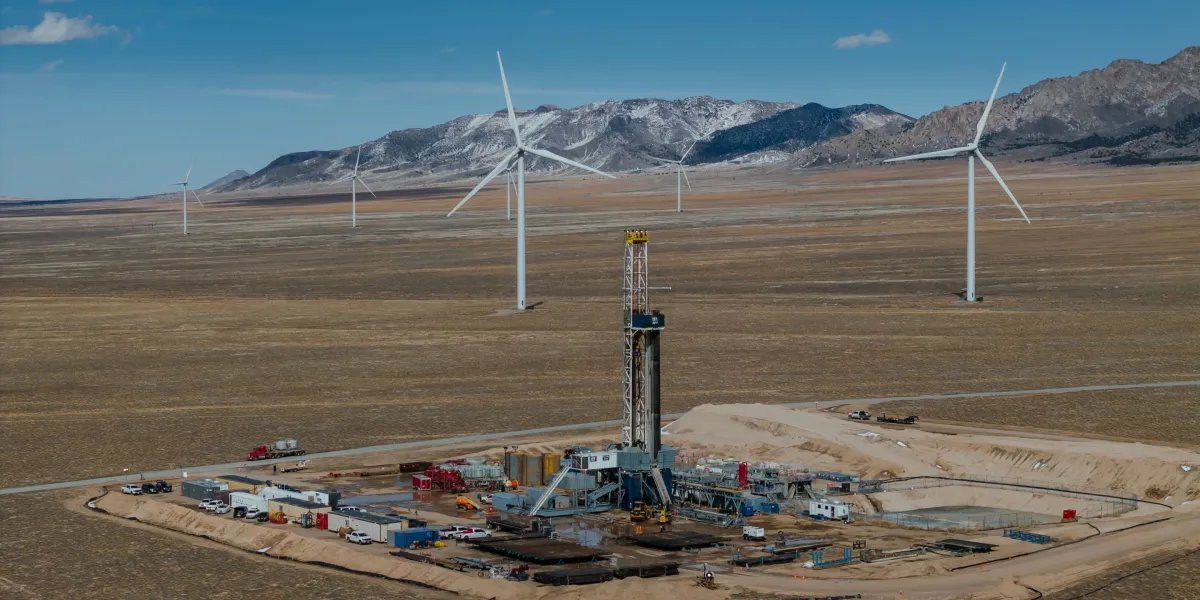
Bill Gates-backed Fervo aims to take the nascent industry mainstream to power the AI boom in short order. The technology combines old-school geothermal science with modern oil-drilling and fracking techniques to develop reservoirs and power plants anywhere the customers want—as opposed to traditional geothermal power, dating back over 100 years, which relies on naturally occurring reservoirs.
“Geothermal is resonating because it’s a proven technology,” Fervo cofounder and CEO Tim Latimer, 36, told Fortune. “With the amount of growth going on in power right now, there’s going to be a lot of everything built, but the product offering we have is 24-7, carbon-free, and can be built quickly. I think it’s very unique.”
After raising $1.89 billion in an upsized IPO—70 million shares at $27 apiece, up from an initial range of $21 to $24—shares quickly spiked to a close of $36.54 on their first day of trading. That easily exceeded the April IPO of next-generation nuclear startup X-energy, backed by Amazon.
Fervo is different type of next gen, also known as enhanced geothermal systems (EGS, not to be confused with ESG), designed to address the scalability limitations of traditional geothermal. Named from the Latin word meaning “to boil,” Fervo’s technology utilizes water heated underground to generate steam for electricity-producing turbines, then pumps the cooled water back into the subsurface to be reheated and recycled.
Fervo brought a pilot plant for Google online in Nevada three years ago and is currently building its first commercial plant in Utah, called Cape Station. The 500-megawatt project—enough to power nearly 400,000 homes—will begin delivering some power by year’s end and come fully online in 2028. Southern California Edison is the primary customer.
“Whether it’s utility companies or hyperscalers, they’re looking at what is cost effective, what’s low risk, and what can be built quickly. Those are the things that really matter right now,” Latimer said.
Cape Station entails drilling wells 10,000 feet deep—about 2 miles—and then directionally drilling horizontally another 7,500 feet to create adequately sized reservoirs, and fracking (hydraulic fracturing) the rock to release the flows of water naturally heated to more than 400 degrees. Utah—and much of the western U.S.—is geographically ideal because the necessary heat levels are accessible at shallower depths than most of the country.
“Two miles is still a mind-boggling depth, bit it’s well within the realm of what we’re doing today,” Latimer said. “As the technology cost structure continues to improve, we’re really excited to develop and expand beyond the western United States.”
Geothermal versus everything
Wind and solar power have intermittency issues and their federal tax credits are expiring. Nuclear requires acquiring nuclear fuel and disposing of waste. Fusion remains unproven commercially. Gas-fired power plants must account for fuel price volatility and rising construction costs. Geothermal doesn’t require fuel, produces no waste, and its tax credits run through 2033.
Latimer acknowledges Fervo’s costs are still too high but says that will rapidly change as it scales. The medium-term goal is to cut costs by more than 50%—from $7,000 per kilowatt to $3,000—approaching the lowest-cost solar farms and gas plants. Fervo estimates reaching $5,500 per kilowatt later this year.
“That’s an important goal for us because that makes us the cheapest form of power, period, with or without any tax credits,” Latimer said. “The fact that it’s reliable, 24-7, and clean is just going to be a bonus on top.”
Geothermal was disadvantaged until 2022 when President Biden’s Inflation Reduction Act included it in the renewable energy credits. And President Trump’s One Big Beautiful Bill attacked wind and solar with accelerated expiration dates while maintaining geothermal’s tax breaks.
“I think it really speaks to the bipartisan nature of geothermal. If you make a product people want, it kind of cuts through the noise,” Latimer said.
Fervo is backed by Gates’ Breakthrough Energy, Google, and others in Silicon Valley, as well as oil and gas players including Devon Energy and fracker Liberty Energy—whose founder and former CEO, Chris Wright, now serves as U.S. energy secretary.
If anything, the industry has been accused of working too hard to appeal to the Trump administration. The academic journal Energy Research & Social Science published an article this May called, “‘The smokin’ hot trophy wife of the oil and gas industry’: The role of petro-masculinity in geothermal rhetoric and policy,” citing a 2025 event called “MAGMA” (Making America Geothermal: Modern Advances) where a Texas Geothermal Energy Alliance leader used that phrase and accusing the industry of “sexualized rhetoric.”
Latimer distanced himself from such language. “It does our industry a disservice. I think we have something that people like naturally. It can lead to more affordable, reliable, clean electricity, and I don’t see the need to dress it up and use inappropriate language to try to get people excited about it.”
Oil and gas roots
A Texas native, Latimer started right out of college in 2012 as a drilling engineer with BHP just as the Australian mining giant was investing in the U.S. shale oil and gas boom. Fascinated by the rapidly evolving drilling and fracking technologies, he felt he “missed the boat” out on the beginnings of the boom.
“I had the urge to be on the frontier, and then I saw that you could apply these technologies to geothermal, which is a carbon-free energy resource that’s a little bit distinct from oil and gas,” he said. “It got me obsessed with the idea of geothermal.”
He left BHP to earn a master’s degree at Stanford University, where he met Jack Norbeck, who also was studying geothermal reservoir engineering. They cofounded Fervo in 2017.
“We saw that horizontal drilling would be this huge unlock that would transform the geothermal sector just like it did for oil and gas,” Latimer said.
Unlike oil and gas—where wastewater disposal underground is the leading cause of incidental manmade earthquakes—geothermal recycles produced water in a closed loop. “The water just goes down cold and comes back hot,” he said. “Through four years of operations, we’ve had no challenges with seismicity associated with our projects.”
Traditional oil and gas giants, such as SLB and Baker Hughes, are now investing in geothermal. Ormat Technologies, the only other publicly traded U.S. geothermal firm, recently partnered with SLB to develop EGS—though Ormat is a 60-year-old company pivoting from traditional geothermal, while Fervo has focused on EGS from the start.
Fervo holds leasing options on roughly 600,000 acres across the western U.S and is assessing its next 10 sites, with the potential to eventually generate a whopping40 gigawatts of power—enough to power roughly 30 million homes. For context, only 4 gigawatts of geothermal power have been developed in all U.S. history.
“It could be a massive, massive amount of electricity,” Latimer said. “We want to move very quickly and do this at a scale the geothermal industry has never seen before.”