
Cardano founder Charles Hoskinson said Monero represents the kind of privacy-preserving cryptocurrency Bitcoin might have become if stronger cryptographic tooling had been available at the time, praising the project’s technical design and its refusal to dilute its cypherpunk principles.
Speaking in an interview with David Gokhstein, the Cardano founder framed Monero not as a marginal privacy coin, but as one of the sector’s more important ideological and technical reference points. His comments centered less on price or market structure than on a broader debate over privacy, usability and what role uncompromising projects should play in crypto’s long-term direction.
“Honestly speaking, Monero is what Bitcoin should have been,” Hoskinson said. “They just didn’t have the technology at the time, and it’s a lot more complicated to run a privacy-preserving system. But there’s a lot to love in Monero, like the ASIC-resistant puzzles, the full-chain membership proofs, how they handle the view keys.”
Cardano Founder Praises Monero
Hoskinson’s argument was that privacy at scale is inherently harder to implement than transparent settlement. In his telling, Monero’s contribution is not limited to a single feature, but to a stack of design choices built around keeping privacy central while still maintaining a usable network.
He cited Monero’s work around ring signatures and privacy-preserving architecture as examples of a project that pushed crypto beyond transparent ledgers without abandoning decentralization. “These are smart things,” he said, adding that Monero “was a pioneer in ring signatures” and “a pioneer in a lot of privacy at scale.”
The praise is notable because it comes from one of the most visible founders in the broader crypto industry and touches on a recurring fault line in the sector: whether cryptocurrencies should prioritize auditability and regulatory legibility, or stronger default privacy for users. Hoskinson’s comments placed Monero firmly on the side of the latter, while acknowledging that this comes with trade-offs in complexity.
He also drew a distinction between cryptographic rigor and product usability, arguing that privacy systems are often built by specialists whose threat models can make products difficult for ordinary users to navigate.
“Because the thing about privacy is it’s built usually by cryptographers, and cryptographers are super weird paranoid people living in basements with no friends,” Hoskinson said. “And the reason they became a cryptographer is they think everybody’s out to get them.”
The line was delivered jokingly, but it supported a more serious point. According to Hoskinson, the challenge for privacy-focused systems is not only to achieve strong guarantees, but to make those guarantees accessible without weakening the underlying ethos.
“What the Monero community did, and they pioneered, was figuring out how to make it more usable, but they never violated once their cypherpunk ethos,” he said. “So you still mine it, and there’s still that decentralized mindset and all these other things.”
UPDATE: Charles Hoskinson says “Monero is what Bitcoin should have been. There’s a lot to love in $XMR, like ASIC-resistant puzzles, full-chain membership proofs, how they handle view keys, these are smart things. They’ve been a pioneer in ring signatures and privacy at scale.” pic.twitter.com/fZpIPooubC
— Angry Crypto Show (@angrycryptoshow) May 13, 2026
That framing matters because Monero has long occupied a distinct position in crypto. It is not merely a privacy feature bolted onto a larger smart-contract ecosystem; its identity is tied to default privacy, mining, and a community culture that tends to resist compromise. Hoskinson suggested that this kind of hardline position remains necessary, even in an industry increasingly shaped by institutions, compliance demands and public-chain analytics.
“You need people like that in the space to be part of that conversation and to be uncompromising in that conversation,” he said.
Hoskinson then used a superhero analogy to describe how different crypto communities can serve different functions. Not every project, in his view, needs to solve the same problem or make the same trade-offs. Some may focus on scalability, others on smart contracts, settlement, identity or privacy. The important point, he argued, is that privacy maximalists should have a seat in the room.
“What you want to do is you bring them together like a justice league,” Hoskinson said. “Everybody’s welcome in the Justice League. So there’s a Justice League of Privacy, and Monero is definitely part of that Justice League, and they’ve always had an important role, which should never be discounted.”
At press time, Monero traded at $394.45.
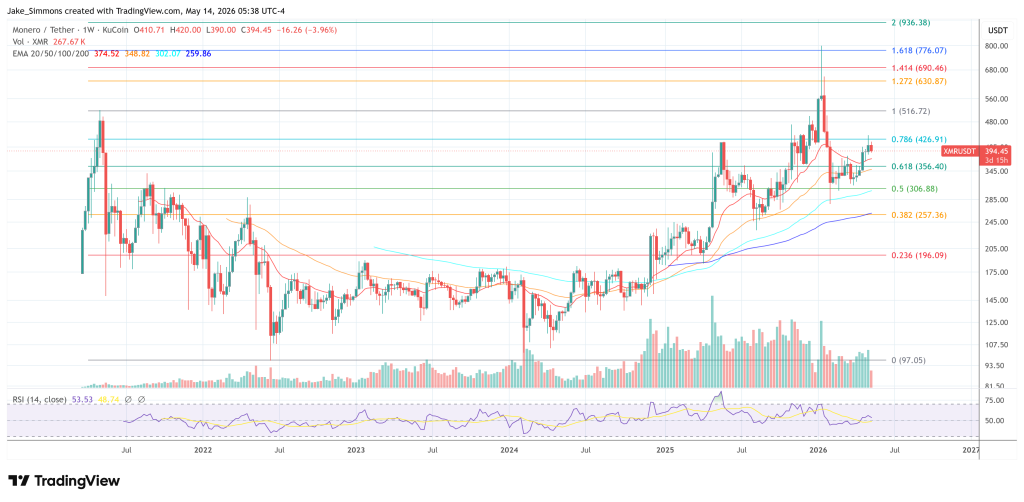
Featured image created with DALL.E, chart from TradingView.com
Editorial Process for bitcoinist is centered on delivering thoroughly researched, accurate, and unbiased content. We uphold strict sourcing standards, and each page undergoes diligent review by our team of top technology experts and seasoned editors. This process ensures the integrity, relevance, and value of our content for our readers.