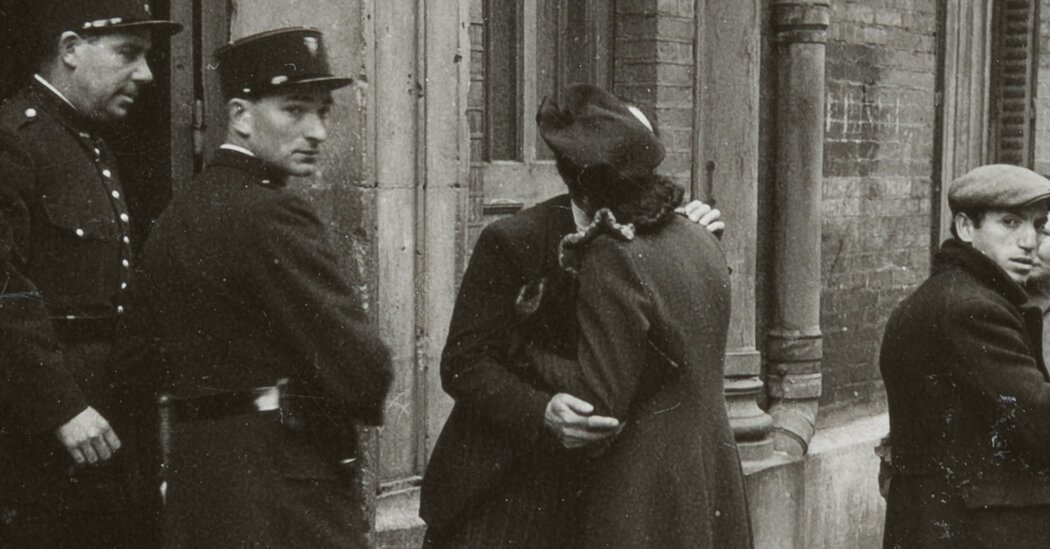
At first the photos were kept on file by the German Propaganda Unit in Paris. After the war, six of the 98 photos were found in the archives of the N.I.O.D. Institute for War, Holocaust and Genocide Studies in Amsterdam, an indication that they were shared among the various propaganda units across Western Europe. A few others circulated among archives. But the vast majority were languishing, unseen, on contact sheets, until 2020, when two amateur collectors came upon them at a flea market. They brought the sheets to Ms. Lalieu, the director of photo collections at the Shoah Memorial in Paris, who analyzed the images in an effort to identify as many people as possible. Ms. Lalieu also identified the photographer as Harry Croner, a man from Berlin, who had gone on to have a stellar career in postwar West Berlin, as a famous cinema and opera photographer. (Half Jewish himself, he spent the end of the war in a labor camp.)
After the photos were found, Ms. Lalieu invited first and second-generation survivors to the memorial in an attempt to identify their parents or grandparents in the pictures. There were some extraordinarily moving moments. Though only five attempts at identification were successful so far, each marks a small victory against the backdrop of Nazi cover-up and of the looming loss of memory. A few of the photographs were shared publicly for the first time in 2021.
One year after these photos were taken, in mid-July 1942, about 13,000 Jews — mostly women and children — were rounded up, pulled out of Paris apartments and taken to an indoor sporting arena, the Vélodrome d’Hiver, in southwestern Paris. They received little food or water and were subject to abject conditions. Depleted and distraught, they were sent from there to the internment camps of Drancy, Pithiviers and Beaune-la-Rolande. Later, a majority were sent on to Auschwitz.
It was an arrest of mass proportions, a stain on French history. We know this history from eyewitness testimonies, from memoirs of the few survivors and from the mass of police documents. Only a single photograph of the roundup is known. In it five buses are parked alongside the Vélodrome d’Hiver. The image was most likely taken clandestinely from an overlooking window. With the discovery and exhibition of this new group of photographs, the picture and understanding of the Holocaust in France have deepened.
The value of an image is entirely dependent on context. Taken to prove racial superiority, these 98 photos on display through December now show depravity. They also jar awake memory, shore it up against time. In an ephemeral era of mass documentation — of our own lives, of our public and private existence — the re-emergence of these photographs is a tangible reminder that some images refuse to be erased from our collective past.