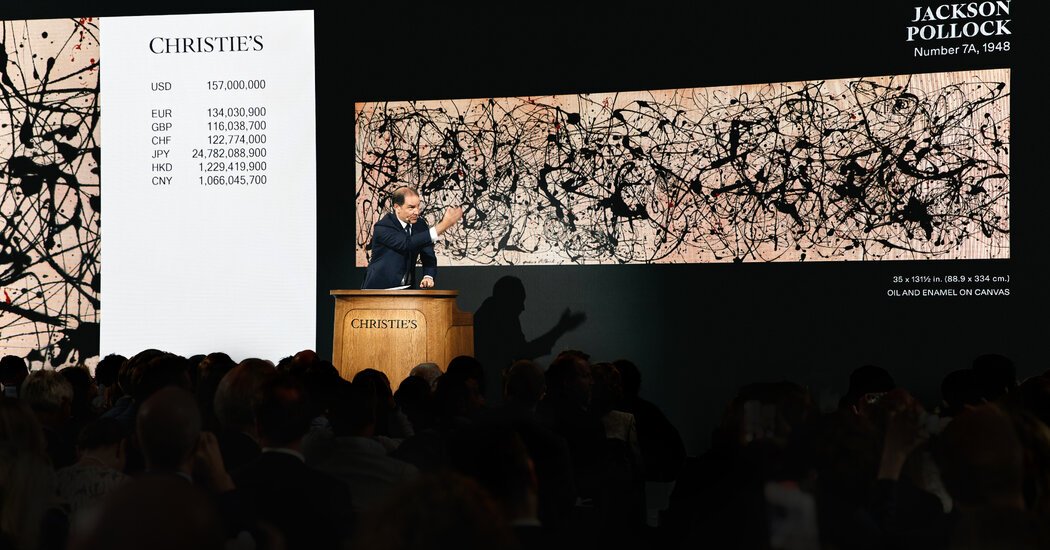
Auction records for two 20th-century masters shattered at Christie’s Rockefeller Center salesroom on Monday night. A swirling “drip” painting from 1948 that Jackson Pollock created by flinging, drizzling and pouring oil paint and enamel across the surface of a canvas he rolled out on the floor of his barn in Springs, N.Y., sold for $181.2 million with fees. Just minutes earlier, a bronze head sculpture by Constantin Brancusi, from around 1913, brought in $107.6 million.
The two sales were part of a $630.8 million auction of 16 works from the estate of the publishing magnate — and obsessive art collector — S.I. Newhouse, who died in 2017 at age 89.
The estate sale and a second auction on Monday evening of 20th century artworks sold for a combined $1.1 billion, coming in at the top end of the expected range, and with many artworks selling above their high estimates. It was the latest sign that the top of the art market was springing back to life after several years of contraction, with the help of treasures recently released into the market by estates of major patrons like Newhouse, Robert Mnuchin, Agnes Gund and Henry McNeil Jr.
It took only seven minutes of fierce bidding for Pollock’s “Number 7A, 1948” to eclipse the Abstract Expressionist artist’s previous auction record of $61.2 million (or $73 million, accounting for inflation), for a much smaller example that Sotheby’s sold five years ago.
The bids were mostly in increments of $1 million. “I won’t complain,” said the auctioneer Adrien Meyer, recording the number as it cranked past the previous record.
And just as bidding started to die down, around $154 million, a new bidder entered the battle, pushing the final hammer price to $157 million, before the auction house added buyer’s fees.
Newhouse’s nearly 11-foot-long canvas was the first large-scale drip painting by Pollock to be auctioned since 1961, according to Christie’s. Pollock’s drip technique “was as radical as Duchamp’s urinal and Picasso’s cubism,” said Alex Rotter, Christie’s global president.
Two other 1948 drip paintings have sold privately for $140 million (in 2006) and $200 million (in 2015). But major postwar works by the artist rarely come to auction. “I started 27 years ago in the auction business, and I’ve never had a Pollock,” Rotter said.
The most valuable collection offered during this spring’s weeklong marquee sales in New York, which end Thursday, the Newhouse lots had been expected to bring in more than $450 million. Estimates are calculated without the added premium of buyer’s fees.
Another star of the group, Brancusi’s bronze-and-gold-leaf sculpture “Danaïde,” carried a $100 million estimate. Newhouse bought the elegantly rendered head — inspired by the Romanian artist’s encounter with a young Hungarian art student named Margit Pogany — for $18.2 million in 2002 (about $33 million in today’s dollars). At the time, it was the highest price ever paid at auction for a sculpture.
On Monday, that work made market history again, eclipsing Brancusi’s auction record of $71.2 million in 2018 (or around $94 million with inflation). Ahead of the sale, Christie’s drummed up some pop-culture buzz by releasing a promotional video of Nicole Kidman visiting the galleries and dancing around the sculpture to David Bowie’s “Golden Years.”
All 16 of Newhouse’s works carried a third-party guarantee, meaning that the auction house had secured an agreement from others to pay a minimum price for each artwork. The chatter among industry veterans was that one buyer had guaranteed nearly the entire Newhouse collection. (Christie’s declined to comment.)
“The sale was all killer with not much filler,” said Stephanie Armstrong, managing partner of the art advisory Beaumont Nathan. “It was geared toward a certain caliber of collector, and the reality is there are relatively few at that level in today’s market.”
An Infusion of Patrons
For the past three years, many collectors decided to hold onto their trophies and wait out the market’s choppy waters. But the tide began to turn in the second half of last year when several valuable estates came to auction, including that of the cosmetics heir Leonard Lauder. The success of extremely expensive artworks tends to energize the market downstream, and a Gustav Klimt portrait, which sold for a record $236.4 million at Sotheby’s in November, seemed to improve the mood of buyers and sellers.
Counting the Newhouse results, 28 artworks by 17 artists have sold at auction for more than $100 million with fees (excluding inflation), according to data from the market intelligence firm Arthur Analytics. The most expensive remains Leonardo da Vinci’s “Salvator Mundi,” which shocked the art industry by making $450.3 million at Christie’s in November 2017. Picasso has surpassed $100 million at auction most frequently, with six lots achieving this milestone. Gustav Klimt and Alberto Giacometti have done so with three artworks each, and Amedeo Modigliani and Andy Warhol with two apiece
All told, the spring auctions are expected to tally up to $2.6 billion. The season’s bonanza began on May 14 at Sotheby’s, which sold $433.1 million worth of art in one night, a marked improvement over May of last year. The evening’s top lot was a red abstract painting by Mark Rothko from the estate of the banker-turned-art-dealer Robert Mnuchin, which brought in $85.8 million with fees but fell short of Rothko’s auction record. (That benchmark was set in 2012 by a 1961 work that sold for almost $87 million, or nearly $126 million in today’s dollars.)
“It’s an iconic composition with a very demanding presence,” said Drew Watson, who directs art services at Bank of America, of the recently sold Rothko painting. “It comes from the 1950s, which is the mature period of his output.”
By Monday evening, the painting’s benchmark was surpassed by a 1964 Rothko canvas from the Gund collection. “No. 15 (Two Greens and Red Stripe)” sold for $98.4 million with fees.
The Newhouse sale represented the fourth tranche of art to be auctioned from the publisher and Condé Nast chairman’s collection since his death. The first three brought in a combined $415.8 million. After the latest tranche of artworks, the total value more than doubled, to just over $1 billion. Newhouse’s widow, Victoria, told The New York Times that she had decided to sell because she was moving to a smaller apartment. “It’s an effort to simplify my life,” she said.
Her decision to edit her collection is also in keeping with her husband’s well-documented practice of buying and selling. While some collectors, like Gund, took pride in the fact that they almost never sold their art, Newhouse frequently offloaded treasures to make room for new ones. He “simply enjoyed the activity of falling in love with works of art and sought to repeat that impulsive act,” the art historian Mark Rosenthal wrote in 2019.
Newhouse was drawn to big names like Pablo Picasso, Piet Mondrian and Jasper Johns, but he often eschewed bright colors and conventional beauty in favor of historical significance, according to experts. “None of these are pretty trophy works,” said the art adviser David Norman, who did not work with the Newhouse family. “They are serious collectors’ works, dense with meaning and art history.”
There was also an early Cubist painting by Picasso, “Homme à la guitare” from 1913, which sold for $40.9 million with fees and Mondrian’s jazzy 1921 painting “Composition With Large Red Plane, Blue, Gray, Black and Yellow,” which sold for $39.7 million.
Smaller scale records were set Monday night, too. In the 20th century art sale, Alice Neel’s “Mother and Child (Nancy and Olivia),” a 1967 portrait of the artist’s wide-eyed daughter-in-law and squirming first grandchild, sold for $5.7 million with fees. The painting, included in Neel’s 2021 survey at the Metropolitan Museum of Art, had been in the same private collection since 1984. The result topped the $3 million ($3.8 million with inflation) paid for Neel’s still life “Dr. Finger’s Waiting Room” in May 2021 at Christie’s.
Newhouse bought the now-record Pollock painting from Alfred Taubman, the former owner of Sotheby’s, in a private sale in 2000. As Tobias Meyer, who advised Newhouse and is not related to the auctioneer Adrien Meyer, recalled in an essay for the Christie’s catalog, “We sat on the windowsill and he looked at the transparency and exhaled loudly. Then he handed it back and said: ‘I’ll take it.’”
Meyer asked, “Don’t you want to see it first?” Newhouse replied that he had seen the work in the apartment of the designer Herbert Matter in the late ’60s and again with the art dealer Harold Diamond in the ’80s.
This time, he wasn’t going to let it get away.