Japan’s core CPI rose just 1.4% in April, a four-year low driven by government subsidies, but analysts warn the Iran war will push inflation sharply higher in coming months
Summary:
- Japan’s core CPI, excluding fresh food, rose 1.4% year-on-year in April, the slowest pace since March 2022, against a market forecast of 1.7% and a prior reading of 1.8%
- The core-core index, stripping out fresh food and energy and closely watched by the BOJ as a gauge of demand-driven inflation, rose 1.9%, down from 2.4% in March and the slowest since July 2024
- Headline CPI came in at 1.4%, below the 1.6% forecast and the 1.5% prior reading
- Government subsidies on school tuition were a primary driver of the April slowdown
- Analysts expect inflation to re-accelerate in coming months as Iran war-related energy costs and supply disruptions feed through to a broader range of consumer prices
- The BOJ is widely expected to raise its policy rate to 1% from 0.75% at next month’s meeting (June 15 and 16); the April data is among factors the board will examine ahead of that decision
Japan’s core inflation fell to its slowest annual pace in four years in April, pulled lower by the effect of government subsidies on school tuition costs, but the calm in the data is widely expected to prove short-lived as the economic consequences of the Iran war continue to build.
The core consumer price index, which excludes volatile fresh food costs, rose 1.4 percent year-on-year in April, the weakest reading since March 2022. The outcome came in well below the median market forecast of 1.7 percent and followed a 1.8 percent gain in March. Headline CPI also missed expectations, printing at 1.4 percent against a forecast of 1.6 percent.
The Bank of Japan’s preferred internal gauge, a measure that strips out both fresh food and energy to give a cleaner read on demand-driven price pressure, slowed to 1.9 percent from 2.4 percent in March, its weakest level since July 2024. The deceleration across all three measures reflects, in significant part, the distorting effect of government intervention rather than any genuine cooling in underlying price dynamics.
That distinction matters considerably for the policy outlook. Wholesale inflation, which tends to lead consumer prices by several months, accelerated in April at its fastest pace in three years, driven by sharply higher oil and chemical goods prices linked directly to the Middle East conflict. The Iran war has effectively closed the Strait of Hormuz to normal traffic, disrupting flows through a corridor that accounts for roughly a fifth of global oil and gas supply. The resulting price surge is working its way through Japan’s import-dependent economy with a lag that has yet to show fully in consumer data.
The BOJ finds itself navigating an awkward stretch of the rate cycle as a result. A June rate increase to 1 percent from the current 0.75 percent remains the broad market expectation, and the wholesale price data supports the case for continued tightening. But the war has introduced a layer of inflationary pressure that the central bank cannot easily accommodate through rate policy alone, while simultaneously weighing on growth in an economy heavily reliant on fuel imports from the Middle East region.
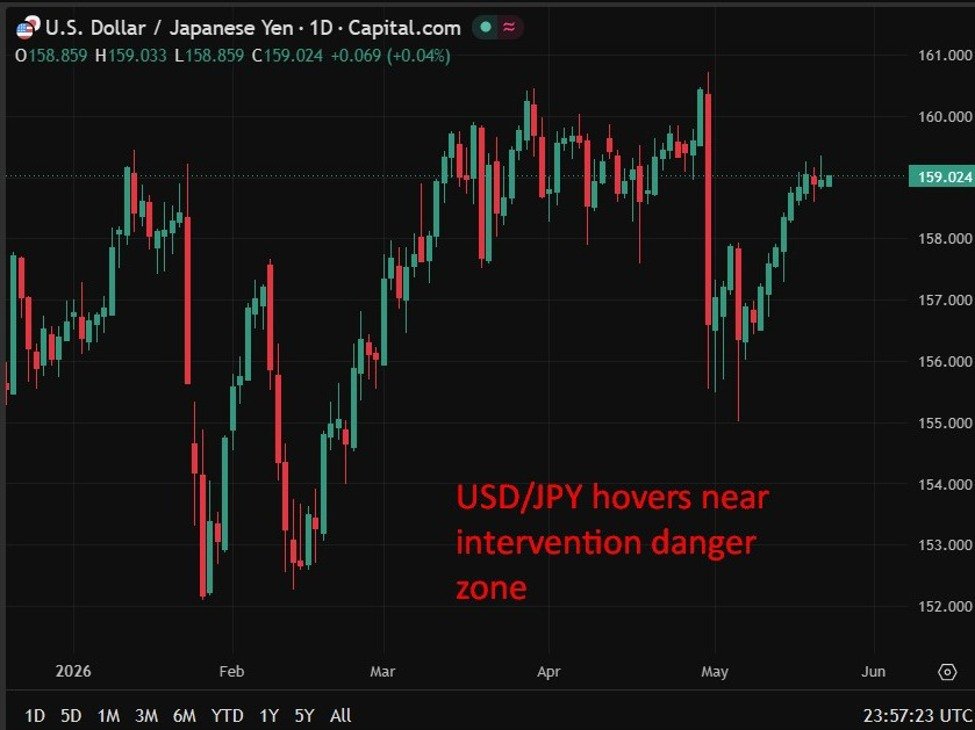
A weak yen compounds the difficulty. Safe-haven demand for the dollar following the outbreak of the Iran conflict has pushed the currency lower, raising the cost of energy and other imports further and adding to the pipeline pressure that wholesale prices (Japan wholesale prices surge 4.9% as Iran war drives import cost spike) are already signalling.
Analysts are broadly aligned on the view that April’s soft print will not last. As energy cost increases and supply disruptions feed through into a wider range of consumer goods and services in the months ahead, inflation is expected to re-accelerate, putting the BOJ’s calibration of the pace and extent of further rate increases back at the centre of market attention.
—
The yen faces a complex backdrop: softer headline inflation reduces immediate pressure on the BOJ to accelerate tightening, but wholesale price data pointing to the fastest pace in three years signals that consumer prices are likely to re-accelerate in coming months. Markets will be watching the BOJ’s June meeting closely, where a move to 1 percent on the policy rate remains widely anticipated despite today’s softer read. The Strait of Hormuz disruption continues to underpin upside inflation risk, keeping the BOJ’s rate-hike calculus uncomfortably tied to geopolitical developments it cannot control.