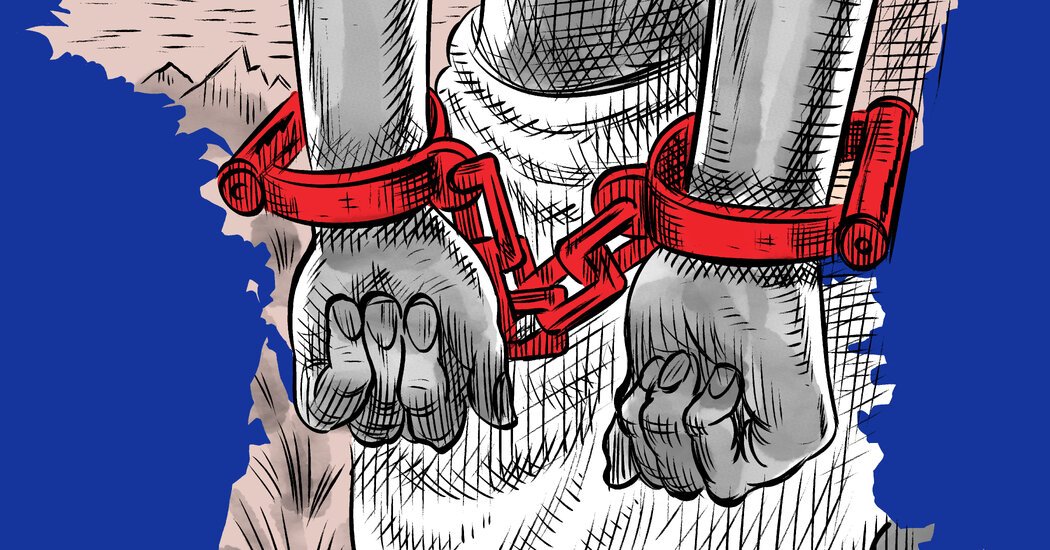
In May 2025, François Bayrou, then the prime minister of France, fielded an unusual question from a member of Parliament: Why hadn’t France formally revoked the Code Noir, the notorious set of laws that had been used to enforce slavery in French colonies? It would be safe to assume that Mr. Bayrou didn’t see that question coming; few people understood that the laws were still on the books. Visibly surprised, he announced that a bill to abolish the Code would be brought before Parliament and, he hoped, passed unanimously. After his government fell the Code seemed destined to endure.
Now, a year later, a cross-party bill written by Max Mathiasin, a lawmaker from Guadeloupe, will come before the National Assembly on May 28 to formally annul the slave laws — 341 years after King Louis XIV signed them into existence. This is undoubtedly the right thing to do. But what the Code Noir, or Black Code, reveals about the architecture of France’s colonial slavery deserves far more attention than a symbolic vote.
To the extent that people have heard about the Code Noir, they know that it was the legal basis for transforming African captives into “movable goods,” or heritable human property. One might think that the Code was designed primarily to justify colonial profit, which it certainly did. But its laws were also deeply informed by Louis XIV’s conservative Catholic worldview. The first article of the document didn’t even mention enslaved Black people; it expelled Jews from the Caribbean colonies.
Much of the Code is based on the chilling bargain that slave-trading Catholic countries offered to African captives: They lost their freedom but gained eternal salvation through Christ. Louis felt this to be the keystone of his slave economy. In the English colonies — early Virginia, for example — captives were generally not baptized, because many Protestants believed that Christians could not legitimately be held in bondage.
Louis’s belief that a systematized regime of forced labor could be a conduit for godly benevolence became an essential part of daily life in his colonies. Religious orders such as the Jesuits, who were called to educate both free and enslaved populations, ended up running slave plantations to finance their missions.
Consider the case of a Dominican priest named Jean-Baptiste Labat, who managed a sugar plantation in Martinique in the 1690s. In charge of baptizing his enslaved population, he sometimes mourned the death of an enslaved child. Yet if he caught someone engaged in African religious practice, he ordered unthinkable tortures. That a priest like Labat, who was a firm believer in the Code Noir, could be simultaneously compassionate and monstrous was not merely a failure of character; it was the system working exactly as designed.
The French Code belonged to a grim family of New World slave laws. The Spanish were the first to put forward a legal framework governing bonded workers across Mexico, Peru and the Caribbean. The British colonies of Barbados and Jamaica enacted their own ruthless regulations in the 1600s. A patchwork of distinct slave codes also came into being in North American colonies, from Massachusetts to Georgia.
What made Louis’s Code distinctive was not only its fusion of religious paternalism and commercial cruelty, but also that this single edict dispatched from Versailles would eventually govern slavery across so much of the world. Versions of the Code were adopted across the Caribbean, in the Indian Ocean colonies of Mauritius and Réunion and, in 1724, in the enormous Louisiana Territory. Well before President Thomas Jefferson purchased Louisiana in 1803, the Code had already shaped the legal framework governing tens of thousands of enslaved people there.
In the past, France generally treated the story of New World slavery as someone else’s problem. The national narrative celebrated the fact that revolutionary France abolished slavery in 1794, well before either the British or the Americans. Textbooks tended to skip over two inconvenient facts: Napoleon actually reinstated slavery in the Caribbean in 1802. And then there is the Haitian Revolution, in which an estimated 200,000 Black Haitians perished during their fight for freedom in the late 18th and early 19th centuries.
France’s Second Republic abolished slavery for good in 1848, but somehow no one got around to invalidating the decree that had made it all seem so logical. That the Code Noir survived in France’s legal corpus may well be an accident. That so many failed to act on it — or chose not to — for 177 years is not.
All nations shy away from the uglier chapters of their pasts. France’s case is especially painful, however, because the ideals it most prizes — liberty, equality, fraternity and the universal rights of humankind — are the antithesis of human enslavement. Something else about France that makes its situation so striking: Ever since World War II, during which racial identity cards facilitated the deportation of approximately 75,000 Jews in France, nearly all to their deaths, the country has refused to recognize racial categories of any kind.
Today, there are no such boxes to check on a national census, no such sorting of government statistics. On one level, this is admirable: We are, after all, one species. Yet this powerful ideal has sometimes served as a shield against self-examination. The logic is simple: no race, no problem.
While the city of Nantes has built a remarkable memorial and museum dedicated to exploring the country’s colonial and slave-trading past — and a landmark 2001 law recognized French slavery as a crime against humanity — the story of France’s Caribbean colonies remains obscured or misunderstood in the mainstream, reduced to a single day of remembrance each May 10.
Credit is due to Mr. Bayrou and Mr. Mathiasin for having the determination to bring this historic moment before the French nation. Yet repealing this antique document will surely be the simplest part of this process. As Mr. Mathiasin has said — and as we know all too well in the United States — slavery’s legacy lives on in a country’s politics, culture and communities. In America, it’s evident from the smallest towns in the South to the biggest cities in the North; in France, from the banlieues of Paris and Lyon to the overseas departments of Guadeloupe and Martinique. The Code Noir may be finished, but the project of grappling honestly with this history has only just begun.
Andrew S. Curran is the William Armstrong Professor of the Humanities at Wesleyan University and the author, most recently, of “Biography of a Dangerous Idea: A New History of Race from Louis XIV to Thomas Jefferson.”
The Times is committed to publishing a diversity of letters to the editor. We’d like to hear what you think about this or any of our articles. Here are some tips. And here’s our email: letters@nytimes.com.
Follow the New York Times Opinion section on Facebook, Instagram, TikTok, Bluesky, WhatsApp and Threads.