
In the early days of the generative artificial intelligence boom, Sanofi’s chief digital officer, Emmanuel Frenehard, wasn’t particularly impressed with the AI tools that were being pitched.
The French pharmaceutical giant eschewed licensing an enterprise version of the AI chatbot ChatGPT for internal use. Frenehard also didn’t make Copilot, Microsoft’s AI assistant, widely available for employees after conducting a small pilot.
“We looked at it, and said, ‘This is lame,’” says Frenehard. “This is just going to be a massive cost, but the value will be limited, compared to what you can do with a public ChatGPT. What difference is it, apart from your data is secured?”
Instead, Frenehard said he took inspiration from the hospitality industry, where experts at the front desk know all the best restaurant recommendations and local travel tips. This led to the launch of an internally developed and hosted generative AI companion called Concierge, which debuted in October 2024 and is now used by 60,000 employees globally, about 80% of Sanofi’s total workforce. Frenehard said that most of the employees who don’t use Concierge work in manufacturing and spend very little time in front of a computer.
Concierge has access to data from vendors including cloud-based software provider ServiceNow and business software giant Workday, Sanofi’s own internal policies and organizational charts, and connects external, agentic systems between the drugmaker and German enterprise software vendor SAP.
More recently, Frenehard’s focus has been on deploying agentic AI to more dramatically change workflows across IT, procurement, and sales. And, for the most part, he’s resisting the agentic capabilities that are being pitched by vendors. “I don’t want to have Salesforce agents, speaking to ServiceNow agents, going to speak to SAP agents,” explains Frenehard.
Instead, his vision is to run those workflows directly on Sanofi’s centralized data lake and lean on his partnerships with cloud-software company Snowflake and Elementum AI, the latter a startup that helps automate IT support, supply chain management, and other tasks, through an agentic AI workflow orchestration platform that has been built inside Snowflake’s AI data cloud. Snowflake’s venture capital arm disclosed an investment stake in Elementum AI in September 2025.
“In the last six months, more and more CIOs have discovered the importance of controlling their data,” says Nader Mikhail, CEO of Elementum AI. “The strategy of not forcing the customer to use our own database—they use their own, not ours—has been super powerful.”
For IT, Frenehard’s goal is for AI agents to autonomously resolve as much as 80% of employee requests, which he said could generate 10 million euros ($11.6 million USD) in annual savings. He also predicted that tens of millions in bottom-line savings would be achieved by automating procurement purchasing decisions.
For the top line, Sanofi is beginning to deploy Concierge to the sales team, rolling out the AI capabilities to 60 representatives earlier this month. The tool can help these employees prepare for meetings with doctors, including pulling relevant patient history, marketing data, and guiding what worked—or didn’t work—during prior conversations with medical professionals. Frenehard estimates that AI can save one day a week for each sales representative who uses AI in this manner.
His long term vision with this strategy to remake IT, procurement, and sales is to no longer rely on what software-as-a-service vendors are pitching when it comes to their own agentic capabilities. “I’m convinced that we are moving toward a world where software is becoming far more individual to the company,” says Frenehard, who asserts the software and AI experiences in Sanofi shouldn’t closely mirror rivals Novartis or AstraZeneca, even if they all operate in the same sector.
That said, Sanofi hasn’t shied away from partnering with the largest AI hyperscalers. The company’s external partnerships include utilizing sector-specific AI tools from Anthropic’s Claude for Healthcare, as well as a collaboration with OpenAI and Formation Bio to build AI-powered software to speed up drug discovery.
Sanofi’s resistance to embracing agentic AI services sold by SaaS companies comes amid Wall Street’s bearish view on the software-as-a-service sector. While many SaaS vendors have made AI a central part of their product offerings, the proliferation of agentic AI has led companies like Sanofi to chart a different course, which could threaten SaaS vendors and their standard per-user fee structure.
In April, Frenehard says Sanofi held a “digital month,” which encompassed AI training focused on how to properly use Concierge. And despite all of his bullishness on AI, Frenehard acknowledges workflow transformation hasn’t been a linear experience, even for his own team, which manages the IT support function.
As AI-related job displacement becomes more prevalent across the tech industry, banking, insurance, and other sectors, fear has escalated that workers will be replaced by technology.
Sanofi’s cost savings tied to agentic AI use cases within IT and procurement will come from cuts to external vendors, Frenehard stressed. “If you start using AI and say, ‘I’m going to remove some employees because of AI,’ then you are going to create more friction,” says Frenehard.
John Kell
Send thoughts or suggestions to CIO Intelligence here.
NEWS PACKETS
California is taking a closer look at AI layoffs. In the wake of layoffs at large tech firms including Cisco Systems, Meta, and Salesforce, California Gov. Gavin Newsom announced an executive order to get a handle on the situation. While light on enforcement actions, the order instead launches a government-backed academic analysis of AI’s impact on the workforce and the creation of a database to track AI’s effects on employment. Intuit, headquartered in Silicon Valley, last week announced it would cut 17% of its workforce and invest the savings on “big bets,” which could include AI. The maker of TurboTax said the job cuts weren’t directly tied to AI. And while plenty of other employers have made the direct link, on Monday, Nvidia CEO Jensen Huang called that framing “lazy.” “AI has just arrived,” Huang told a Singapore broadcaster, according to Business Insider. “How is it possible they’re already losing jobs?”
Some CEOs are beginning to say the AI jobs apocalypse is overhyped. David Solomon, the CEO of investment bank Goldman Sachs, on Friday published a guest essay with the New York Times in which he argued that while AI is reshaping lives and could automate 25% of current work hours within the next decade, massive job displacement isn’t likely. “Even after decades of ATMs, digital banking and bank consolidation, employment in commercial banking is at roughly the same level today as it was in the mid-1990s,” wrote Solomon. OpenAI CEO Sam Altman and Anthropic CEO Dario Amodei have also recently walked back their dramatic predictions about AI’s impact on labor. “I’m delighted to be wrong about this,” Altman said an in interview on Tuesday. “I thought there would have been more impact on entry-level white-collar jobs being eliminated by now than has actually happened.”
Trump whiffs on AI regulation; Pope Leo weighs in. On Thursday, the White House canceled an event where President Donald Trump was due to sign an executive order that would give the federal government an opportunity to evaluate advanced AI models before releasing them publicly. Throughout Trump’s second term, the federal government has taken a hands-off approach to AI regulation, which the president has framed as key to allowing innovation to flourish amid global competition. The New York Times reports that Trump delayed the signing because he “didn’t like certain aspects of it,” without elaborating on which parts he objected to. Days later, Pope Leo called for AI regulation and numerous other actions, including worker retraining, protections for children, and discouraged the use of AI for decisions involving weapons.
SpaceX files IPO; OpenAI looms in the near future. SpaceX filed its initial public offering with the Securities and Exchange Commission last week. And while most of the company’s revenue is derived from its Starlink satellite internet division, AI played a prominent role in the filing too. As Fortune reports, a vast bulk of the company’s total addressable market comes from AI, including enterprise applications, infrastructure, and consumer subscriptions, totaling $26.5 trillion. Musk’s xAI, the division of the business with the generative AI chatbot Grok, has reported widening losses and is spending billions to expand its infrastructure footprint. Meanwhile, rival OpenAI is reportedly planning to file its IPO in the coming days or weeks, according to the Wall Street Journal, citing people familiar with the matter, with a plan to go public as soon as September.
Anthropic reportedly in talks to rent Microsoft’s AI chips. The Information reported last week that Anthropic is in talks to rent AI server chips from Microsoft, to help the startup meet growing demand for its AI services. Big tech giants including Microsoft, Google, and Amazon have prioritized growing their chips business to rely less on AI chipmaker Nvidia, who reported a strong first quarter last week, even as competition is getting more intense from rivals including Advanced Micro Devices and Broadcom. Meanwhile, questions are percolating over the strength of Microsoft’s own position in the AI race, due to friction with partner OpenAI, slower-than-anticipated demand for Copilot products, and the AI coding assistant GitHub Copilot lagging behind rivals like Claude Code, according to a recent Fortune report.
ADOPTION CURVE
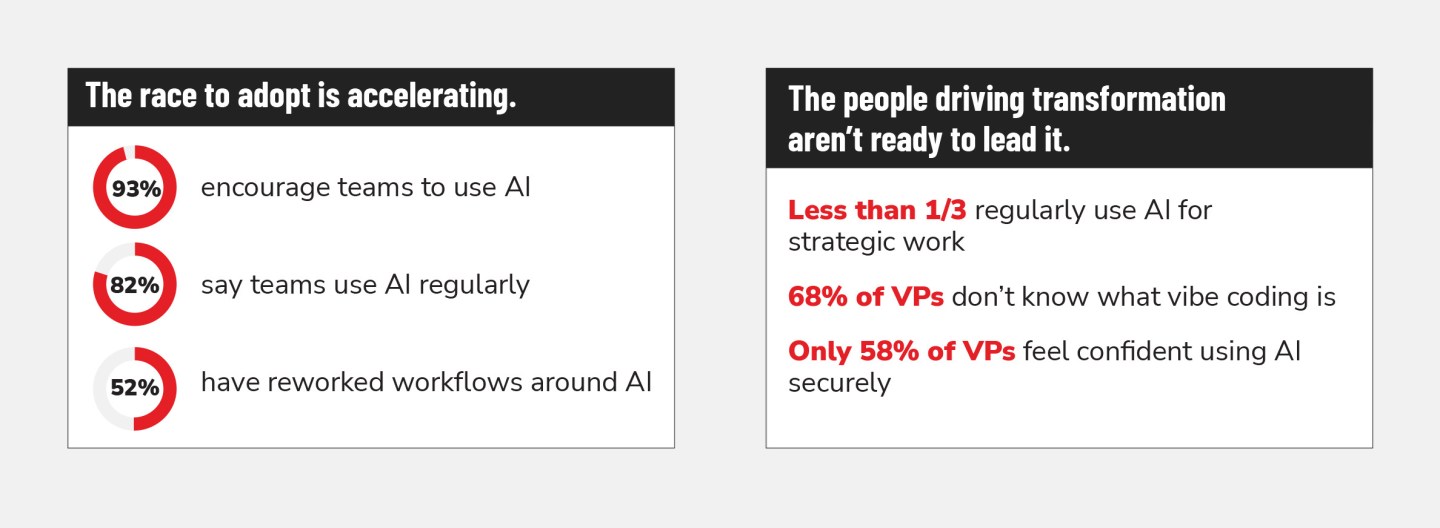
AI usage is still stuck in the lower-stakes use cases. A new study found that nearly all leaders (93%) encourage their teams to use AI, up from 60% two years ago, with regular usage among their team also increasing to 82% in 2026 from 52% in 2024. And yet, most of the applications remain on the margins of work: searching for information (69%), summarizing content (68%), and drafting emails (58%), while the more strategic uses lag for financial modeling (28%) and scenario planning and organizational design (both at 27%), according to a survey of more than 500 U.S. and U.K. senior leaders conducted by tech education provider General Assembly.
The study also found that while four in five leaders have attended an AI training course, there’s less confidence among vice presidents than directors. The former group of employees is less sure about using AI without compromising company data, haven’t made as much progress on reworking their team and worker tasks around AI, and aren’t as aware of buzzy trends like vibe coding.
Daniele Grassi, CEO of General Assembly, tells Fortune that many enterprises still have too much focus on AI training for the top leaders. There’s also the so-called “super users,” who tend to be more self motivated. And employees still on the sidelines are still wary to jump in and use AI more amid fears of job displacement.
“Until you really move the core of the company, you will not see the transformation,” said Grassi. “And that’s why we are a little bit stuck.”
Courtesy of General Assembly
JOBS RADAR
Hiring:
– Nice Group is seeking a chief technology officer, based in Carlsbad, California. Posted salary range: $220K-$270K/year.
– Estée Lauder is seeking a VP of global infrastructure and technology operations, based in New York. Posted salary range: $277.2K-$471.9K/year.
– New York Life is seeking a VP of head of corporate functions technology, based in New York. Posted salary range: $250K-$300K/year.
– MIT Lincoln Laboratory is seeking a deputy CIO of data, analytics, and AI, based in Lexington, Massachusetts. Posted salary range: $250K-$320K/year.
Hired:
– Abridge appointed San Oo as CTO, joining the healthcare AI startup after most recently serving as SVP of engineering at software startup Notion. Oo previously served as CTO at Singapore-based online shopper rewards platform ShopBack and as VP of engineering at messaging app Slack.
– Arch Insurance North America promoted Imran Jalozie to the role of CIO, where he will lead enterprise IT infrastructure and platform modernization. Jalozie joined the insurance company in 2022 as VP of IT application development and has served as interim CIO since May 2025. Jalozie has also worked as an adjunct professor in the computer science and technology department at Illinois State University since 2018.
– Giga Energy named Angad Sandhu as CTO. He joins the energy infrastructure provider after most recently serving as director of data center infrastructure at Google. Before that, Sandhu spent five years at Tesla, where he helped scale the electric vehicle manufacturer’s gigafactory engineering and manufacturing operations.
– Northwest Bank appointed Chad Ballard as CIO, effective May 18, to lead the Ohio-based bank’s IT strategy and operations. Most recently, Ballard was CIO for shared services operations at Wells Fargo. He also previously held leadership roles at JPMorgan Chase and PNC.
– Veritext Legal Solutions announced the appointment of Mike Coen as CTO, where he will lead platform modernization, AI initiatives, and the global engineering organization for the legal technology company. Coen most recently served as chief product and technology officer at healthcare technology provider TeleTracking Technologies.
– Arvig promoted Ben Wiechman to the role of CTO. He joined the telecommunications and broadband provider in 2011 as a system administrator and most recently had served as director of network strategy and engineering. In his new role, Wiechman will focus on scaling Arvig’s 18,500-mile fiber network in the Midwest.
– BioVigil appointed Brad Ryba as CTO, joining the healthcare company to oversee technology and data. Most recently, Ryba served as a co-founder and CTO at software provider Rimsys Regulatory Management Software. He was also head of digital at GBU Life and a director at Intellias and EDMC.
Fortune AIQ Special Digital Issue: The AI Economy
From global corporations to local entrepreneurs, artificial intelligence is changing the way businesses operate, compete, and succeed. Explore all of Fortune AIQ, and read the latest collection of stories below:
–After AI stole his clients, one Big Tech ghostwriter is using AI to get them back
–Outnumbered: At $4 billion ClickUp, a 3:1 agent-to-human ratio is rewiring work itself
–How a mom-and-pop car wash chain went from sticky notes to AI-powered operations that are upleveling every part of the company
–Solo founders are using AI to do the work of entire teams—but going it alone has limits
–How EarthRanger uses AI to help protect endangered species—and boost the wildlife tourism industry
–The smartphone’s days are numbered. Meet the device that could come next