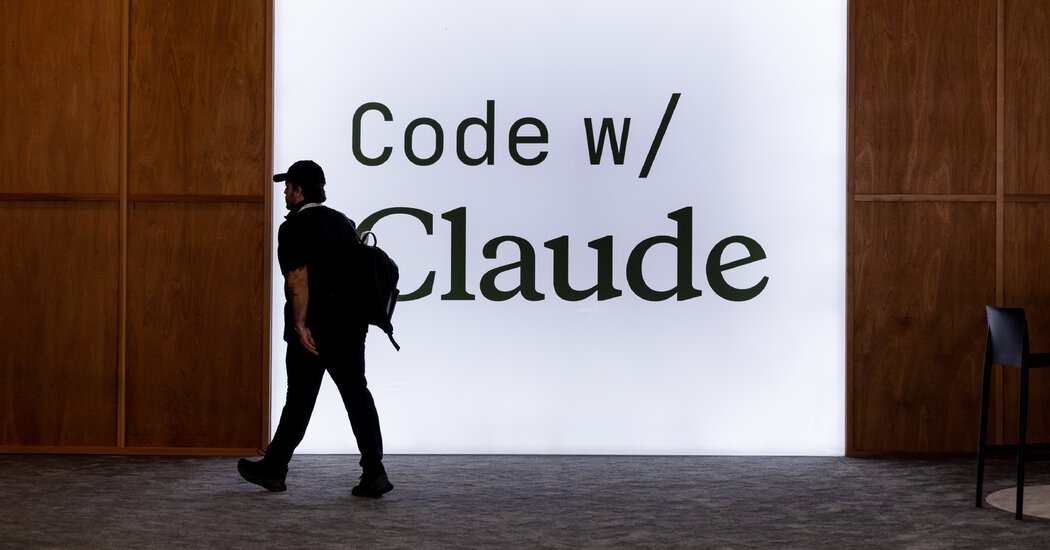
Anthropic, once the lesser-known artificial intelligence competitor to OpenAI, has been on an inexorable rise over the past few months.
The San Francisco company recently dueled with the Pentagon over the use of A.I. in warfare. It released a powerful A.I. model, Mythos, that it said was uncannily capable of finding and exploiting hidden flaws in software. And the company advised Pope Leo XIV on his papal encyclical delivered on Monday, in which he warned about safeguarding humanity from A.I.’s most disruptive effects.
On Thursday, Anthropic punctuated its ascent by officially passing OpenAI as the world’s highest flying A.I. start-up. Anthropic said it had raised $65 billion in financing that values it at $900 billion before the inclusion of the new capital, a deal that puts it ahead of OpenAI’s last valuation of $730 billion. The company also unveiled a new flagship A.I. model, Claude Opus 4.8, which is significantly better than its predecessor at generating computer code.
The new investment, which was led by investors including Greenoaks Capital, Sequoia Capital, Altimeter Capital and Dragoneer Investment Group, boosted Anthropic’s value by nearly two and a half times its previous valuation of $380 billion about three months ago.
The funding underlined the company’s success in developing A.I. technology that excels in writing software code, which has turned into a robust business. Since Anthropic improved its A.I. coding technology in November, hundreds of businesses have signed up to pay for the software. The company said its “revenue run rate,” which is its expected revenue for the year based on its current performance, crossed $47 billion this month.
“This funding will help us serve the historic demand we are experiencing, stay at the research frontier, and bring Claude to more of the places where work happens,” said Krishna Rao, Anthropic’s chief financial officer.
Anthropic’s trajectory stands out, even amid a heated frenzy over A.I. Just 62 days ago, OpenAI — which had kicked off the A.I. boom with its release of the ChatGPT chatbot in 2022 — announced it had raised $122 billion in a funding that put its value at $730 billion, a number that it took roughly a decade to achieve. Anthropic, which was founded in 2021, has surpassed that in half the time.
The company’s momentum has gathered steam in recent months as Dario Amodei, Anthropic’s chief executive, has spoken out about the potential dangers of A.I. and called for regulation of the technology. That led to a bitter fight with the Pentagon over how A.I. should be used in warfare, among other public imbroglios.
Anthropic’s rise only adds to its contest with OpenAI and Elon Musk’s SpaceX as the private companies race to go public.
Last week, SpaceX revealed its public offering prospectus and is expected to reach the stock market as soon as next month. OpenAI also plans to file confidentially for an initial public offering in the coming weeks. Anthropic insiders have said the company was also considering an I.P.O. that could come as soon as this year, though the company has declined to comment.
The battle is far from over. Facing pressure from Anthropic, OpenAI has trimmed side projects in favor of prioritizing work on its own coding software, called Codex. SpaceX recently entered an agreement to buy Cursor, a software coding interface popular with developers, and has agreed to sell some computing power to Anthropic.
A spokesman for OpenAI declined to comment. Mr. Musk did not respond to a request for comment.
In its latest funding, Anthropic brought in new strategic investors including Samsung, Micron and SK Hynix, companies that build storage, memory and logic chips that are crucial to the development of A.I. In a blog post, Anthropic said these strategic partners would help boost the company’s computing power as demand for Claude Code grows.
Anthropic has now raised more than $130 billion since it was established, according to PitchBook, which tracks start-ups. Its roster of investors includes Capital Group, Menlo Ventures, Iconiq Capital and Lightspeed Venture Partners, as well as tech giants like Amazon and Google.
Anthropic’s new Claude Opus 4.8 outperforms all other publicly available A.I. technologies on vibe coding, which is when A.I. technologies create software in response to prompts written in conversational English. Opus 4.8 scored 10 percent higher on the vibe coding benchmark test from Vals AI, a company that tracks the performance of the latest A.I. technologies, compared with the previous Anthropic model, said Rayan Krishnan, the chief executive of Vals AI.
The new model also outperformed its predecessor in mathematics, another area where the leading A.I. technologies continue to improve by leaps and bounds.
(The New York Times has sued OpenAI and its partner, Microsoft, accusing them of copyright infringement of news content related to A.I. systems. OpenAI and Microsoft have denied those claims.)