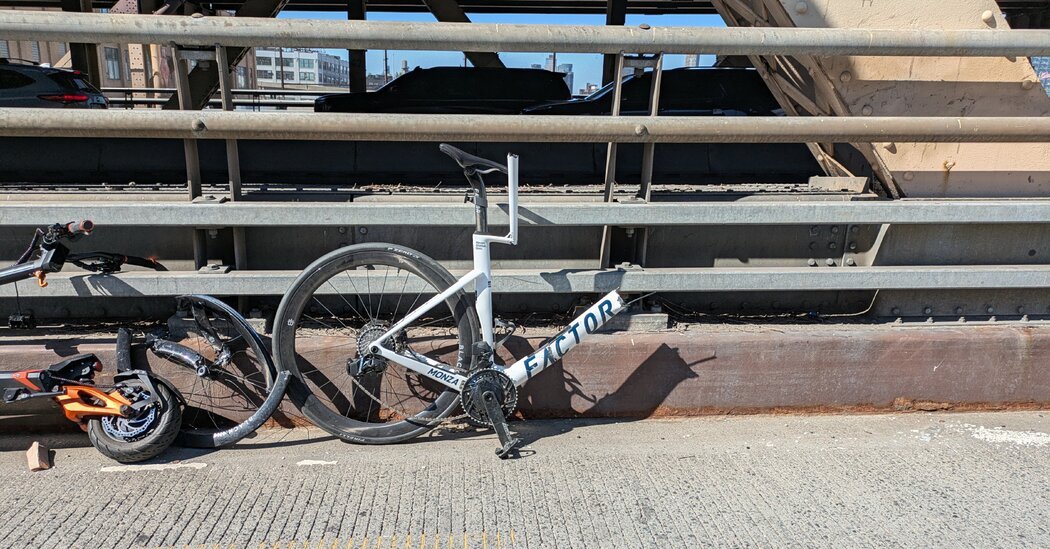
Two men — one on an electric scooter, the other on a bicycle — died on Thursday morning after they collided in the bike lane on the Queensboro Bridge, the police said.
Police officers responded at 8:21 a.m. after a 39-year-old man riding a stand-up electric scooter crashed into a 35-year-old cyclist. The e-scooter driver was traveling westbound, while the cyclist was traveling eastbound, the police said.
The men were brought to NewYork-Presbyterian Hospital in Queens, where they were pronounced dead. Photos taken in the aftermath of the collision show a white bike snapped clean in half, with an orange e-scooter lying next to it. The crumpled front tire of the bike rests against the bridge.
The e-scooter involved in the crash was not legal for street use, because it was capable of much faster speeds than allowed under city law, and should not have been operated on any city streets or bike paths, according to Vincent Barone, a spokesman for the Department of Transportation.
The speed limit for bicycles and electric bikes is 15 miles per hour. An electric standing scooter — one that doesn’t have a seat — is illegal in New York City if it has the capability of traveling more than 20 m.p.h.
The photos of the crash site appear to show a Teverun Blade GT Suit II+ e-scooter, billed on the company’s website as a “wolf in a suit” that can reach almost 53 m.p.h.
“Beneath its sleek, understated design lies immense power and explosive acceleration,” the company’s description reads. “Every twist of the throttle delivers thrilling speed while maintaining effortless control, turning your daily ride into an extraordinary experience.”
The white bike appeared to be a Factor Monza, a traditional pedal bicycle with a lightweight frame that does not have a motor.
“This terrible tragedy is a grim reminder that illegal, high-speed micromobility devices, like the stand-up e-scooter involved in this incident, are dangerous and have no place on our roadways or bike paths,” Jeremy M. Edwards, a spokesman for the mayor’s office, said in a statement. “Every New Yorker deserves to feel safe, and the Mamdani administration will continue working to remove these illegal devices from our streets and bring accountability to micromobility use.”
Danny Pearlstein, a spokesman for Riders Alliance, a transportation policy nonprofit, said the speed of the illegal vehicle was most likely the reason for the severity of the crash.
“This is like throwing a grenade on city streets,” he said, blaming the device manufacturers and suppliers.
Last year, the Department of Transportation redesigned the bridge’s outer roadways, separating bike and pedestrian traffic, and doubling the space for bikes and other micromobility vehicles.
This is the first time a cyclist has been killed on the Queensboro Bridge since at least 2014, according to Transportation Alternatives, a street safety advocacy group. Between 2022 and 2025, electric scooters have been involved in crashes that have seriously injured 76 cyclists and pedestrians, the group said.
Ben Furnas, the group’s executive director, said in a statement that the crash was preventable, and he renewed calls for the passage of a City Council bill that would end the sale of e-bikes capable of going faster than 20 m.p.h.
“Twenty is plenty — no matter who you are or how you’re traveling,” he said. “Speed kills.”
Christopher Maag contributed reporting.