When Magyar emerged from the building to address the assembled crowd, he offered his own lesson of his impossible victory. “Against a machine of power,” he said, “we don’t need another machine of power, but real people who — going from mailbox to mailbox, house to house, in the cold, the frost and the rain — are capable of anything for their homeland, their neighbors, their relatives and their community.”
The next task was “to rediscover how to see ourselves as a community once again,” he said. “Therefore, I ask you to turn toward those compatriots who are disappointed today, who are afraid, or who experience this period as a loss. Do not try to defeat them; do not look down on them. Listen to them and talk to them. Tell them that this country belongs to them, too; that they are needed, just as everyone is needed; and that together, we will rebuild Hungary, because there is no left, there is no right — only Hungarians.”
One of the secrets of Peter Magyar’s success, Balint Magyar had told me, lay in reclaiming the symbols of the nation: the flag, the national anthem, the very idea of Hungarian-ness. Now Peter Magyar was watching over an elaborate national performance: the raising of the flag, soldiers goose-stepping, cavalry in ornate uniforms.
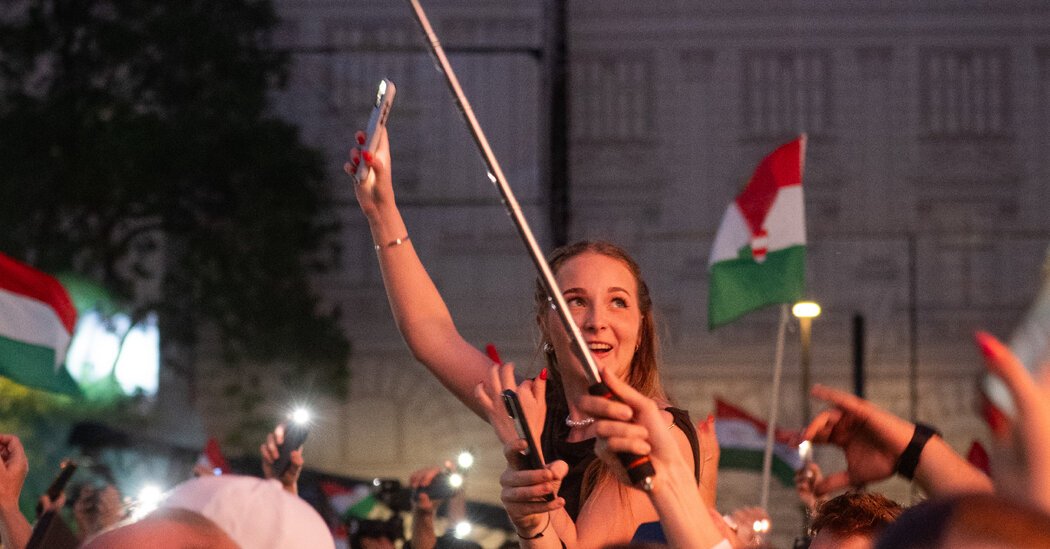
And then the pageantry was over, but Magyar was still separated from the crowd by large expanses of empty space, the distance that Orban’s government had so carefully engineered. Magyar started motioning to the crowd: Come closer, come closer — but people were already pressed up against the edge of the reflecting pool. After a few moments, the excitement and the desire to be fully a part of this historic moment became too much to resist. Some men hiked up their pants and ran across the reflecting pool — which, it turned out, was just a couple of inches deep. Almost immediately, hundreds more followed. They ran splashing through the water and onto the other side, filling the space from which they had so long been excluded. “This is your house now!” Magyar exclaimed.
Everyone I interviewed on this trip to Budapest believes in this new era. Academics believe that they will be free to teach again. Young people believe that they will be the first generation in years for whom staying in Hungary is a desirable option. Civil society activists believe that they will be able to stop fighting for their own survival and focus on helping the people they want to help. Marta Pardavi, co-chair of the only organization in Hungary that provides free legal representation for people seeking asylum, was even hopeful — despite the absence of any such promises — that the new government would resume accepting asylum applications.