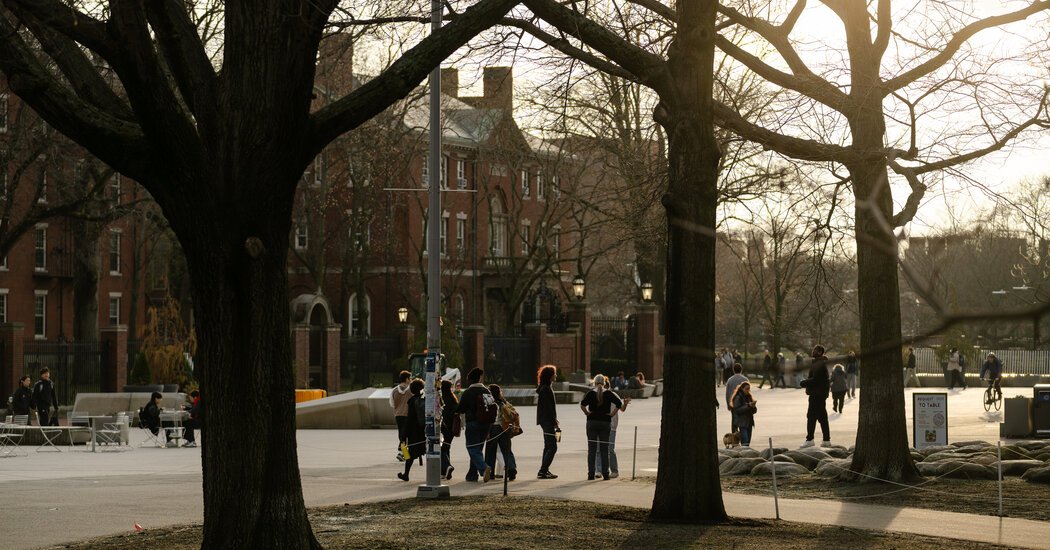
The Trump administration has quietly slowed funding for scientific research at Harvard and other universities that have been targets of a White House pressure campaign, according to government data reviewed by The New York Times.
The funding slowdowns at the National Science Foundation, one of the largest single sources of federal research dollars for universities, have also affected Duke, Princeton and Yale, records show. Grant proposals that had previously been recommended for funding by employees who oversee the review process have been flagged in recent months for additional scrutiny, but with no clear explanation provided in the records and researchers left largely in the dark.
The holds had set off alarm bells inside the agency and on some campuses. Federal judges ruled in two separate cases last year that the Trump administration had broken the law by halting research grants as a way to impose policy changes.
A White House spokeswoman said the administration’s reviews of grants were in compliance with federal law. An N.S.F. spokesman declined to comment.
After The Times inquired about the slowdown on Tuesday, the administration began releasing some grant funding on Wednesday, Thursday and Friday, and released the hold for some of the institutions on Thursday. Nature, a scientific journal, reported on the slowdown on Thursday. It was not clear whether the funding releases were related to the media inquiries.
Michael Gerhardt, a constitutional law professor at the University of North Carolina, said the holds at the N.S.F. may violate a ruling in September from Judge Allison D. Burroughs of U.S. District Court in Massachusetts, who barred the administration from blocking future research funding for Harvard out of retaliation.
“It’s the same game the administration has been waging since Day 1,” Mr. Gerhardt said.
All four universities have been targets in the Trump administration’s yearlong bid to expunge “woke” ideology from college campuses. The campaign has mostly entailed halting research funds and opening civil rights investigations.
The government publicized many of those funding freezes and investigations last year. But the recent holds have been more discreet.
They come amid growing turmoil at the N.S.F., which accounts for about $9 billion in research money supporting work from Arctic research to particle colliders to space observation. The agency has been targeted by the Trump administration for substantial budget cuts, and it has also lost about a third of its employees in layoffs or forced retirements. Last month, the administration fired its oversight board.
On Tuesday, The Times inquired about more than 40 grants worth about $35 million that had been placed on hold for the four universities. Harvard accounted for about half of that total. The grant proposals ranged from research on next generation quantum to pharmaceutical and agricultural markets and nuclear physics.
On Wednesday and Thursday, the N.S.F. released holds on nearly a dozen grants, some of which had been paused for months.
There was no clear pattern in the type of research that has been held up, or the funding that has been approved in recent days.
Mathematics professors at Harvard, several of whom spoke on the condition of anonymity out of fear of putting their funding in jeopardy, said they or their colleagues had waited months for word from the N.S.F. regarding grant proposals involving studies of advanced theories in geometry and algebra. One professor whose proposal had been submitted in 2024 finally received word this week that his study had been approved.
Some school officials acknowledged that funds had been paused, but they were unable to explain why.
“Like other universities, we have experienced a slowdown in new federal research grants,” said Peter Schiffer, Princeton’s dean for research. “The N.S.F. has not informed us of any blanket action involving our pipeline of N.S.F.-funded projects, many of which involve quantum science and engineering, computing, and a range of other emerging technologies that are critical to the economic and national security of the United States.”
Chris Simmons, the vice president for government relations at Duke, said the university was not aware of any official pause, adding, “We are highly concerned with the lag in the awards from the N.S.F.” Duke’s first new grants for the fiscal year were approved on Thursday, records show.
Harvard has faced more government actions than any school since President Trump returned to office, particularly after the nation’s oldest and richest university sued the administration over the funding cuts and won.
While the administration has vowed to appeal the decision, the White House has started work on a broader overhaul of the federal grant-making process.
In August, Mr. Trump signed an executive order requiring each executive agency to designate a senior presidential appointee to review all grant awards to ensure that the contracts align with “agency priorities and the national interest.”
As of May 1, the N.S.F. had committed only 10 percent of its congressionally appropriated funds, roughly half of what the foundation had awarded by this point in previous fiscal years, according to Grant Witness, which tracks scientific grants.
Ted Mitchell, the president of the American Council on Education, said the foundation slowdown has been “substantial.”
“We are worried and confused, because we have not gotten any explanation,” Mr. Mitchell said.