Steven Lovelace is not sure Alberta should break away from Canada and become its own country.
He worries about his landlocked province if it secedes.
Plus, he is a self-described patriot.
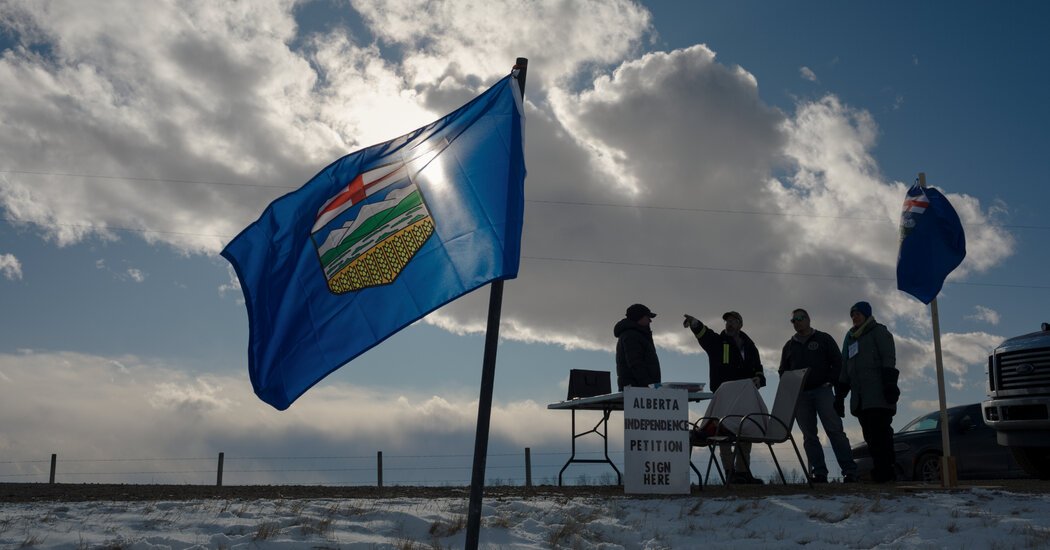
“I love Canada, that’s the hard part,” he said in an interview in Slave Lake, a town of 7,300 people in central Alberta, where oil, gas and forestry are big employers. But Mr. Lovelace, a 31-year-old pulp mill tradesman, signed a petition demanding a vote on the question anyway.
After months of high political drama that included a courtship between separatists and the Trump administration, it looks increasingly likely that Mr. Lovelace will get his wish on Oct. 19.
“I don’t go day to day talking about separation,” he said. “But I want to scare Ottawa,” Canada’s capital and the seat of the federal government.
Alberta, an oil-rich Western Canadian province often referred to as the “Texas of Canada,” is hurtling toward a referendum that will ask citizens: Do you want to stay in Canada, or have a separate, binding referendum to secede?
A referendum on holding a referendum, so to speak.
The mere asking of the question has lit a political fire. In Alberta, the debate has become urgent, making most Albertans who don’t want to secede feel compelled to speak out against it. Canada’s political class in Ottawa, where Albertan separatism has historically elicited shrugs or sneers, is suddenly paying attention.
Prime Minister Mark Carney has tried to address Albertans’ grievances and puncture secessionist momentum while also managing a historic rift in Canada’s relationship with the United States. He can ill afford a separatism crisis with a province that exports its oil to the United States.
This past week, Mr. Carney said the referendum amounted to a “dangerous bluff” and compared it to Brexit. He spoke from experience — he led the Bank of England when Britain voted to leave the European Union in 2016 and had to help the country navigate the economic fallout.
Over a Century of Alienation
Many Albertans say the province has been treated badly since the day it joined the Canadian confederation in 1905.
Political cartoons at the time portrayed eastern Canada — practically a continent away from Alberta — milking the province for its resources. (In one, from 1915, a cow is depicted straddling the length of Canada being fed by farmers in Alberta, Manitoba and Saskatchewan, and milked by men in suits and top hats in eastern Canada.)
That sense of being exploited has animated a separatist fervor ever since, underpinned by a belief that the ranchers, farmers and oilmen who settled this part of Canada were made of different stuff.
But even as Alberta and the federal government clashed during the last century, separatism remained a minority movement.
In recent years, no more than 20 percent of Albertans have supported separatism, polls showed, and they were often dismissed as rural cranks or pro-United States agitators, secretly angling for Alberta to become a U.S. state.
“This idea is not new,” said Corey Hogan, a Liberal member of Parliament for Alberta’s largest city, Calgary, who has began an impassioned campaign for Alberta to stay in Canada. “What’s new is that people are talking about it.”
The views of Mr. Lovelace, the pulp mill tradesman, offer a window into how a once-fringe movement is attracting a broader segment of Albertan society by harnessing people’s grievances.
Mr. Lovelace said he wanted Albertans, who are, in general, wealthier than other Canadians, to regain control of how their taxes are spent, instead of letting them be managed by Ottawa. Alberta has a population of roughly five million — about 12 percent of Canada’s 41.5 million — and produces 15 percent of the country’s gross economic output.
Trevor Tombe, an economics professor at the University of Calgary, said Albertans were not being taxed more than other provinces, but, because the province is wealthier and younger, it contributes more to the federal budget than it receives — just as British Columbia and Ontario do.
“It’s a consequence of good things, it’s not a consequence of Alberta being targeted,” Mr. Tombe said. “It’s not as though there’s a higher income tax rate in Alberta than anywhere else.”
Mr. Lovelace also expressed anger toward Mr. Carney’s predecessor, Prime Minister Justin Trudeau, arguing that his climate-focused policies stifled Alberta’s ability to grow its oil and gas industry.
Mr. Hogan, the lawmaker, said the federal government needed to understand and address the resentment leading some Albertans to flirt with the idea of secession.
“It’s about a feeling that we don’t count,” he said. “It’s at best indifference and often hostility from the East.”
Come for the Secession, Stay for the Conspiracy
In a glum hotel conference room in Slave Lake, 100 or so people listened to a presentation in favor of Albertan independence by Mitch Sylvestre, one of the movement’s most prominent leaders.
Most had already signed the petition to hold a separation referendum and were there to hear their views confirmed in the company of like-minded people.
Mr. Sylvestre, a tall man with a strong jawline and alert eyes, pulled up a PowerPoint presentation. He had done this 119 times before, he said.
“Alberta is a colony of eastern Canada, and it will be very clear when I’m done,” he went on. “We have to be naïve to think that they do not covet what we have. Every war in history has been started by your neighbor wanting what you have.”
Thunderous applause rose from the crowd.
About an hour into the presentation, things took a turn.
Slides showing how Albertans were being “taxed to death” gave way to conspiracy theories popular in the right-wing corners of the internet.
Mr. Sylvestre, in no particular order, asserted that Mr. Carney wanted to install a “technocratic dictatorship,” that the Canadian federal government was a communist Trojan Horse, and that there were Chinese soldiers stationed in Canada, after noting he had once seen six fit Asian men at a supermarket.
He capped it off with a jab at Mr. Trudeau’s partner, the pop-star Katy Perry: “She kissed a girl and she liked it,” he snickered, referencing one of the singer’s hit songs.
The crowd was rapt, but in the end, had a more practical question.
What would the currency be when Alberta splits?
“The U.S. dollar,” Mr. Sylvestre said confidently.
Friends Like These
The Trump administration has denied making any material promises to Albertan separatists.
But White House and State Department officials confirmed that State Department officials met with separatist movement activists in Washington three times last year.
“The department regularly meets with civil society types. As is typical in routine meetings such as these, no commitments were made,” the State Department said in a statement.
The activists said they had been sworn to secrecy about whom they had met with, but they described the meetings.
Jeffrey Rath, an Alberta lawyer and prominent independence leader who participated in all three meetings, said one State Department official was so senior he went to see Mr. Trump in the Oval Office after wrapping up. “We’re not meeting juniors in the basement,” he said.
Mr. Rath and other attendees said they were told to give up on any suggestions that Alberta could join the United States (only a fragment of Albertan separatists like the idea).
The separatist vision is for Alberta and the United States to be closely aligned, he said. “We’ll have a common market-type arrangement economically, with zero tariffs on both sides of the border, on 100 percent of all goods and services.”
The administration appears in sync with that vision.
“Alberta is a natural partner for the U.S.,” Scott Bessent, the U.S. Treasury Secretary, said in a January interview. “They have great resources; the Albertans are very independent people.”
The Danielle Smith Factor
For most Albertans, the fact that a referendum on separation is scheduled to be held at all is a shock.
“It was a fever dream, and suddenly, it’s real,” said Tye Rubisch, a friend of Mr. Lovelace’s who works in the oil and gas sector in Slave Lake, but is apprehensive about separatism.
Mr. Rubisch is Indigenous and anxious about secession because it would throw into question binding treaties the country has signed with First Nations laying out their legal rights, including fishing, hunting and farming rights, as well as control over large parts of their ancestral lands.
That concern put a stop to a petition effort by the pro-independence activists last month, when a judge sided with an Indigenous group and ruled that the referendum could violate their treaty rights.
Enter Danielle Smith.
The premier of Alberta announced she would ram through that legal quagmire and hold a referendum anyway, proposing a convoluted framing — a choice between staying in Alberta or having another binding referendum to leave — as a compromise.
Ms. Smith, a nimble operator who has often changed course in response to shifting political winds, created the conditions for separatists to hold a referendum by lowering the threshold of signatures required to trigger one and extending the time a group had to meet that threshold.
Pro-independence leaders have described her as an ally, and her chief of staff is a prominent intellectual in the independence movement.
And Ms. Smith has relied on the separatists’ votes. She made a comeback from an earlier political crisis to lead the United Conservative Party of Alberta with their help.
But Ms. Smith has started working closely with Mr. Carney on Alberta’s demands, particularly federal support for a new pipeline to carry the province’s oil to the west coast to be shipped to Asian markets.
Mr. Carney and Ms. Smith last month committed to building the pipeline, and Mr. Carney made concessions on environmental regulations. They presented the deal as evidence that the Alberta-Ottawa relationship had turned over a new leaf.
“It’s going to, I believe, convince a few more people that Canada is worth fighting for and it’s worth working towards,” Ms. Smith told reporters.
But Ms. Smith’s handling of the referendum has provoked frustration.
“The premier doesn’t always listen to my advice,” Mr. Carney quipped last week when asked about her call for a referendum.
The next plot twist could come from pro-independence activists irate over not having a straight up-or-down secession vote. They are trying to stage a rebellion to unseat her as party leader.
Mr. Rath, the Alberta lawyer, said Ms. Smith was “completely duplicitous” in watering down the referendum, but that his side would encourage everyone to vote to hold a referendum, couching the choice as simply voting for democracy.
“If you want to to send a really strong message to Ottawa,” he said in an interview last week, “even if you’re still kind of on the fence about independence, this is just a vote to have a vote.”