Oil settled more than 4% higher Monday after Iran’s Tasnim said Tehran halted US talks and planned to fully block the Strait of Hormuz, before Trump’s social media posts pared some gains.
Summary:
- Iran’s Tasnim reported Tehran had halted indirect message exchanges with Washington and that Iran and its “Resistance Front” allies planned to completely block the Strait of Hormuz and activate the Bab el-Mandeb Strait as additional pressure
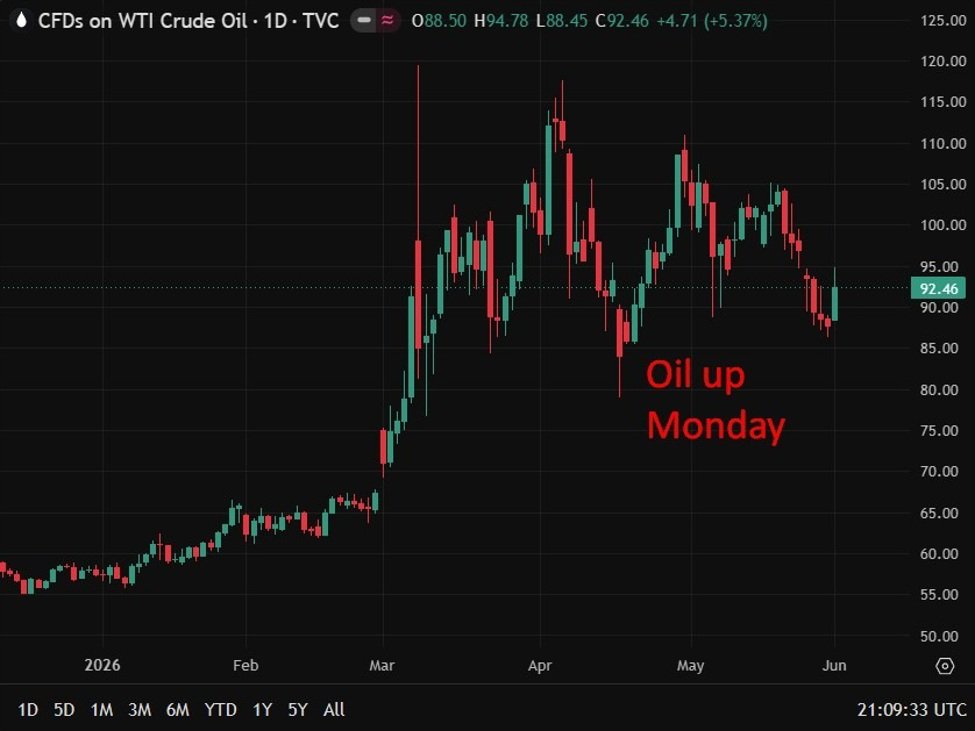
- Brent settled up 4.2% at $94.98 a barrel; WTI closed up 5.5% at $92.16, both well off intraday highs
- Trump said on social media that Hezbollah had agreed to stop all shooting, that no Israeli troops would go to Beirut, and that Iran talks were continuing at pace, trimming earlier gains
- Axios reported a Lebanese official said Hezbollah was ready for a full ceasefire; a planned Israeli strike on Dahiyeh was reportedly postponed after US intervention
- Ship-tracking firm Kpler confirmed only 10 vessel crossings of the Strait of Hormuz over the prior weekend, down from the week before
- OPEC+ was reported likely to raise output quotas by 188,000 barrels per day at Sunday’s meeting, with seven members expected to agree
Oil prices surged more than 4% on Monday after Iran’s state-linked Tasnim news agency reported that Tehran had stopped indirect communications with Washington and that Iranian forces and their regional allies were planning to completely seal the Strait of Hormuz, the world’s most critical oil chokepoint, while also activating the Bab el-Mandeb Strait as a secondary pressure point.
The report landed just ahead of the US equity open and sent both oil benchmarks sharply higher. WTI hit a session peak above $94.75 a barrel before settling at $92.16, a gain of 5.5% on the day. Brent reached just shy of $97.80 before closing at $94.98, up 4.2%. The intraday reversal from highs came after President Trump posted on social media that Hezbollah had agreed to halt all attacks on Israel, that no Israeli troops would enter Beirut, and that negotiations with Iran were continuing at pace.
Further reports contributed to the moderation. Axios cited a Lebanese official saying Hezbollah was prepared for a full ceasefire with Israel, while a planned Israeli strike on the Dahiyeh district of Beirut was said to have been pulled back at the last moment following US intervention. Iran separately called on Pakistan to continue mediating and support a ceasefire, according to IRNA.
The session crystallised the stop-start nature of diplomacy that has characterised the conflict since it began earlier this year. Both benchmarks had posted their steepest monthly declines in absolute terms since the pandemic through May, reflecting optimism that a US-Iran deal was within reach. Monday reversed that narrative, but not the price drop, in a single session.
Ship-tracking firm Kpler said only 10 vessels crossed the Strait of Hormuz over the weekend, a further decline from the week before, underscoring how effectively the waterway remains disrupted. An Axios report from Friday said Iran had laid additional mines in the strait last week. Shipping executives in Athens said any eventual peace deal would need to provide clear operational rules before normal vessel traffic could resume.
With US crude inventories expected to have drawn by around 3.6 million barrels in the latest week, the supply buffer is eroding. One analyst put the timeline to a more acute price spike at one to two months if the conflict remains unresolved.
—
Both benchmarks settled well off their intraday highs, with WTI ranging between ~$88.50 and ~$94.80 and Brent between ~$92.90 and ~$97.80, illustrating just how sensitive prices remain to headline flow from the region. The 10-year US Treasury yield edged up to 4.475% as the oil-driven inflation read weighed on bonds. Goldman Sachs has flagged weak Chinese and European demand as a meaningful downside risk to its Q4 Brent forecast of $90 and WTI forecast of $83, though Monday’s session was a reminder that supply disruptions can overwhelm the demand picture at any moment. With US crude inventories expected to have drawn down by around 3.6 million barrels last week, the supply cushion is thinning ahead of what one analyst described as a price spike scenario just one to two months away.
This attack, UKMTO posted mid-afternoon US time, was on a US-Israeli owned ship.