Do you check the daily screen time on your phone? The number can be jarring.
Like your cholesterol levels or the payoff amount on your mortgage, it’s a figure you feel you should be monitoring, but don’t really want to know.
Last Sunday, a day I spent mostly baking and on a long walk with a friend, I felt as if I had been on my phone for an hour and a half, tops. Turned out it was four hours.
What was I doing all that time? Who knows. I sent some texts. I watched Instagram videos of cats being rescued from vacant lots and strangers giving me pep talks. (“You got this!”)
Most of us spend five or more hours a day on our phones, according to a 2026 YouGov survey. Four in 10 adults say they are online “almost constantly,” a separate poll by Pew Research found.
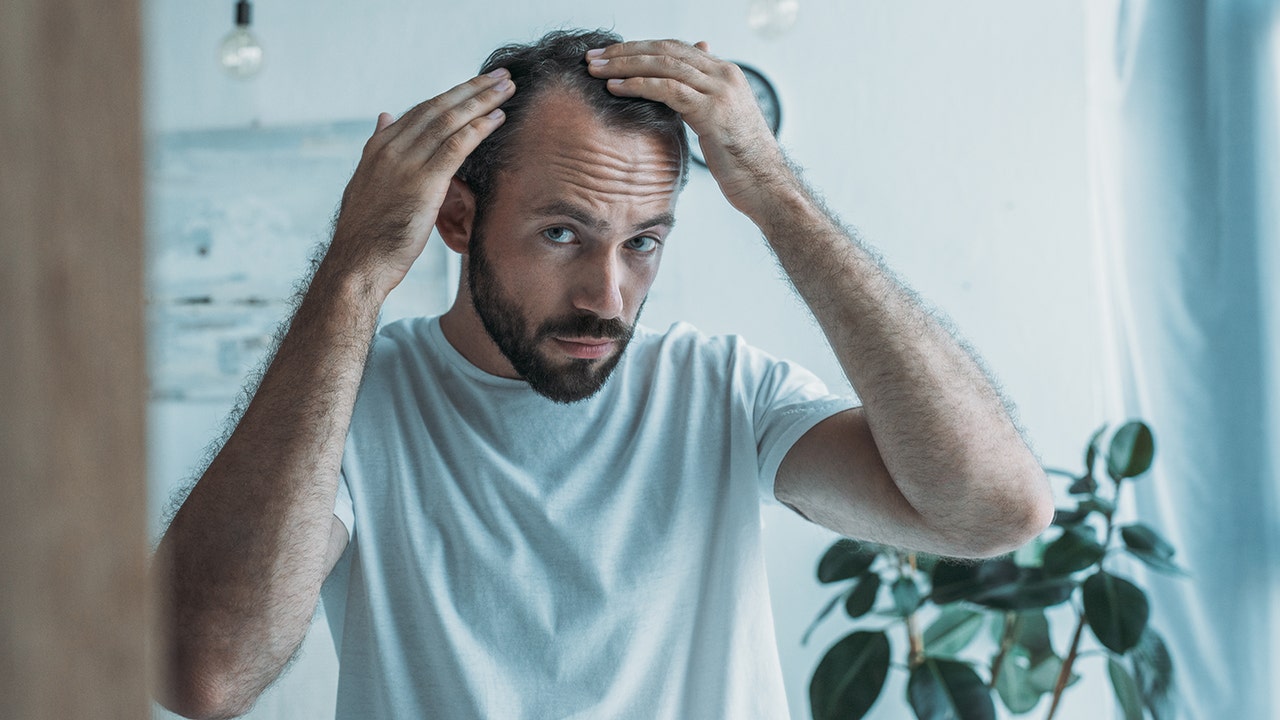
All this time in front of screens has an impact on our mental and physical health, raising our stress levels and shrinking our attention span. Our devices change the way we walk and cause us to breathe less often, a stress response known as screen apnea. Dr. John La Puma, an internist and the author of “Indoor Epidemic,” says our phones also make it more tempting for us to stay inside — where we already spend an estimated 90 percent of our time.
Dr. La Puma has a name for those hours we stare at our phones: ultraprocessed time. “Ultraprocessed time is to your attention what ultraprocessed food is to your metabolism,” he told me. “It’s instant gratification, and it’s designed to be addictive.”
‘Ultraprocessed time’
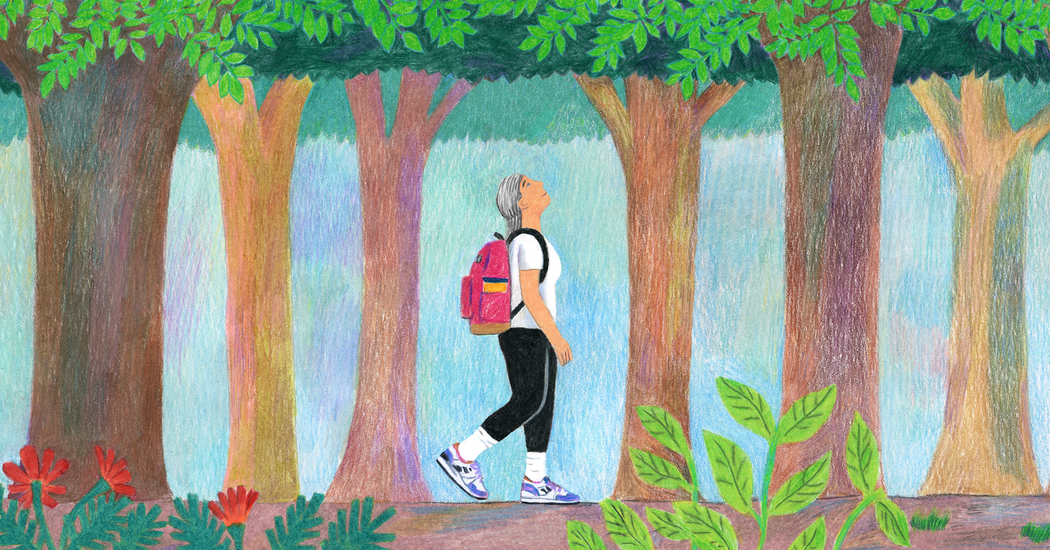
To combat this, we’ve created a monthlong “Touch Grass” challenge. Summer’s almost here. Let’s put those devices down and get some air.
Sign up here, and each week in June you’ll get a set of easy, science-based exercises that will encourage you to put down your devices and engage with real life. We’ve just published the first installment, asking you to commit to spending 20 minutes a day outside without phones. Next, we’ll work on improving our sleep by turning those phones off 30 minutes before bedtime. Then we’ll guide you through hosting a 1990s-style hangout — there were no smartphones in the ’90s, which means no GPS, so make sure to write down directions. To finish, a little art project (with pine cones!).
Our first activity was inspired by a landmark study of nearly 20,000 people. Those who spent at least 120 minutes in nature a week reported higher levels of health and well-being.
That averages out to 17 minutes a day.
We rounded it up to 20. Add some “greens” to your ultraprocessed time and pledge to go outside, device-free, for a total of 20 minutes a day. (It can be in increments!) Try it for a week, or all month (or for the rest of your life).
“You don’t need to be in an open meadow,” Dr. La Puma said. “It can be anywhere you see the sky and breathe outdoor air.” If you’re in a city, that might be a dog park, a rooftop or any street with trees. If you’re a caregiver or can’t leave the house, the front steps, a fire escape or a backyard will work.
It may be uncomfortable at first to be alone with your thoughts. But to get the most out of this in terms of reduced stress, better sleep, higher levels of focus and sharper memory, “you do have to unplug,” said Marc Berman, a psychologist at the University of Chicago and the author of “Nature and the Mind.”
If you need extra motivation, here’s how to check your screen time on iPhone and Android.
‘Release the bees’
At first, field-testing this exercise, I could manage only about five device-free minutes before getting twitchy. I’d take a quick walk around the block and then scurry back home.
If you suspect that you, too, might be uneasy without your phone, give yourself a little task. Count the dogs you see on the walk, or use the time for savoring life, bringing mindful attention to the positive things in it. Maybe an awe walk, designed to cultivate a sense of amazement at the surroundings. Watch the tree leaves rustle, listen to the water flowing downstream.
After a few weeks of beta-testing my 20-minute jaunts, I began to view them as a chance to “release the bees” — the persistent, annoying thoughts that buzz around my brain. Now I have begun to crave this restorative stretch of uninterrupted peace the way I crave those pep talks from strangers. I’ve found I’m less likely to go straight for my phone when I return.
I hope you’ll join me in this experiment by signing up for the “Touch Grass” challenge. And while you’re at it, sign up here to get my newsletter, Well, delivered to your inbox.
THE LATEST NEWS
Middle East
THE SUNDAY DEBATE
During a “60 Minutes” staff meeting last week, the veteran reporter Scott Pelley excoriated CBS News executives and was fired the next day. Was Pelley right to speak out so publicly?
Yes. He courageously spoke up against mismanagement under Bari Weiss and the injection of political bias in reporting, Margaret Sullivan writes for The Guardian: “Pelley will be remembered as a beacon of integrity and a symbol of righteous indignation — somebody willing to lose his job in order to speak truth to power.”
No. He is an activist who hijacked a meeting to attack a colleague instead of speaking to them privately, Joe Concha writes for the Washington Examiner: “It’s this kind of cheesy, theatrical performance by a ’60 Minutes’ correspondent and former anchor of the ‘CBS Evening News,’ a chair once occupied by an actual newsman in Walter Cronkite, that helped turn the longtime newsmagazine into just another program with an agenda.”
FROM OPINION
French Open women’s final: The Russian 19-year-old Mirra Andreeva officially ascended to tennis elite with her 6-3, 6-2 victory over the world No. 114 Maja Chwalinska.
Golf: Madelene Sagstrom was surprised at going viral for playing the U.S. Women’s Open while 26 weeks pregnant, explaining, “It’s my job.” Here’s what that’s been like for her.
BOOK OF THE WEEK

“Whistler,” by Ann Patchett: Don’t be fooled by the cover: It’s not about a horse. Patchett’s latest novel explores the history of a New York family courtesy of a chance encounter between a high school teacher and a book editor who used to be her stepfather. Our reviewer asked, “Is there a place in serious literature for kind, happy characters and kind, happy stories?” The answer, based on this wistful and witty novel, is a resounding yes. Also, kudos to Patchett for her deft narration of the audiobook — a project she’s previously delegated to pros like Tom Hanks and Meryl Streep. Her snippets of song and spot-on portrayals add yet another layer to this delicious parfait. (Read our full review.)
For more: A previously unpublished short story by Edith Wharton about World War I has been released, a century after she is believed to have written it.
THE INTERVIEW

This week’s subject for The Interview is Scott Pelley, who was recently fired from his job as a “60 Minutes” correspondent after 37 years at CBS News.
President Trump reacted to your being fired.
Did he?
He went on a podcast and called you a stiff.
I’m surprised that the president of the United States would bother to notice, but please tell me. I’m not aware of this.
He said you were part of this gang of “stupid, crooked people that don’t care about your country.”
Stupid? I can take that. Stiff? Yeah, probably. Don’t care about the country? I’ve never worn the uniform. But I’ve been in combat for this country, in Afghanistan and Iraq, Kuwait. I’ve been shot at, spent nights in foxholes filling up with water in the desert. I’m not aware that the president of the United States has ever done any of those things for his country. Please correct me if I’m wrong. You become a journalist because you love the First Amendment. You become a journalist because you love the country. And while all the other descriptions that the president used about me might be applicable, not that one. [Tears up] There is no democracy without journalism. It can’t be done. That is why I am a journalist.
Read more of the interview here. Or watch a longer version on YouTube.
THE NEW YORK TIMES MAGAZINE
Try using enzymes to make your laundry and your dishes get cleaner, faster.