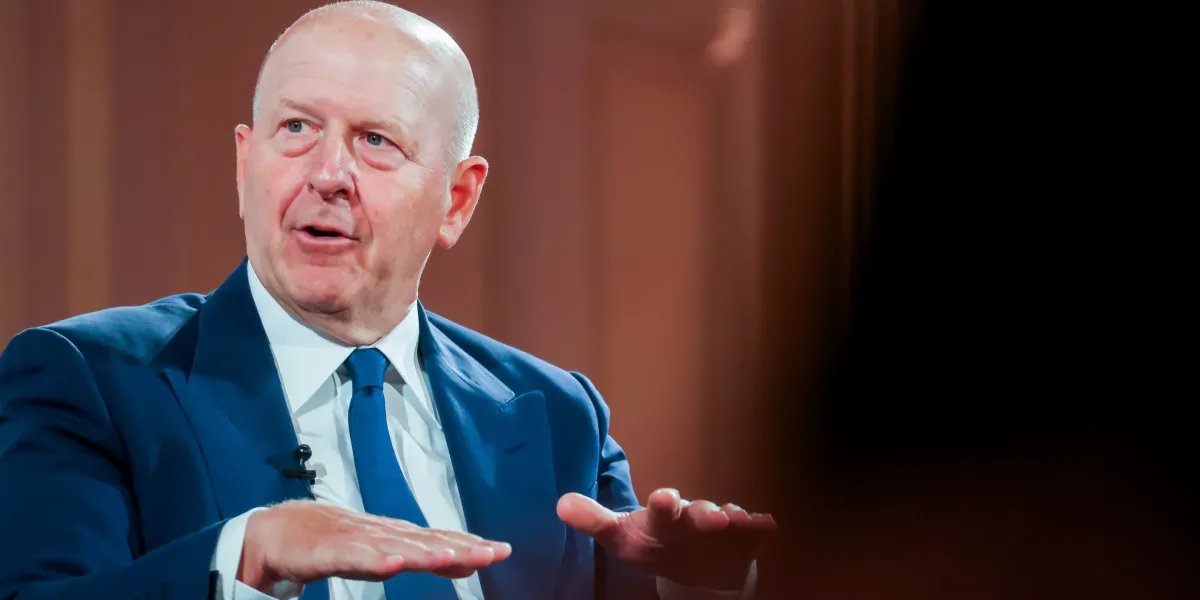
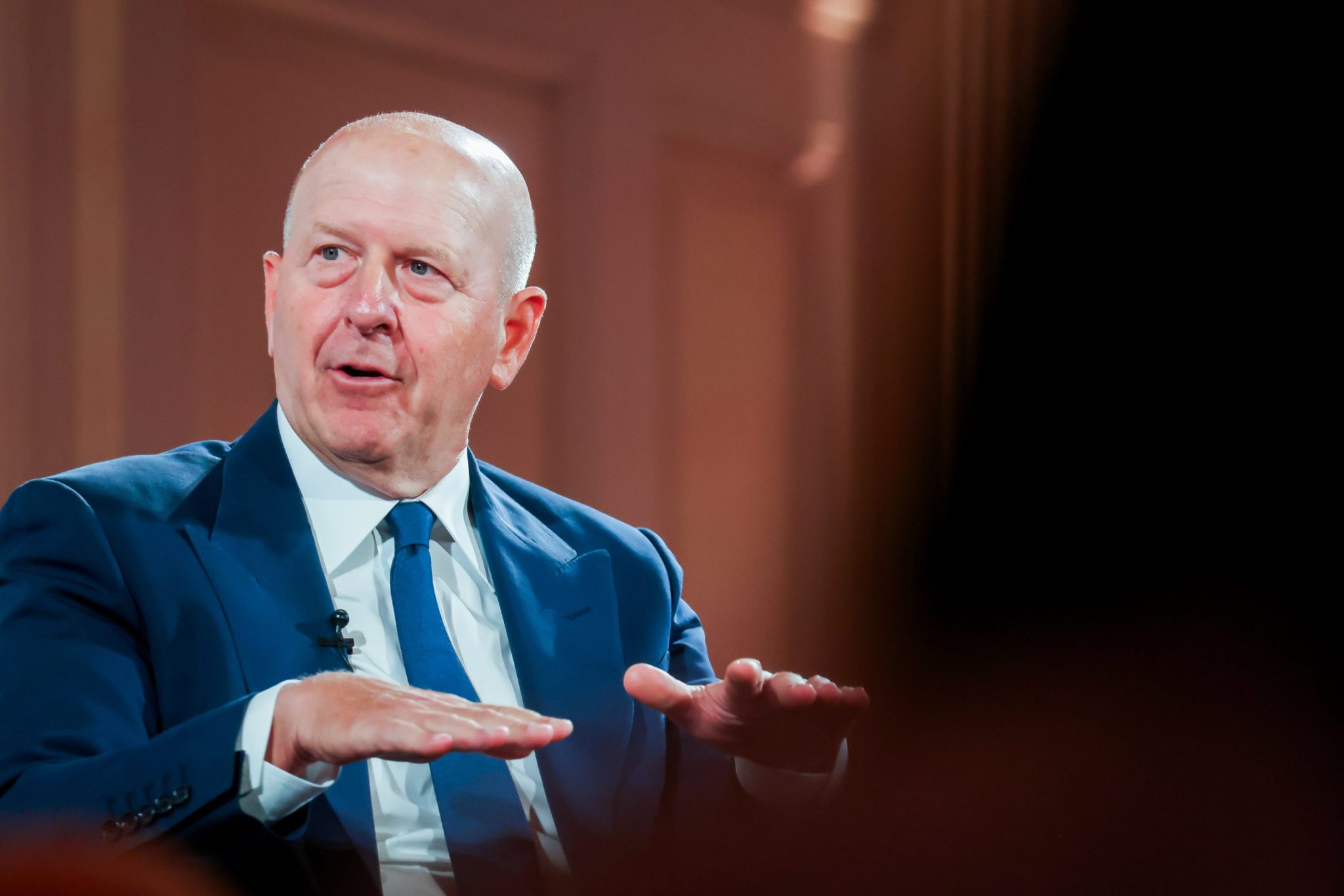
Goldman Sachs CEO David Solomon says artificial intelligence will “probably” reduce the number of people his firm hires in the coming years. His 2026 intern class tells a more complicated story.
The bank accepted fewer than one in 100 applicants for its summer internship program this year, maintaining a sub-1% selection rate for the third consecutive year, according to data shared exclusively with Fortune. The class of 2,500 interns — drawn from more than 500 universities, representing over 90 nationalities and speaking 70-plus languages — arrives at Goldman at a moment when its chief executive is publicly wrestling with one of Wall Street’s most consequential questions: what does the rise of AI mean for young workers?
“You’re going to see nuanced changes that probably to some degree reduce the number of people that we start with over the next few years,” Solomon said in a recent appearance on Bloomberg’s Odd Lots podcast. “But probably not what you and I would call dramatically.” He added: “We’re still going to hire a lot of people out of school.”
The intern class data reflects that commitment. In July, Goldman will bring on approximately the same number of permanent new hires as interns — another 2,500 or so entry-level employees across client-facing, operational, and technology roles. That figure is lower than the 3,000-plus the firm was running in 2021 during the pandemic hiring surge, but consistent with Goldman’s pre-COVID baseline, Solomon noted.
A representative for Goldman told Fortune that Solomon’s comments on Odd Lots weren’t referring to this year in particular but the potential impact of hiring in the next couple years, although the intern class for 2026 is smaller by about 100 from last year’s acceptance of 2,600.
The profile of who’s getting in has evolved alongside the numbers. Goldman disclosed to Fortune that this year’s class includes more than 30 elite athletes — among them a three-time Olympian — nearly 50 musicians, and close to 20 nonprofit founders, signaling a deliberate push by Goldman to recruit beyond the quant-heavy, target-school pipeline that has long defined Wall Street’s talent funnel.
Jacqueline Arthur, Goldman’s head of human capital management, told Fortune that this reflects a deliberate approach to hire beyond the bank’s traditional pipeline. She said Goldman has a “longstanding belief” that “talent shows up in many different forms” and the bank has always looked beyond traditional markers in hiring.
“Different ways of thinking strengthens conversations, how we challenge ideas, and ultimately how we serve our clients,” Arthur said. “What’s changed is the richness of the talent we see. We’re meeting individuals with a wider range of academic backgrounds, lived experiences, and ways of thinking. It allows us to better understand the full person behind the application — and gives candidates a clearer view of the firm and where they might contribute.”
Selective stretch for Goldman
Recent history puts Goldman’s selectivity in some more context. Last year, the bank received a record 360,000-plus applicants — a 0.7% acceptance rate that Goldman called the most competitive intern class in its history. The 2024 class drew 315,126 applications for a 0.9% rate — the first time Goldman had fallen below 1%. A decade ago, the acceptance rate was approximately 5%. The bank declined to share the number of applicants or exact acceptance rate for 2026, except to note it was under 1% yet again.
“I think the selection rate speaks both to the strength of the opportunity and the caliber of talent we’re attracting globally,” Arthur said. The bank doesn’t see interns as temporary hires, but as future leaders of the firm, she added, noting that roughly 40% of partners began as campus hires.
Another question hanging over this class is not so much who got in — it’s what they’ll actually do once they arrive. “Interns contribute meaningfully,” according to Arthur, and the bank therefore gives them high-quality work, access to mentorship, and consistent feedback and coaching.
Solomon, who penned a recent New York Times op-ed titled “I’m the CEO of Goldman Sachs. The AI Job Apocalypse Is Overblown,” has been unusually candid about the challenge of training a generation of bankers who may never need to do the grunt work that shaped his own career. He recalled spending six hours as a young analyst manually constructing stock comparison charts using microfiche and graph paper — a process that now takes seconds.
“The real challenge for us is we’ve got to find ways to apprentice them and teach them a variety of things that they’re not going to intuitively learn, because they don’t actually have to work as hard to get the answer,” Solomon said.
His solution is less about protecting junior roles from AI and more about redirecting them. Rather than having young analysts churn out PowerPoints overnight, Solomon said he wants them in front of clients faster.
“One of the great opportunities we have with this technology expansion is to get our young people out with clients, talking to clients, broadening our client footprint,” he said. “They’re incredibly capable.”
Arthur likewise told Fortune that many technical skills can be taught and developed, but “what’s much harder to instill are qualities like judgment, adaptability, and critical thinking.” As AI and advanced tools become more integrated into how we work, she noted that technical fluency is increasingly common among candidates, and while that is welcome “the real differentiator is how you apply those tools. “Judgment, context, and the ability to think critically have become even more important.” Goldman’s 2025 intern class, she added “interestingly” believed that skills such as emotional intelligence, leadership and creative thinking remain essential and irreplaceable.
It’s a vision that reframes AI not as a headcount threat but as a forcing function — one that compresses the traditional analyst grind and accelerates the timeline for meaningful client exposure. Whether that trade-off ultimately produces better bankers, or simply fewer of them, may be the defining talent question on Wall Street for the next decade.
For now, the numbers suggest Goldman isn’t pulling back. A sub-1% acceptance rate, held for three straight years, is more selective than Harvard, MIT or Stanford, all of which admitted between 3% and 4% of applicants in their most recent cycles. Getting into Goldman’s summer program has, statistically, never been harder.
For this story, Fortune journalists used generative AI as a research tool. An editor verified the accuracy of the information before publishing.