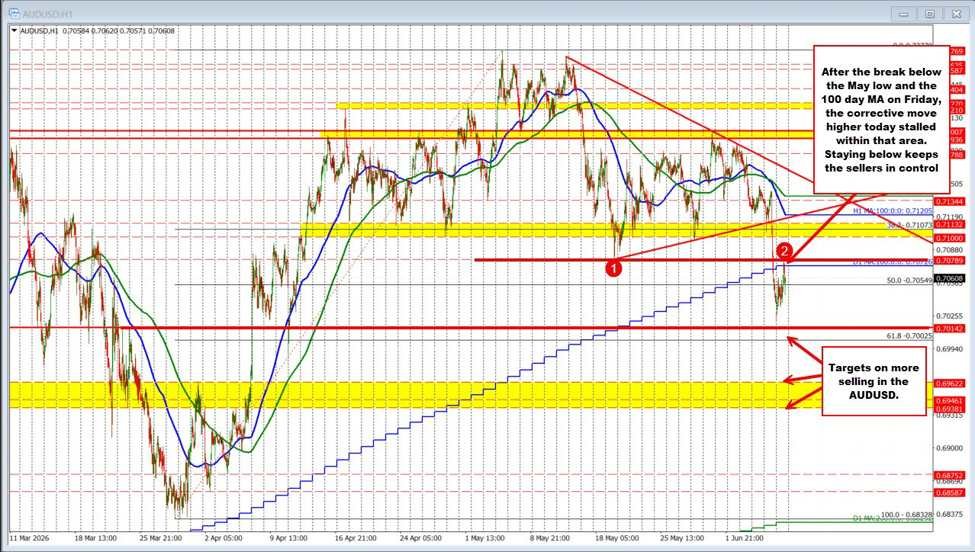
The AUDUSD moved sharply lower on Friday, pressured by risk-off sentiment, a broadly stronger U.S. dollar, and a deterioration in the technical picture. The selling accelerated after the pair broke below a key swing area between 0.7100 and 0.7113, and then fell beneath its 100-day moving average, a level that had held since November 2025. The 100-day moving average currently comes in at 0.7073.
The decline extended to a low of 0.7019 before buyers stepped in as U.S. stocks reversed higher and Treasury yields moved lower. That rebound lifted the AUDUSD back above the 50% retracement of the rally from the late-March low to the early-May high at 0.70549, and briefly pushed the pair back above its 100-day moving average.
However, the recovery lacked follow-through. The rally stalled just short of the former May low at 0.70789, with the high reaching only 0.7077. Since then, the pair has rotated lower and is once again trading around the 50% retracement level.
From a technical standpoint, the inability to reclaim and hold above the 100-day moving average keeps the sellers in control. For buyers to regain the upper hand, the price needs to move back above that moving average and remain there. Until then, rallies are likely to be viewed as corrective within a broader bearish shift.
On the downside, the next target zone comes in between 0.7002 and 0.7014. A break below that support area would increase the focus on the 0.6938 to 0.6962 region.
One factor supporting the rebound case is the improvement in risk sentiment. U.S. equities have extended their gains, with the NASDAQ up 466 points, or 1.81%, at 26,175, and back above its 200-hour moving average at 26,081.76. That is typically a positive backdrop for the Australian dollar and could encourage additional risk-on flows into the AUDUSD.
However, despite the strength in equities, the AUDUSD has been unable to generate a sustained rally. That relative underperformance suggests sellers remain active, and reinforces the importance of the 100-day moving average as the key line separating a deeper recovery from a continuation of the recent decline.