As Pope Leo XIV prepared last month to issue a major statement about the perils of artificial intelligence, he briefly turned his attention to an evening WhatsApp message about a car part.
One of the pope’s close friends, Armando Jesús Lovera, had sent Leo an image of a flashing sign on his car’s dashboard warning about the state of the vehicle’s catalytic converter.
“What’s going on with the Citroën?” the pope texted back.
“It’s dying,” Mr. Lovera responded.
“Is it running or is it stopped somewhere?” the pope asked.
Mr. Lovera informed “Bob” — the name he uses for the pope in his contacts — that he was on the way back to his home city in Spain after an event to promote his new book, “From Roberto to Leo,” about their friendship.
“How much further do you have?” the pope asked, in an exchange Mr. Lovera showed me on his phone. Then the pope implored his friend to “keep a close eye on the engine temperature” and to “drive carefully.” Finally, the Holy Father signed off with a word of fatherly advice to Mr. Lovera, an editor at a Catholic publishing group, whom he has known for decades.
“Sometimes at low speed it doesn’t run well,” the pope wrote. “But at a higher speed, the oil flows normally.”
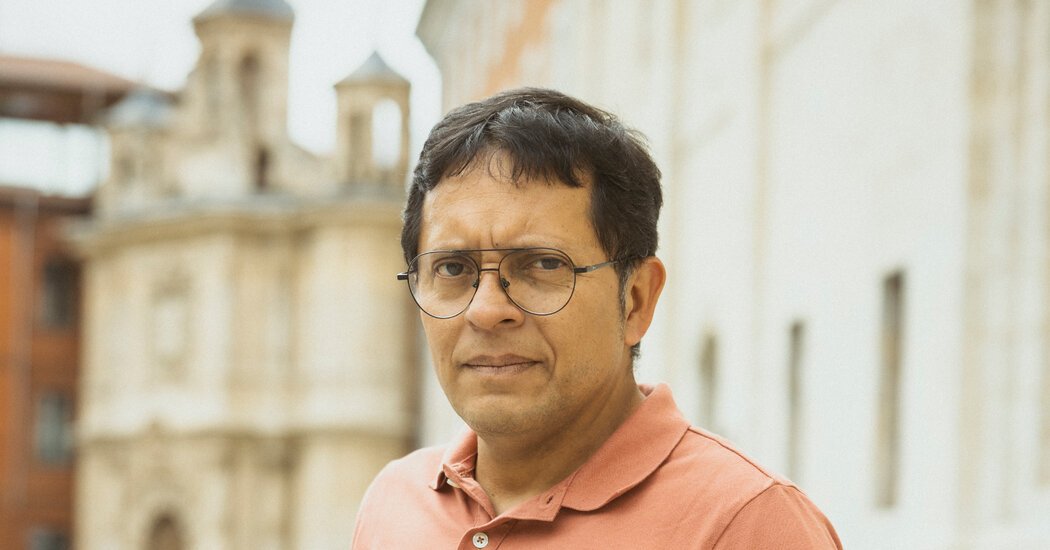
Mr. Lovera, 52, and Pope Leo, 69, have been close friends since they lived together for seven years in Peru, in a formation house, a live-in community for Catholics considering a life dedicated to the faith. Leo, then a missionary priest known by his pre-papal name of Robert Prevost, ran the house.
Over the decades — as Mr. Lovera moved to Spain and Mr. Prevost became a bishop, cardinal and then Pope Leo — the two have stayed tight.
Mr. Lovera and his family visited the pope for five days in July and they will join the pope again in Rome this August, Mr. Lovera said.
“To play tennis,” he said, “to feed the fish.”
This past weekend, as Leo began his weeklong visit to Spain with a tight schedule of events, he found time to send his old friend a greeting in a text message. “We said hello,” Mr. Lovera said.
Originally from a Roman Catholic family in Iquitos, a town in the Peruvian part of the Amazon, Mr. Lovera moved to Colombia with the goal of becoming an Augustinian missionary. There, in 1991, he first met the man who would become Leo; soon after, Mr. Lovera moved with other Augustinians into the formation house, in Trujillo, Peru.
Leo taught the small, tight-knit group spiritual exercises and also how to manage money — “because you cannot give what you don’t have,” Mr. Lovera said, in an interview at the vast Augustinian headquarters in Valladolid, the city where he lives, a two-hour drive north of Madrid.
“He used to tell me that a community isn’t made of superheroes, but of brothers who decide together what is best,” Mr. Lovera added.
The two shared a love of music, mathematics and long road trips.
“We’ve been travel buddies,” said Mr. Lovera, who became the group’s driver even though he didn’t have a driver’s license. The future pope filled their long hauls with car talk, expounding on how to drive cars through flooded streets. When he once spent the night at the Lovera family’s modest home, they had no bed to offer him, only a sofa.
It was so hot and humid that the future pope elected to sleep in a rocking chair. “My mother was dying of embarrassment,” Mr. Lovera recalled.
Leo left Peru in 1999 after being elected to lead the Augustinian Order in the Midwest, and soon after, Mr. Lovera decided to leave the missionary track. Community living, he decided, wasn’t for him, and he wanted to do more to protest against the economic policies of the Peruvian government at the time. He also didn’t take well to an order to travel to Rome to study the teachings of St. Augustine: “I wanted to be more independent,” he said.
Mr. Lovera said that Leo had talked to him about the change and that, instead of giving him a teacher’s lecture, had offered a friend’s understanding.
“Don’t feel obligated,” Mr. Lovera recalled his friend telling him, emphasizing that a holy life could be lived in different ways. Mostly, Mr. Lovera recalled, they joked about the Y2K bug that people at the time feared would wipe out the world’s computers at the turn of the millennium.
Soon after, Mr. Lovera moved to Spain for a job with a Catholic publisher. Leo later became the global leader of the Augustinian Order, a job based in Rome that required constant international travel, including to Spain, where he visited Mr. Lovera.
Mr. Lovera would often visit Chicago and catch up with the future pope’s family, including Leo, who happened to be there in November 2004. At that meeting, Mr. Lovera told his friend about a young Peruvian woman in Spain who had caught his eye. But when he had asked her out, Mr. Lovera explained, she had told him only that she would think about it — and mentioned a teddy bear that she coveted.
“I told him, ‘I have to find a teddy,’” Mr. Lovera recounted. The men hit the road, driving to malls looking for the right stuffed toy, finally finding what Mr. Lovera was looking for in a Target near New Lenox, Ill.
Back in Spain, the woman accepted the gift, but initially rejected Mr. Lovera. He persisted, though, and they eventually married in a civil ceremony with the future pope as their witness.
In 2010, Leo landed in Spain for meetings with Spanish Augustinians and Mr. Lovera picked him up at the airport. It was the day of the final of the soccer World Cup and the future pope — a professed Real Madrid fan — decided that they should pull over to watch the match. In a pizza bar, they watched Spain defeat the Netherlands with a late goal in overtime and both men chanted, “I am Spanish” with the crowd, Mr. Lovera said.
For Mr. Lovera, the pope was his co-pilot. In 2012, for instance, Leo drove with Mr. Lovera to check out a house in Valladolid that Mr. Lovera and his wife wanted to buy. “I have never stopped consulting him,” Mr. Lovera said.
In December 2013, after the Loveras’ civil wedding, Leo married the couple in a church in Trujillo, and he later traveled to see them after the birth of their two daughters, whom he baptized. The girls, now 9 and 11, don’t quite understand that he is pope, Mr. Lovera said, and “see Roberto as part of the family.”
Once they reached school age, Mr. Lovera began to call his friend from the car when driving to pick the girls up from school, he said. When Leo became pope, those frequent calls became texts, but they remained in regular contact, Mr. Lovera said.
Last May, he asked the pope’s permission to write a book about their friendship, and the pope approved. “I trust you. You are my friend,” the pope said, according to Mr. Lovera.
In October, they posed together with the published book, which highlights their efforts to build solidarity among marginalized Peruvians in a time of upheaval.
Last month, Leo mentioned to Mr. Lovera that his brother, John Prevost, still called the pontiff from Chicago for I.T. support.
“And Roberto says, ‘John, I’m the pope,’” Mr. Lovera recalled.
“‘Oh, sorry, pope,’” the pope’s brother responded, according to Mr. Lovera. “‘My computer is broken.’”
On his own calls to the pope, Mr. Lovera said that he didn’t talk about tech or politics or about the church’s future. Instead, he said, “I talk about cars!”