You might recognize Midway, Utah, as the storybook backdrop to Hallmark Christmas movies like “Christmas on Duty.” If you’re from Utah, you might recognize it as the village that looks transplanted from the Swiss Alps, complete with a glockenspiel clock warbling hourly from the town hall.
But if you’re a woman with any degree of susceptibility to gingham aprons, hand-hewn sourdough knives, milk cradling a thick layer of cream, enamel candlestick holders or highly realistic, highly cute asparagus-shaped candles to go in the candlestick holders, you might know Midway for another reason. You might know it as the home, however reluctant, of the Ballerina Farm Store.
Ballerina Farm, which supplies the store, is a working farm about half an hour’s drive away from Midway through the snow-frosted mountains and cow pastures of rural northern Utah. But it’s also a woman — the incarnate imagination of 35-year-old Hannah Neeleman, a Juilliard-trained ballerina who gave up dancing to become a farmer and mother of nine.
Ballerina Farm is the brand she built atop warmly lit videos of herself pulling off wholesome culinary feats, like feta from milk she milked herself, often in a prairie dress, usually with several blond children underfoot, always near her vintage-looking cast-iron Aga stove.
And, fairly or not, Ballerina Farm has become a byword for a certain kind of influencer at the center of an impassioned debate over what a woman should be. She has 23 million followers across TikTok, Instagram and YouTube, and many of them seem to roundly dislike her. Her, or what they think she stands for.
Settled by Swiss converts to Mormonism in the 1800s, Midway doesn’t do well with change. When Main Street’s first and only stoplight appeared some years ago, “it was like the world was coming to an end,” said Jennifer Mangum-Whaley, 56, an interior designer who also owns Midway’s year-round Christmas store.
When she heard the Ballerina Farm Store was coming to town, Ms. Mangum-Whaley checked out the company’s farmstand. “There were teens in line like it was Disney World,” she said. “I was like, ‘What is this?’”
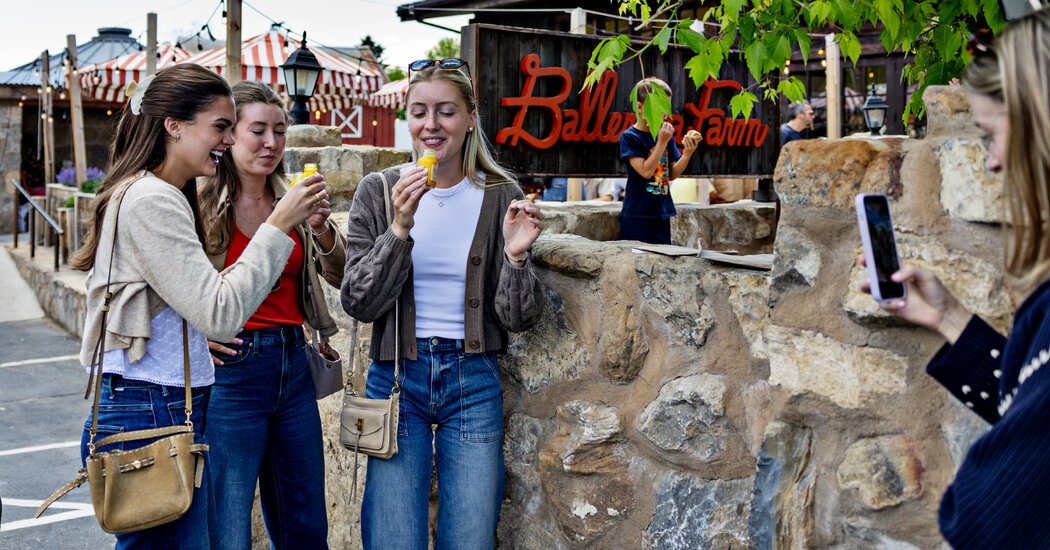
For some in Midway, Ballerina Farm Store’s opening last July has been nothing short of another traffic-related apocalypse. Droves of young women in long dresses and cowboy boots began lining up for soft serve made with Ballerina Farm’s signature vanilla-flavored protein powder and strawberry whey lemonade, treats many immortalized on TikTok or Instagram before eating. Cars jammed the streets. Neighbors fortified the block against interlopers with traffic cones and signs warning, “Resident Parking Only.”
As the national birthrate declines, Trump administration officials and their allies have attacked feminist gains and urged women to embrace family over career. To liberal feminists concerned that “tradwife” influencers exalt so-called traditional gender roles, Ballerina Farm is to such regressive family values what Midway is to Christmas: an embodiment so picture-perfect, Hallmark itself couldn’t do better.
Yet around Midway, a trajectory that dumbfounds some faraway viewers — she danced at Juilliard, and now she’s milking a sheep? — sticks out much less.
Many families, like the Neelemans, are Mormon. Plenty have a farming connection. Mercedes Sprinter vans loom from some driveways. They can seat families of up to 15.
“Growing up here, it’s like, you’re supposed to want to be a mom, you’re supposed to want to be a wife,” said Ella Eggertz, a Utah Valley University freshman from Midway, who, without husband or baby, feels “like a spinster” at 19.
But Utah, and its expectations, aren’t forever. “We’ll get out someday!” she said, laughing. “I want a career.”
Neither is it unusual in Utah to parlay one’s family and domestic skills into an influencing career, and then a brick-and-mortar store. Midway is also home to the Dainty Pear, a country-chic emporium stocked with French soaps, gourmet tinned fish and Bibles, owned by the local influencer Sarah Clark. The Food Nanny, by Lizi Heaps, another Utah food influencer, is also opening a Midway location.
“For sure, the per-capita tradwife numbers have gone up,” said Lindsey Leavitt, 45, a co-owner of Folklore, a progressive bookstore in Midway.
But for all the traffic (which Ms. Neeleman denied was caused by Ballerina Farm), Ms. Leavitt said, the store has helped draw tourists and day-trippers. “They’ve made me a crapload of money, and I’m very grateful for that,” she said.
Among the many criticisms of Ms. Neeleman is that she sells young women on a vision of stay-at-home motherhood that only a thin, white, beautiful woman could glamorize, and only a woman of means could attain. Her husband’s father founded JetBlue, as her detractors are quick to point out.
In an interview, Ms. Neeleman said she and her husband, Daniel Neeleman, had received no financial help from family, saying they had worked hard, through “extremely difficult” years, to build their farm.
Yet if her content is meant as pronatalist propaganda, which she denies, most of the women interviewed around the store were no converts. They said they had no illusions about the work and extra help nine children probably required behind the scenes, the movie magic enhancing her videos or the fact that, despite appearances, she had a paying job.
Some fans weren’t sure if they wanted children. Those who did said they wouldn’t raise them full-time, wanting at least a part-time job. And while a few of those with children said she made them feel inadequate by comparison, most said they admired her for being not only a mother, but also a businesswoman — one who used content creation to stay home while working.
“I think it’s great,” said Lori Rutland, 57, the owner of the local Rocky Mountain Chocolate Factory. “It’s the American dream, and she doesn’t even have to leave her house.”
But, she added, “it’s not attainable for the average person.”
Abbey Wood, 29, a barista at a nearby restaurant who left the Mormon Church as a teenager, said she understands the liberal critique — fueled by a 2024 Times of London profile that depicted Ms. Neeleman as submitting to her husband’s every wish — that Ms. Neeleman is “entrapped, and it’s like indentured servitude,” Ms. Wood said.
Ms. Wood was personally “very committed” to working until retirement. Still, something about Ballerina Farm spoke to her, and not only the good prices on the grass-fed ground beef she buys there.
“I live my whole life on a time clock,” she said, so homemaking “has become a very big fantasy or a dream for me.”
She added: “It does seem like a luxury, too. Almost kind of fanciful, in this economy, in 2026.”
Her ambivalence was mirrored in a King’s College London survey last year of young British women, a rare academic examination of tradwife popularity. It found that young women watched such content not because they embraced traditional gender roles, but because it offered an escape from the impossible-seeming grind of juggling work and family.
Bridgett Sorto Ayala, 23, who was visiting the store from Las Vegas, does not want children. But she said the pressures of a full-time career, especially with a family, hardly seemed better than stay-at-home motherhood.
“Maybe neither side has a good answer, because there isn’t one,” she said.
Ms. Neeleman says she found a good answer in her husband, and in farming.
Ballerina Farm combined her husband’s passion for agriculture with hers for healthy food and raw milk, she said, and allowed them to spend their time together as a family instead of having separate careers.
“We’re equally yoked in parenthood and business,” she said.
Ms. Neeleman said she thought women should pursue whatever path God set for them: work, motherhood or both. She herself identifies “first and foremost” as a wife and mother, she said, one who has written, “I want to put food on the table that makes my children happy and keeps my husband giving me the wink.” But, she said, she and her husband were both “going a million miles an hour” realizing their business ambitions.
“It’s an exciting time for women,” she said. “If you want to do multiple things, I think there is opportunity for that now, the first time really ever, which is amazing.”
It’s certainly an exciting time to be a woman in the business of analog, bucolic nostalgia. Post-pandemic, pre-MAHA America was rapidly smitten with Ms. Neeleman’s live-off-the-land lifestyle, seemingly unadulterated by ultraprocessed snacks, a microwave or even a Whole Foods.
If Los Angeles has Erewhon, the health food store famous for its $20 smoothies featuring “colostrum, lucuma and tocos” and other meticulously curated foods that are organic, biodynamic or merely hard to pronounce, Utah has Ballerina Farm. The Ballerina Farm aesthetic — all polished, just-so sweetness, like an American Girl doll play set for grown-ups — might be different, but they share the same zeitgeisty fixation: Purify your food, purify your life.
In early May, the store was offering a special, the Pirouette, a “functional” twirl of cherries, ginger, beets, strawberries, dates and whole milk from Ballerina Farm cows “layered with Vanilla Bean Farmer Protein yogurt and marbled with a shot of extra-virgin olive oil” ($11). Tubs of beef tallow sat near housemade ketchup, a $150 wooden egg tray and 2020s gourmet-grocery staples like chili crisp and harissa.
Kelsea Palmer, 29, who was visiting with two of her sisters, home-schools her four children, makes herbal tinctures, cooks from scratch and dreams of off-the-grid homesteading. The sisters, who grew up in Arizona, said they loved that Ms. Neeleman had forsaken big-city life for farming. In an individualistic culture that they felt discouraged having children, they said, it was inspiring to watch Ms. Neeleman raise hers.
“I think that trad life should be glorified more,” Ms. Palmer said. “Let’s see some positivity in being a mom.”
For some Mormon mothers, raised to value stay-at-home motherhood, Ms. Neeleman and influencers like her had succeeded in making their unpaid, unseen labor paid and seen.
“It’s the first profession where women can out-earn men,” said Tiffany Rosenhan, a Utah novelist who had four children by 29 before turning to writing. “It’s the coolest thing to happen to women in a very long time. It gives them freedom to leave their husbands and feed their children.”
But, she added, “the illusion that women do it without help is where the harm is done.”
It’s a vision of individual empowerment that some of Ms. Neeleman’s critics say does nothing to change the odds stacked against American women, including the lack of paid leave policies and affordable child care.
When asked, Ms. Neeleman declined to discuss how much household help she has. A public relations representative intervened to say that Ms. Neeleman, whose posts regularly feature her children, wanted to keep details of her children’s lives private.
The airbrushing of everyday challenges was what made Gabby Doe, 25, a teacher in nearby Park City, reluctant to shop at Ballerina Farm.
“It’s all publicity and branding and sets an unrealistic expectation of what farm life is,” said Ms. Doe, who has experienced the unpicturesque dirt of her sister’s organic farm firsthand. “It really gets me.”
Yet there she was with a friend, browsing the store’s farm-grown vegetables. “I’m guilty of it, too,” she said, laughing. The food, after all, was local. It was fresh. And it was good.