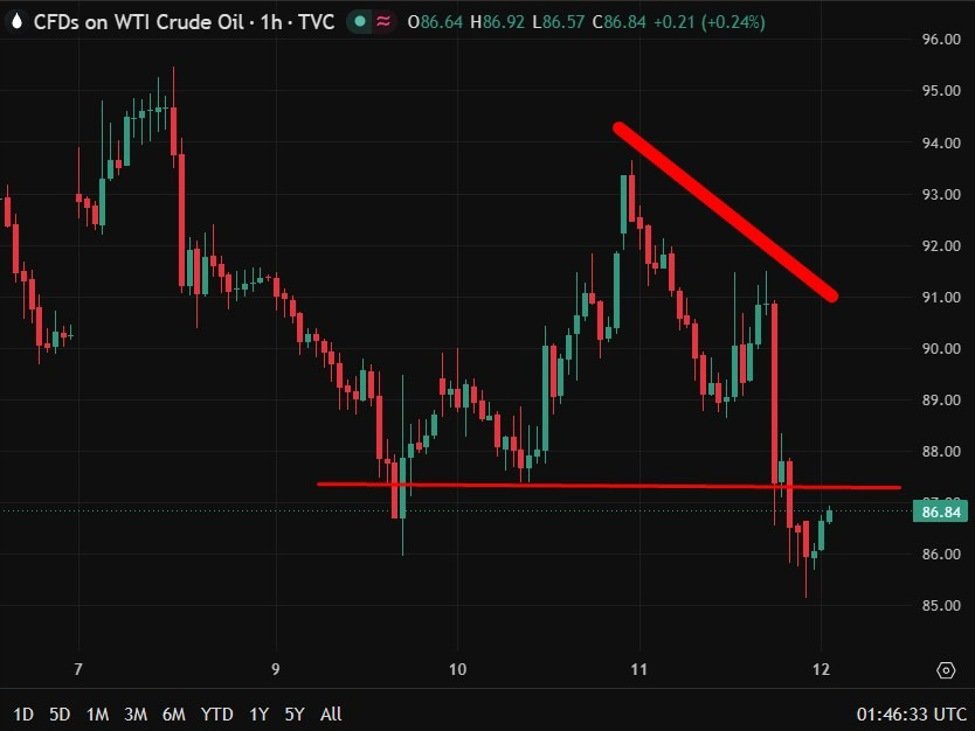
The statement reads primarily as posturing aimed at domestic and regional audiences, asserting strength rather than explicitly rejecting any deal. Still, the rhetoric of continued strikes and a closed Strait of Hormuz reinforces the disconnect between Washington’s framing of an imminent agreement and the security situation on the ground. For oil markets, the signal is one of leverage-building ahead of any signing, not necessarily a breakdown, though the tone leaves room for further volatility if read as hardening Iran’s negotiating position.
–
Iran’s IRGC said the country is stronger than ever and ready for a “decisive, regret-inducing” response to any aggression, citing recent strikes on US bases and the closure of the Strait of Hormuz.
Summary:
Source: IRGC statement
- The IRGC said Iran is in a stronger, more prepared and more deterrent position than ever, with “fingers on the trigger” for any aggression
- The statement marks the anniversary of Operation True Promise 3 and the “Second Imposed War” beginning February 28
- IRGC and Iranian military say they struck 18 US targets in the past 24 hours, including airbases in Kuwait and Bahrain
- Iranian Army drones reportedly hit the US Fifth Fleet headquarters in Bahrain
- IRGC says it launched 12 ballistic missiles at the US-operated al-Azraq air base in Jordan, targeting F-35, F-15 and F-16 facilities
- Iran reiterated the Strait of Hormuz is closed to all vessels, citing regional insecurity from US aggression
- Statement framed recent operations as shifting the regional balance of deterrence in Iran’s favour
Iran’s Islamic Revolutionary Guard Corps issued a statement on Thursday asserting that the country is now in a stronger, more prepared and more deterrent position than at any point previously, saying it maintains full intelligence dominance over enemy movements and remains ready to deliver a “decisive, immediate, painful and regret-inducing response” to any aggression.
The statement, marking the anniversary of what Iran terms the “Second Imposed War” that began on February 28, came alongside claims of significant recent retaliatory action. The IRGC and Iranian military said they struck 18 US targets across the region in the past 24 hours, including airbases in Kuwait and Bahrain, while drones reportedly hit the US Fifth Fleet headquarters in Bahrain. Separately, the IRGC said it launched 12 ballistic missiles at the US-operated al-Azraq air base in Jordan, targeting facilities housing F-35, F-15 and F-16 fighter jets.
Iran also reiterated that the Strait of Hormuz remains closed to all vessels, citing regional insecurity caused by what it described as US aggression, with the IRGC Aerospace Force commander warning against any attempt to threaten the waterway.
Rather than an explicit rejection of any prospective deal, the statement reads as an assertion of leverage, framing Iran’s recent military actions as evidence the balance of deterrence has shifted in its favour, ahead of any potential signing.