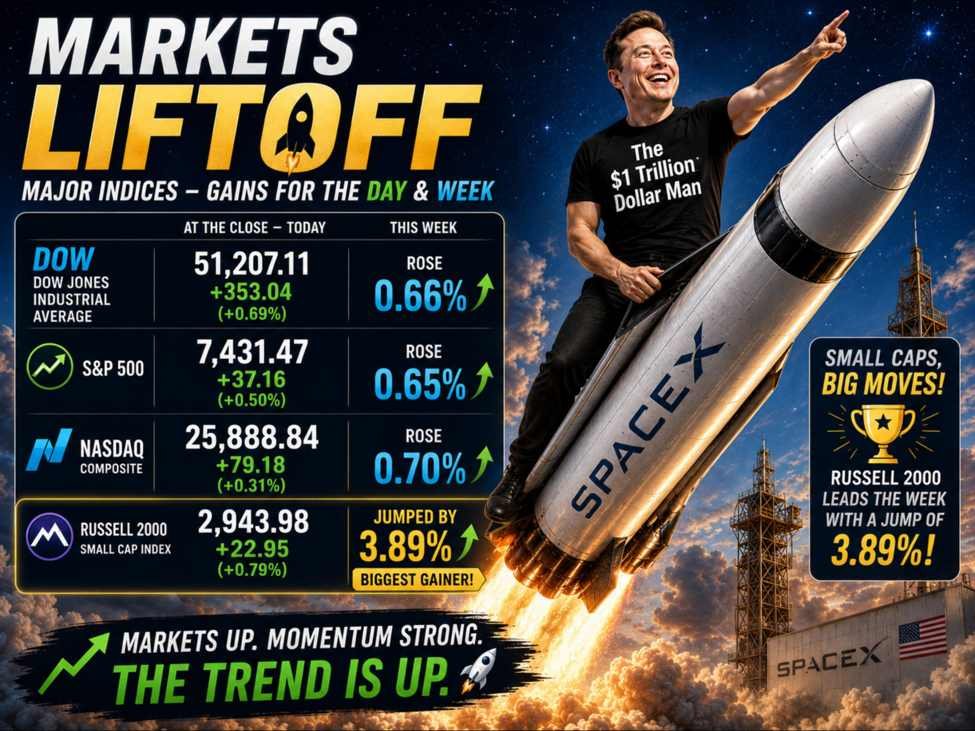
The major stock indices all closed higher on the day helped by the the framework for a deal between Iran and the US/Israel.
Reports indicated that the United States, Iran, and Pakistan have made significant progress toward a peace agreement aimed at ending the conflict, with negotiators suggesting a framework deal is close at hand. Any initial agreement would serve as a starting point for what are expected to be lengthy and complex nuclear negotiations in the months ahead.
As part of the proposed framework, Iran would commit to foregoing the development of nuclear weapons and would agree to eliminate its stockpile of highly enriched uranium.
However, the plan has yet to receive formal approval from key Iranian security and military factions, including influential elements within the Islamic Revolutionary Guard Corps.
SpaceX’s successful $75 billion (and record) IPO also help to the positive tone. The shares are priced at $135 to raise $75 billion. The price closed the day at $161.11, with a high of $176.52, and a low at $149.34. The initial trade was at $150.
Looking at the major indices:
- Dow Jones Industrial Average: 51,207.11, +353.04 points (+0.69%)
- S&P 500: 7,431.47, +37.16 points (+0.50%)
- Nasdaq Composite: 25,888.84, +79.18 points (+0.31%)
- Russell 2000: 2,943.98, +22.95 points (+0.79%)
For the trading week:
- Dow Jones Industrial Average rose 0.66%
- S&P 500: rose 0.65%
- Nasdaq Composite: rose 0.70%
- Russell 2000: jumped by 3.89%
The leadership from the Dow Jones Industrial Average and the Russell 2000 suggests investors were willing to broaden their exposure beyond the mega-cap technology sector, although the Nasdaq still finished the day in positive territory. The gains point to improving risk sentiment and a willingness to look beyond the narrow group of AI and technology leaders that have driven much of the market’s advance.
Looking ahead to next week, investors will be focused on developments in the Middle East, movements in Treasury yields, and, most importantly, Wednesday’s Federal Reserve rate decision. The Fed is widely expected to leave interest rates unchanged, but traders will be paying close attention to the tone of the statement and Chair Kevin Warsh’s comments. If policymakers gain confidence that inflation pressures are easing, particularly with energy prices retreating, the market may interpret the Fed’s stance as incrementally more dovish, providing further support for risk assets.
Energy prices have already begun to move in that direction. Crude oil fell 6.5% this week and is now down nearly 29% from its early-March peak. National average gasoline prices have eased to around $4.10 per gallon, down from highs near $4.55. While prices remain above the $3.12 level seen a year ago, the recent decline is a welcome development for consumers and policymakers alike. Notably, crude oil was trading near $60 per barrel at the onset of the Middle East conflict and, despite the recent pullback, remains elevated at roughly $84.40. Continued declines in energy prices could help reinforce the narrative that inflation is moving lower and lessen pressure on the Federal Reserve in the months ahead.
Several stocks posted impressive gains this week, with technology and semiconductor-related names leading the advance as investors continued to favor AI, data center, and chip infrastructure themes.
SanDisk was the week’s top performer, surging 26.9%, as investors continued to bet on improving memory demand and a stronger outlook for storage-related products. Intel rallied 25.6%, extending its recent rebound amid optimism surrounding its restructuring efforts, foundry business, and the broader recovery in semiconductor stocks.
Chip equipment maker Lam Research climbed 20.9%, benefiting from continued strength in semiconductor capital spending, while Micron gained 13.6% for the week despite a modest decline on Friday. Investors remain focused on robust demand for high-bandwidth memory used in AI applications. Similarly, ASML rose 13.5% as demand for advanced chip-manufacturing equipment remains strong.
The AI trade also fueled gains in Arm Holdings, which jumped 11.1% on Friday alone and finished the week up 11.0%. The company’s chip architecture remains at the center of next-generation AI and mobile computing developments.
Outside of technology, there were signs of improving risk appetite and consumer confidence. Macy’s advanced 14.5%, while Target gained 10.3%, suggesting investors were willing to look beyond technology and into beaten-down retail names. In the consumer discretionary space, Shake Shack rose 11.3%, and SharkNinja added 11.7%.
Travel-related stocks also participated in the rally. American Airlines climbed 10.9% and Alaska Air gained 10.5%, helped by easing energy prices and hopes that lower fuel costs could provide a tailwind for profitability.
Meanwhile, Robinhood Markets continued its strong momentum, rising 12.9% for the week as trading activity and investor interest in financial technology names remained robust.
The common theme among many of the week’s biggest winners was a renewed appetite for growth and cyclical stocks, with semiconductor, AI, travel, and consumer-discretionary names attracting the bulk of investor interest.