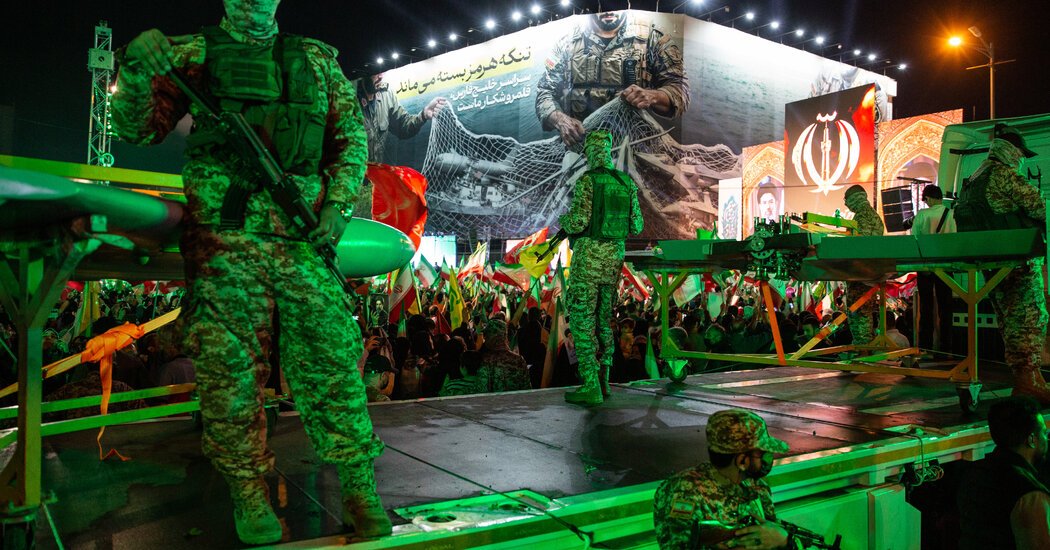
The United States and Israel went to war in Iran seeking regime change. Nearly four months later, there has been regime change, but not the kind they wanted. The Islamic Republic 3.0, as some call it, is now less a theocracy and more a military junta dominated by the powerful Islamic Revolutionary Guards Corps.
Washington and Jerusalem also went to war to eradicate Iran’s nuclear program and end the threat it poses. So far, this conflict has only produced a wounded Iran more willing to take risks and more likely to persist in its goal of advancing its nuclear program.
The United States and Iran traded blows this past week while trying to find a path toward settling the war. By Friday, despite accusations of duplicity from both sides, officials in Tehran and Washington said they were closing in on a deal, while emphasizing that an initial agreement, known as a memorandum of understanding, had not been finalized. Iran’s foreign minister, Abbas Araghchi, said that an agreement had “never been closer.”
Even agreement on the memorandum will leave Tehran with some leverage, as the two sides engage in serious negotiations on Iran’s nuclear program and its future role in the Strait of Hormuz. Many details would be left to a 60-day period for negotiations, which may or may not succeed.
In the course of this war, Iran has gone from appearing weak and defenseless to a regime not only surviving, but also retaining important military and nuclear abilities. Iran’s extensive security apparatus seems firmly in control of all aspects of governing, society and foreign policy.
Iran is now led by “a younger, more brazen generation in power,” said Sanam Vakil, the director of the Middle East and North Africa program at Chatham House, in what Aaron David Miller, a former American diplomat at the Carnegie Endowment, called “a transition from divine power to hard power.”
These new leaders believe they can survive even a major renewal of fighting without significantly altering their negotiating positions or their larger regional aims. Those aims include to restore their power of deterrence so that they cannot be attacked again as they were in late February.
They also want to maintain the right to enrich uranium, even at low levels after a period of suspension, and will retain the scientific knowledge and equipment that would allow them, should they choose, to again become a nuclear-threshold state, one that would have all the elements of a nuclear weapon without having put one together.
The new Iranian government has shown itself to be a tough negotiator willing to accept a high level of pain to preserve its core interests.
This attitude is very different from the caution shown by the former supreme leader, Ayatollah Ali Khamenei, who was assassinated on the first day of the war, Feb. 28. He had for years banned the production of a nuclear weapon and always worked to avoid a joint Israeli-American attack on Iran.
Having survived the attack, Iran’s leaders no longer feel those same constraints. They are convinced, analysts say, that President Trump has no intention of restarting a full-scale war and note that he has put limits on Israel’s desire to do so. That helps explain why Iran, for the first time this week, dared to directly attack Israel after Israel bombed the strongholds of Hezbollah, Iran’s proxy in Beirut, Lebanon, which Israel had regularly done for months.
Iran’s attack on Israel was also a way for Iran to connect its demand for a cease-fire in Lebanon to the negotiations with the United States over ending the war in Iran. Israel wants to keep the issues separate.
With the new regime, objectives that the United States and Israel have not achieved through war will not be achieved through more coercion, said Ali Vaez, the Iran project director for the International Crisis Group. The Iranians believe the worst is behind them, he said. And they will work to retain their core demands — their right to uranium enrichment, their ballistic missile program and their support for their proxies, like Hezbollah, Hamas and the Houthis.
Under any deal, experts say, Iran is likely to agree to a limited suspension of enrichment, and agree that half of its current stockpile of highly enriched uranium will be exported and the other half diluted to a lower level of enrichment. But Iran would still retain its nuclear knowledge and infrastructure, including advanced centrifuges.
That, together with an ability to shut down the Strait of Hormuz again whenever it chooses, will give Iran a “card to prevent Israel and the United States from attacking again,” argued Danny Citrinowicz, a retired Israeli military intelligence officer who specializes in Iran. It will also give Iran renewed influence in the region.
“A war meant to prevent Iran from acquiring nuclear weapons will be the war that pushed them over the Rubicon,” he said.
He and others point out that before the war, Iran had offered Mr. Trump’s envoys in Geneva a better deal than it is currently offering in the nuclear negotiations with the United States.
A newly emboldened Iran is likely to press harder for its other demands.
Iran wants some $12 billion in frozen assets released up front, with another $12 billion as a later payment for progress on carrying out any deal. The Iranians want to test Mr. Trump’s willingness to face down what will be strong opposition from some Republicans and Israel about handing over money to Iran. As for the key nuclear issues, other than an Iranian commitment not to build a bomb, they are largely left for more detailed negotiations over the following 60 days.
Iran is also continuing to demand that it be able to charge ships in some fashion to use the Strait of Hormuz.
Despite its willingness to take risks, Iran wants a deal to ease the growing economic pressure in the country and to allow it to sell the oil it has been pumping but storing through the American blockade of the strait. Iran’s economy is in tatters and could produce more anti-regime protests once the war finally ends. But Iran believes that Mr. Trump is in even more of a hurry, so it has not been making the concessions Washington wants, said Ms. Vakil, the Chatham House analyst.
Iran’s long-term goals remain, she said, to prevent a future attack, to divide the Arab nations of the Gulf over how far to accommodate it, to push for the alienation of Israel among Arab states and to diminish U.S. military presence and abilities in the region. The risk, she said, is that Iran will overplay its hand and miscalculate, as it has in the past.
Even with an early deal, the analysts doubt that the negotiations will ever get to the thornier issues, like a detailed nuclear agreement, much as the Gaza agreement Mr. Trump negotiated has stalled.
“So we’re likely to be in a limbo state for a long time, which is to Iran’s advantage,” said Suzanne Maloney, an Iran specialist at the Brookings Institution. “No war, no peace is comfortable for Iran,” she said, because it will only increase pressure on Mr. Trump to take any kind of deal to free up the strait and try to restore equilibrium in the market for energy, fertilizer, aluminum and so much more.