The choreography matched what they’d practiced on the ground, thousands of feet below: The five parachutists clasped each other, let go, turned, and joined again.
Overhead, their friend, Dustin McKinney, was skydiving with a camera, getting it all on video.
It was the second jump of the day on Sunday, with many more planned. The weather was good at Skydive Kansas City in Butler, Mo., and the single-engine turboprop was ferrying jumpers into the sky one load at a time, then returning to pick up more.
Lacy Reynolds and the rest of her group landed softly and walked into a hangar at the drop zone. They shed their helmets and gloves, and laid down their parachute packs. Ms. Reynolds took off her shoes so she wouldn’t tread on her gear and damage it.
They buzzed with excitement about how well the formation jump had gone. They wanted to jump together again, but there weren’t enough spots left on the next flight. They agreed to wait until the fourth flight — except for Mr. McKinney. He was booked for a work jump to film new skydivers.
Ms. Reynolds listened to the plane take off, with Mr. McKinney inside.
In seconds, there was a boom.
To Ms. Reynolds it did not sound like an explosion, or anything high-pitched. It was a great, thunderous thud.
Skydivers meticulously perform safety routines, but the operation of the plane itself is beyond their control.
The National Transportation Safety Board has been sounding alarms since at least 2008 about what it has described as inadequate regulations for skydiving planes and their pilots. It has urged the Federal Aviation Administration to mandate rules for the industry similar to those for commercial charter flights.
“Even though passengers exercise no control over” the skydiving flights, the F.A.A. “continues to allow these flights to be conducted under less stringent regulations and with little to no oversight,” the N.T.S.B. wrote in a 2021 report.
Still, skydiving has gotten safer in recent years as it has gotten more popular, according to the United States Parachute Association. The fatality rate in 2005 was around one death per 96,000 jumps. In 2025, it was around one per 217,000 jumps.
Sixteen people died last year.
But those deaths came during jumps. Since 2020, just five people have been killed in plane crashes related to skydiving, according to the association.
On Sunday in Butler, 12 more would lose their lives.
When Ms. Reynolds heard the impact, she ran out of the hangar, her socks squelching in ground soaked from the previous night’s rain. She looked up and down the runway line, north and south. She couldn’t find the plane.
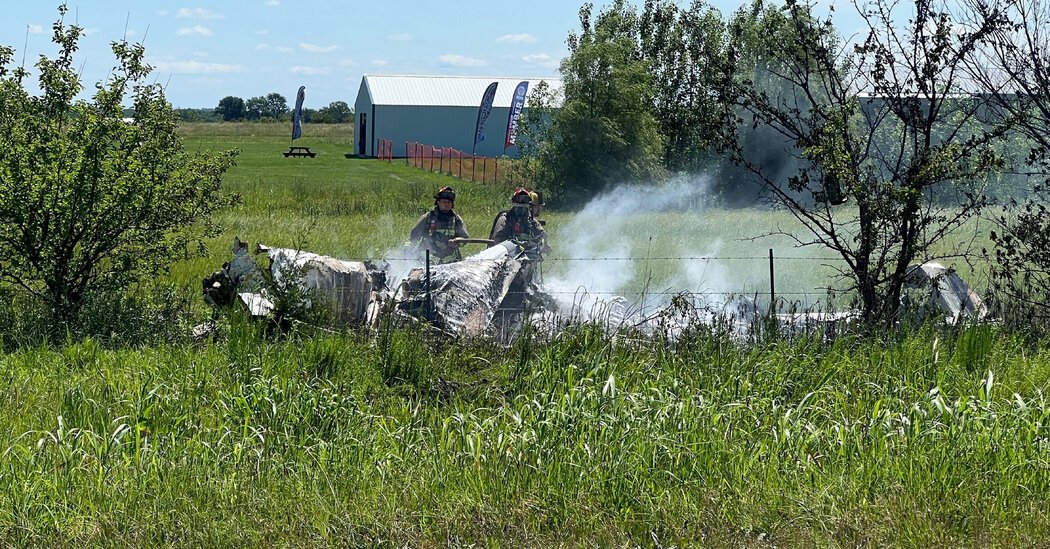
She turned around. The Pacific Aerospace 750XL was right behind her in the field, on the ground. And it was on fire.
She ran to it. She yelled, “Get out of the plane.” She cried. She fell to her knees. It was too hot to get closer.
“You could hear almost like small explosions that were happening within the plane, and every time I would hear that, I just screamed more,” she said.
Ms. Reynolds jumped for the first time on Halloween in 2021 after being talked into it by a neighbor who wanted to cross an item off her bucket list.
That would have been the end, but early in the next year she met her boyfriend, and he’d never been skydiving. The two jumped together, and he loved it. He signed them both up for classes. These days, Ms. Reynolds, 41, jumps more often than he does. She’s now jumped roughly 600 times — about 70 of them with Skydive Kansas City — and is certified to teach students who are jumping for the first time.
Ms. Reynolds is from Arkansas and joined the Coast Guard when she was 18, regularly uprooting her life as she moved every three or four years. Friendships with skydivers offered community, and jumping from planes cleared her head. In the air, she was not thinking about bills, or the tasks of motherhood, or her job at the Coast Guard’s payroll headquarters in Topeka, Kan., where she lives.
“I don’t do it because I have a death wish,” she said. “I do it because I love it. It’s fun. It’s extremely safe. And it’s something that you get to share with just only a handful of other people.”
On Sunday after she saw the plane on fire, her emergency instincts kicked into gear. Ms. Reynolds ran back to the hangar and someone called 911.
Who was on that plane?
“Every time a name would pop in my head — oh, that was my friend,” Ms. Reynolds said. “Oh, that was my friend. Oh, that was my friend.”
Ms. Reynolds knew 10 of the 12 people onboard. It became clear to her that none could have survived. Among them was Mr. McKinney.
His path to the skies was different from Ms. Reynolds’s — his connection to it perhaps even more personal. After his first jump in 2019, Mr. McKinney became immersed in the sport as part of staying sober, said his wife, Katie Nold. It became his new addiction, his new adrenaline rush.
“It was instrumental in helping him with that journey,” said Ms. Nold, 42, who lives in an outer suburb of Kansas City with their two children, who are 11 and 9.
Mr. McKinney, 44, was a drummer and also worked as a skydiving videographer and a technology professional at a furniture store. Ms. Nold said she had been in love with him since they were teenagers, always admiring the big life he led and how he still made her feel that she was at the center of it.
“He made everything more colorful,” she said. “Life was more vivid, more energetic, more beautiful, more interesting and safer to explore when he was around. It just feels like a very drab and very scary world without him.”
The relatives of the victims weren’t allowed to come to the crash site. They were gathered at a building down the street. After Ms. Reynolds gave statements to police officers and federal investigators at the drop zone, she visited the families.
Then, she joined stunned skydivers congregating at Johnny’s Tavern, a strip-mall sports bar just west of Kansas City frequented by customers at Falcon Skydiving, Ms. Reynolds’s usual drop zone.
By the time Ms. Reynolds and her boyfriend arrived, about 20 people were already in a back room. Over drinks at two large tables, they told the others what they had witnessed. They hugged and cried, and they shared memories of their friends.
After a couple of hours, people began to disperse, but some weren’t ready to go home.
Instead, they headed to Falcon, to the drop zone.
There, Ms. Reynolds sat with two friends on a couch, crying.
“I don’t know if I want to skydive anymore,” she thought, “But I also know myself, what skydiving has done to me, how much joy it brings me.”
Skydivers say that if you ever experience the terror of having to save yourself with an emergency parachute, you should jump again as soon as possible. “The longer you sit on the ground, the more in your head you’re going to get,” Ms. Reynolds said, “and the more you’re going to probably talk yourself out of jumping again.”
Around 7:30 p.m., Ms. Reynolds walked to the plane at Falcon with her friend. Her heart pounded as it ascended. The seconds between takeoff and 2,000 feet — the minimum height to jump safely — felt endless.
Ms. Reynolds and her friend looked at each other as their plane kept climbing and reached altitude. They dedicated their jump to the friends they had lost.
A green light went on.
They leaped.
Kitty Bennett contributed research.