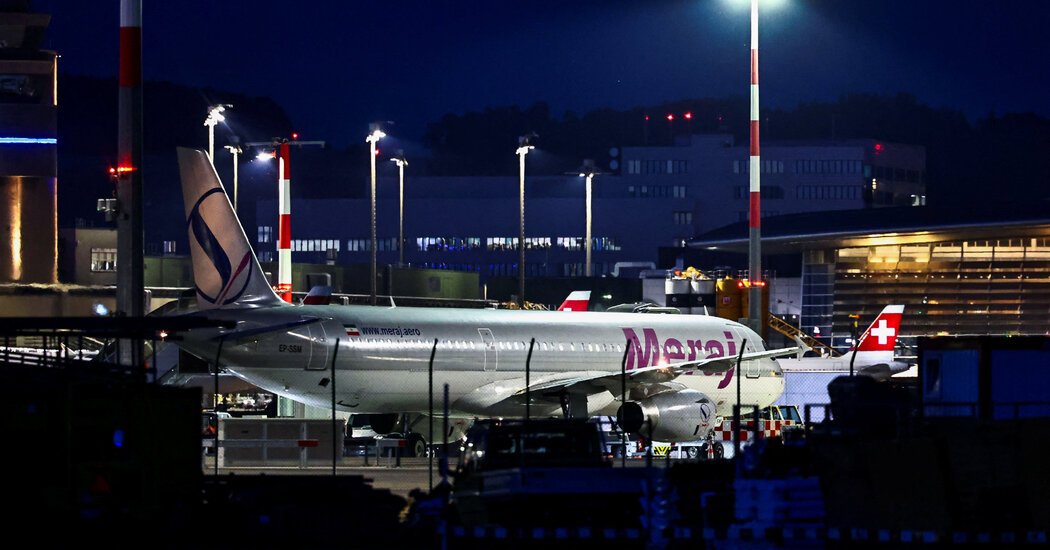
Vice President JD Vance arrived in Switzerland early Sunday ahead of talks to flesh out the preliminary deal to end the war in Iran that were expected to begin later in the day.
An Iranian negotiating team arrived hours earlier. The delegation included Gen. Mohammad Bagher Ghalibaf, Tehran’s lead negotiator in past talks and the speaker of Iran’s parliament, and Abbas Araghchi, Iran’s foreign minister.
Mr. Vance told reporters before leaving the United States that he would only attend peace talks in Switzerland “for a day or two.” He will lead a negotiating team that includes President Trump’s special envoys, Steve Witkoff and Jared Kushner, who Mr. Vance told Fox News were already in Switzerland.
Pakistan, which has served as an intermediary in the peace effort, said on Saturday that “technical talks” would begin on Sunday and include Pakistani and Qatari mediators. Pakistan’s foreign ministry said that its delegation would include the country’s prime minister Shehbaz Sharif and its army chief, Field Marshal Syed Asim Munir.
The discussions come at a delicate time. The conflict in Lebanon between Israel and Hezbollah, an Iran-backed militant group, threatens efforts to reach a broader peace and keep shipping flowing in the Strait of Hormuz. The U.S.-Iranian talks were scheduled to start on Friday, but they were postponed after continued clashes between Israel and Hezbollah in Lebanon.
Tehran said the Israeli strikes violated the agreement. Iran’s military went further on Saturday by claiming to have closed the Strait of Hormuz in response. The U.S. military said that marine traffic there continued to flow and asserted that Iran “does not control” the strait.
There are many other thorny questions that could be discussed during negotiations. President Trump’s interim agreement with Iran punted the future of Iran’s nuclear program to future talks, did not address Iran’s missile program and failed to resolve whether the Strait of Hormuz, the crucial maritime trade route off southern Iran, would remain open for free passage.
Esmail Baghaei, the spokesman for Iran’s foreign ministry, told state media on Saturday that the trip was intended to “follow up on the implementation of the other side’s commitments.” He warned that “negotiations on a final agreement” would begin only when Iran believes the United States is upholding the deal.
Tehran has accused the United States of reneging on commitments in the agreement by failing to rein in hostilities between Israel and Hezbollah, which exchanged fire again on Saturday despite the announcement of a cease-fire in Lebanon on Friday. The U.S.-Iranian agreement calls for a cease-fire on all fronts, including Lebanon, but neither Israel nor Hezbollah have signed onto the pact.
Mr. Vance told reporters before departing on Saturday that he hoped negotiators would “make progress on the nuclear issue” and the “Lebanon cease-fire issue,” adding that he was “sure the Iranians are going to have issues they’d like to discuss as well.”
Sanam Mahoozi, Zolan Kanno-Youngs and Yan Zhuang contributed reporting.