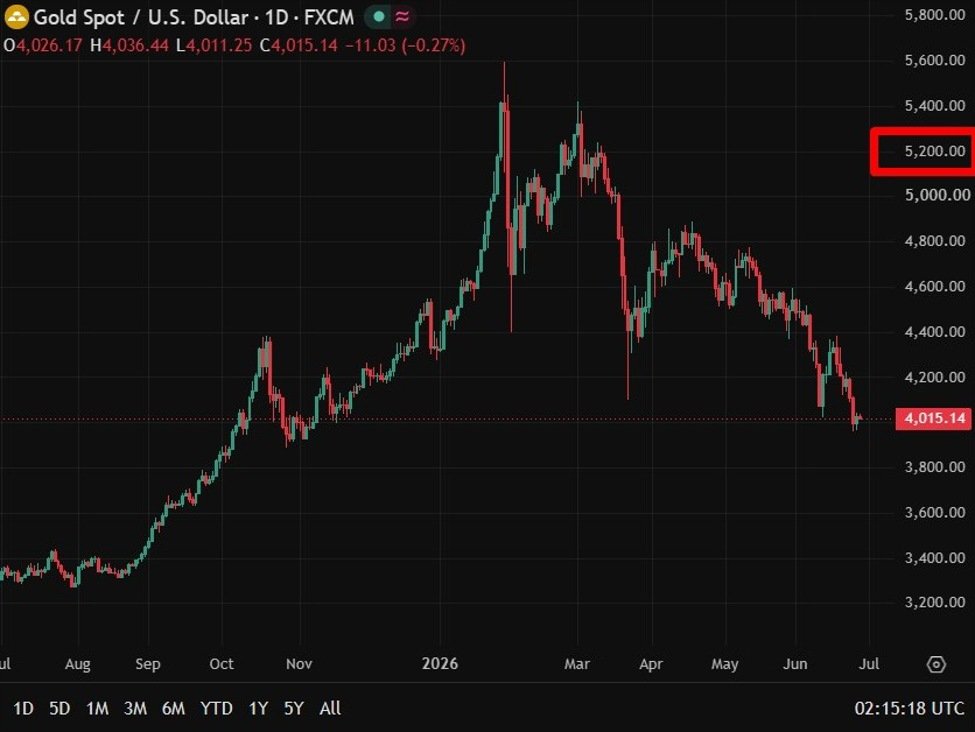
UBS’s 5,200/oz target implies roughly 30% upside from current levels, a call that rests on three pillars: a Fed that holds this year and cuts in 2027, a dollar that is structurally stretched and likely to weaken over time, and central bank demand that provides a durable floor. The near-term range of 3,850 to 4,000 set by momentum and technical indicators is less bullish, and UBS explicitly flags rising real yields and dollar strength as headwinds that could keep gold pinned in the short run. The Poland and China central bank purchases in May are a useful data point for the structural demand argument, though UBS acknowledges that central bank buying alone is unlikely to drive prices sharply higher without the macro catalyst of a Fed pivot or dollar reversal. For positioning, UBS recommends an allocation of up to mid-single digits in percentage terms for investors with a real asset bias.
—
Gold will recover to US$5,200 an ounce over the next 12 months as the Fed moves toward rate cuts and the dollar weakens, UBS says, calling the current pullback a buying opportunity.
Summary:
- Gold fell below 4,000 an ounce for the first time since November, leaving it more than 26% below its January all-time high, pressured by a stronger US dollar and higher real yields
- UBS expects gold to recover to 5,200 an ounce over the next 12 months, viewing the current level as an opportunity for underallocated investors to build exposure
- Near-term momentum and technical indicators point to a trading range of 3,850 to 4,000, with rising real yields and dollar strength raising the opportunity cost of holding gold
- UBS expects the Fed to hold rates for the rest of 2026 and deliver a first cut in 2027, with gold finding support as markets begin to price out expectations for further hikes; slower growth and fading fiscal support into next year are seen as additional tailwinds for bullion
- Long US dollar positioning looks stretched and structural headwinds including large fiscal and external deficits suggest the dollar’s upside is limited, UBS says, noting that dollar weakness has historically been a powerful driver of gold prices
- Central bank purchases remain a stable demand pillar, with preliminary May data showing Poland buying 18 metric tons and China securing 10 metric tons; UBS expects annual central bank purchases to remain in a range of 750 to 1,000 metric tons
Gold’s slide below 4,000 an ounce this week marks a more than 26% retreat from its January all-time high, but UBS sees the pullback as an opportunity rather than a turning point, projecting a recovery to 5,200 an ounce over the next 12 months as the Federal Reserve edges toward rate cuts, the dollar loses structural support and central banks continue absorbing supply.
The Swiss bank, in a note to clients, acknowledged the near-term headwinds are real. Rising real yields and a stronger US dollar have elevated the opportunity cost of holding gold, and momentum and technical indicators suggest prices may continue to trade in a 3,850 to 4,000 range in the short run. But UBS argues those pressures are temporary rather than structural.
On the Fed, UBS expects the central bank to stay on hold through the remainder of 2026, with the first rate cut coming in 2027. While consensus expects Wednesday’s core PCE reading to show another acceleration toward 3.4% year-on-year, UBS said trimmed mean and market-based inflation measures favoured by Chair Kevin Warsh are tracking closer to the Fed’s target, and that the impact of tariffs on prices should begin fading in coming months. Gold should find support as markets start to roll back expectations for further rate hikes, the bank said.
The dollar case is similarly structural. UBS flagged stretched long positioning, large US fiscal and external deficits, and already elevated investor allocations to dollar assets as factors that should limit the greenback’s upside and eventually tip the balance against it. A weaker dollar has historically been a powerful tailwind for gold.
Central bank demand provides the floor. Preliminary data for May showed Poland purchasing 18 metric tons and China securing 10 metric tons, and UBS expects annual purchases to remain in the 750 to 1,000 metric ton range. The bank recommends an allocation of up to mid-single digits for investors with an affinity for real assets, citing gold’s diversification value during periods of equity stress, geopolitical uncertainty and fiat currency pressure.