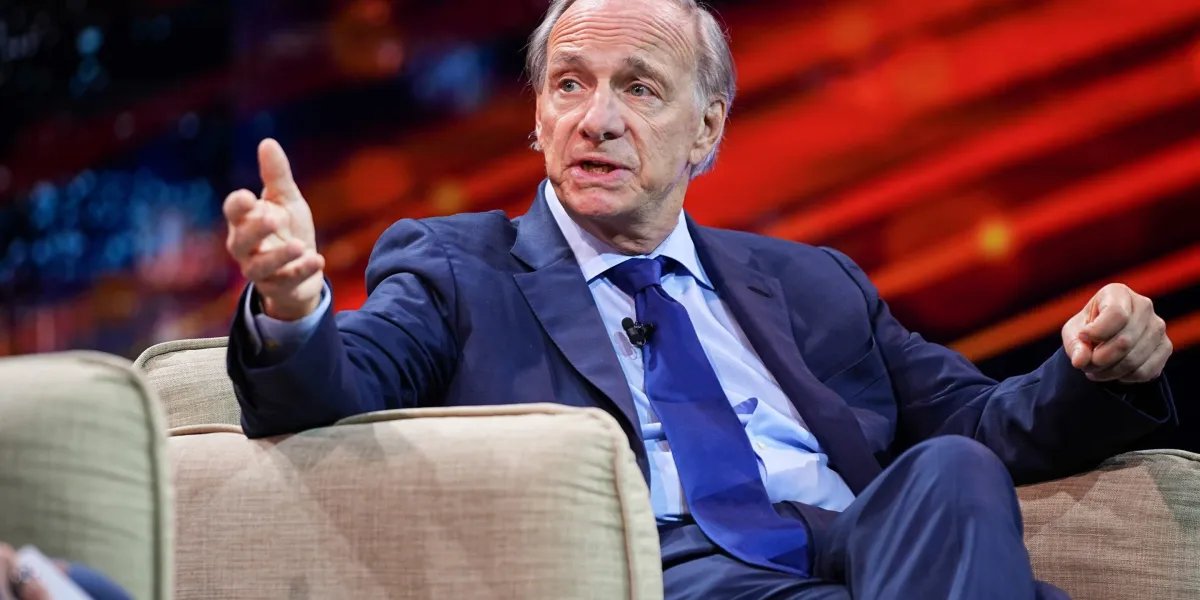

Ray Dalio was a self-professed “below average” student, bringing home grades of C-minus on a good day. However, the billionaire investor is now a household name, and says when he is looking to hire talent, he seeks out people who have had to overcome obstacles to get opportunities.
In a conversation with Harvey Schwartz, CEO of the Carlyle Group, the Bridgewater Associates founder outlined how his early years were no indication of the success he later attained. High school was a struggle, he said, because he had a “lousy” memory, and classes involved teachers merely testing that memory.
In addition, Dalio said, he simply wasn’t interested in much of the content, and instead kept himself busy by working odd jobs.
“I caddied,” Dalio said on the CNN podcast. “And when I would walk around the golf course caddying for people, the stock market was hot at the time. So I would talk about stocks with them.
“I took my caddy money, and I put it into the stock market. First stock I bought was the only company I ever heard of that was selling for less than $5 a share. And my logic was I could buy more shares, so if it went up, I’d make more money, which was dumb.”
That company (Dalio has previously said it was Northeast Airlines, which he first bought at age 12) soon went bankrupt. However, “some other company acquired it, it tripled in value, and I got hooked,” Dalio noted. Northeast Airlines, based in Boston, was purchased by Delta in 1972.
Dalio previously told the sports media outlet Golf that the club in question was the Links Golf Club on Long Island, which no longer exists, and that one of the men he caddied for was Donald Stott of Wagner, Stott & Co., a specialist Wall Street trading firm. Another was George Leib, who had served as the chairman of investment banking house, Blyth & Co.
Dalio’s hiring ethos
Dalio fared better in college (he attended C.W. Post College of Long Island University), saying he was more engaged because he could choose his own courses.
However, having experienced academia as a slog, Dalio now looks to hire people who have also experienced some setbacks in life.
He explained: “I get to hire the best of the best out of whatever schools I want, the best and the brightest. And what I find quite often is the case is that that student who did really, really well—and in remembering all the things that they’ve learned and so on—hadn’t gone through anything like that, [and] may not be the most inventive, may not be the most determined.”
Younger job seekers in the U.S. are facing a complex labor market at present: The St Louis Fed’s latest reading for May 2026 found unemployment for 16- to 24-year-olds was 9.4%, an improvement on mid-2025, but still elevated compared with previous years.
Experts have told Fortune that the job market is changing year to year for young people, and with the emergence of AI, so too have the skills required to land a job.
But Dalio isn’t necessarily looking for a skill, but rather a quality. “There’s a lot of talent out there,” he said. “There’s a lot of people who are talented in the circumstances where there’s barriers, and they got past their barriers. That’s quite good.”