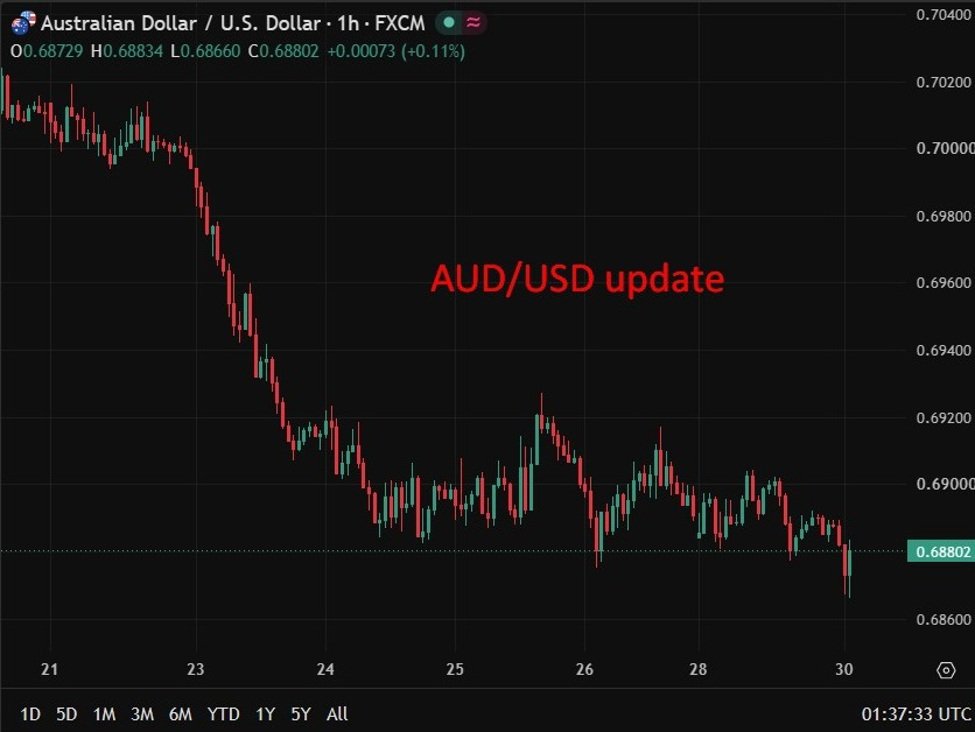
The minutes predate last week’s 10 percent plus slide in Brent, creating a disconnect between the hawkish tone of the document and where markets have since moved, with only 10 basis points of further tightening now priced by year-end and 17 basis points of easing priced through 2027. The AUD faces a tension between the RBA’s explicit willingness to hike again and the market’s view that rates have likely peaked, leaving the currency vulnerable to repricing if upcoming data confirms the softer oil backdrop is feeding through to inflation expectations. Falling Sydney and Melbourne home prices add a domestic growth risk that could reinforce the market’s dovish repricing, even as the board’s own language remains firmly tightening-biased. The gap between the RBA’s restrictive stance and a rapidly easing global oil shock is the key variable for rate-sensitive assets in the near term.
—
RBA June minutes show the board held rates at 4.35% but stood ready to hike again, citing excess demand and inflation risks, though the meeting predated last week’s 10% slide in oil prices.
Summary:
- The RBA held its cash rate target unchanged at 4.35% in June, judging this would best balance its inflation and employment objectives after three rate hikes earlier in the year
- The board said monetary policy needed to remain restrictive to unwind excess demand and would raise the cash rate target further if necessary
- Annual consumer price inflation ran at 4.0% in May, with core inflation at 3.6%, both materially above the RBA’s 2 to 3 percent target band
- The board judged Australian financial conditions to be probably somewhat restrictive, with the cash rate sitting at the top of staff estimates of the neutral rate
- Members noted the housing market had weakened by more than expected, reflecting rate hikes and proposed tax changes, with Sydney and Melbourne home prices falling in recent months
- The board viewed the Middle East conflict as a material upside risk to inflation and downside risk to growth, though it acknowledged an enduring resolution could reduce the extent of cost pass-through to consumers
- Persistently weak productivity growth was flagged as a continuing risk to the timeline for returning inflation to target
- The meeting was held on June 15 and 16, before Brent crude fell 10% the following week, and markets now price just 10 basis points of further tightening by year-end alongside 17 basis points of easing through 2027
The Reserve Bank of Australia said monetary policy needed to remain restrictive to unwind excess demand in the economy, minutes of its June board meeting showed on Tuesday, even as the rate backdrop the board was responding to has since shifted considerably.
The board held the cash rate target unchanged at 4.35% following three hikes earlier this year, judging that holding steady would best balance its inflation and employment objectives. It nonetheless made clear it stood ready to raise rates again if needed, noting that monetary policy needed to remain restrictive to unwind current excess demand through a period of below trend growth. Annual consumer price inflation stood at 4.0% in May and core inflation at 3.6%, both well above the RBA’s 2 to 3 percent target band.
Members judged financial conditions were now probably somewhat restrictive, with the cash rate target sitting near the top of staff model estimates of the neutral rate and above the range estimated by market economists. The board acknowledged it would take time to assess the full impact of tightening undertaken since February, though it appeared at this stage to be having broadly the expected effect, particularly in housing, where conditions had softened by more than anticipated.
That housing weakness, linked to higher mortgage rates and proposed tax changes for property investors, has shown up in falling home prices in Sydney and Melbourne in recent months. The board flagged this as a genuine two-sided risk: while it reinforced the case for restrictive policy working as intended, a more pronounced housing downturn could also weigh on consumption growth and feed back into weaker activity.
The Middle East conflict featured prominently in the board’s risk assessment. Members acknowledged the emergence of a potential path to resolution but described this as still an early stage development, and judged the conflict to pose material upside risks to inflation and downside risks to growth overall. They noted that an enduring resolution could reduce the degree to which firms pass on elevated costs to consumers, but cautioned that underlying inflation would likely still increase to some extent in response to recent fuel supply disruptions regardless of how the conflict evolves.
The minutes also pointed to persistently weak productivity growth as a continuing concern, with members agreeing that a sustained shortfall could impede progress on returning inflation to target even as demand cools.
Critically, the June 15 and 16 meeting predates a sharp deterioration in the oil price backdrop that the board was responding to. Brent crude fell roughly 10% in the week following the minutes’ underlying period, a move that has materially shifted market pricing for the path of Australian rates. Futures markets now imply only about 10 basis points of additional tightening by the end of the year, down sharply from earlier expectations, with traders also pricing in 17 basis points of easing by the end of 2027. That repricing suggests markets believe the RBA’s tightening cycle has likely already peaked, even as the board’s own language in the minutes remains explicitly tilted toward further hikes if conditions warrant.