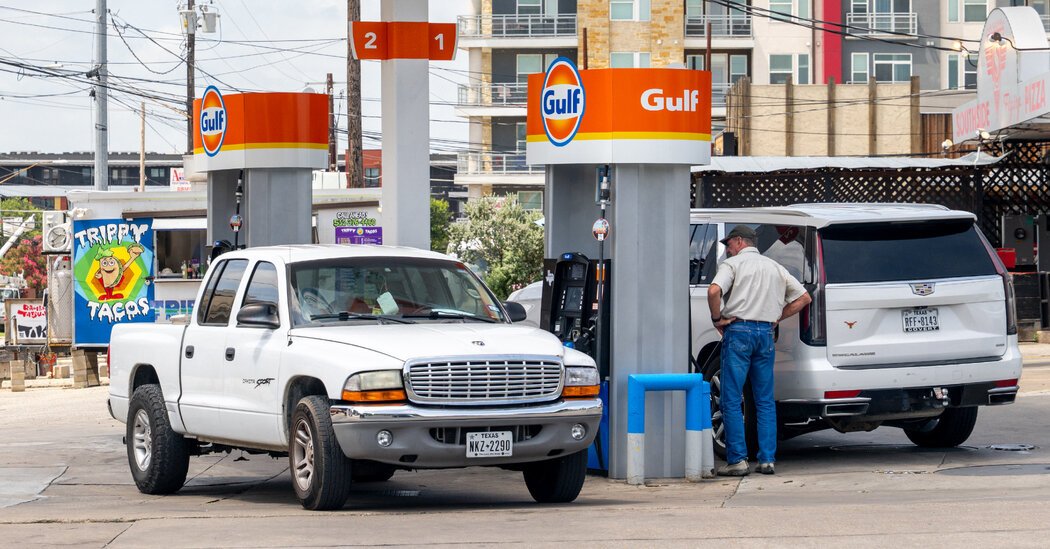
As tankers start sailing again through the Strait of Hormuz, oil prices have fallen nearly to their level before fighting blocked off the Persian Gulf four months ago. As usual for a so-called supply shock, prices at the pump aren’t falling as quickly, as gasoline retailers take the opportunity to recoup some of the profits they lost as prices rose.
President Trump isn’t having it.
“The retailers must quickly react to this statement, and do what they know is right — DROP YOUR PRICE FOR OUR GREAT AMERICAN PEOPLE!” he wrote in a social media post last week. He said he wouldn’t stand for price gouging, “which is totally illegal.”
It’s not the first time a president has warned against price gouging when the politically sensitive price of gas soured public sentiment. President Joseph R. Biden Jr. sounded very similar in 2022, when Russia’s invasion of Ukraine sent energy prices soaring.
So, do they have a point?
In some ways, yes. The difference between what retailers pay for wholesale gasoline and what they charge drivers has been widening over the past decade, from around 20 cents a gallon to about 40 cents, according to data collected by Dow Jones’s Oil Price Information Service. Although much of that can be chalked up to their own rising costs, industry experts say there is likely a component of extra profit.
“It’s inflation, but it’s also opportunity,” said Tom Kloza, chief energy adviser for Gulf Oil. That is especially true for high-volume, fast-growing chains like Wawa and Buc-ee’s, which can buy fuel in bulk for less than the independent store owners who make up more than half the industry.
“The economies of scale just work wonderfully for them,” Mr. Kloza said.
Retail gasoline margins took their last big step up in 2022, as prices topped $5 a gallon. Other costs like wages, insurance and rent were rising steeply as well, increasing the overhead required to provide that gasoline. Retailers charged accordingly, and those costs have generally not gone down.
Gasoline price spikes also tend to push consumers toward loyalty cards, which offer a few cents off per gallon. According to surveys by Upside, which itself offers discounts for new customers, nearly half of drivers say they regularly use such programs. That may prompt retailers to keep posted prices a little higher, since frequent drivers use loyalty points to take the edge off their bills.
“When we’re talking about margin per gallon, that’s assuming the sign price is what people are actually paying,” said Thomas Weinandy, Upside’s chief economist. “But that’s becoming more and more a sticker price rather than the actual paid price.”
This latest period of elevated prices comes with an additional quality that plays to the strengths of large chains: volatility. When prices move up and down rapidly, consumers have little sense of what seems fair, and companies can keep prices high even when costs drop.
Just ask Casey’s General Stores, the publicly traded group of Midwest gas stations that also prides itself on its pizza. The company posted a margin of 46.9 cents per gallon on fuel in the quarter that ended April 30, up 9.3 cents from the same quarter last year and contributing to a 29 percent increase in gross profits from fuel.
“It was just a little bit more volatile on the way up relative to the experience we’ve had in the past, and that enabled us to capture a bit more margin than we might have otherwise,” said Darren Rebelez, the company’s chief executive, on an earnings call last month. Independent stations face the same price pressures with fewer methods of managing them, another executive noted, leaving little reason to give up their own margins.
Murphy Oil also posted a strong quarter and noted that volatility helped its bottom line, as did Sunoco, which emphasized its ability to shift supply networks as different sources and delivery routes changed in price.
“That’s not always a bad thing. In fact, in our world, a lot of times, that can mean value creation,” Karl Fails, Sunoco’s chief operating officer, told investors in June. Margins compress as prices rise, but widen even more as they come down. “I’d say you get an overall kind of net bullish margin environment,” Mr. Fails said.
There might be one more thing going on.
Gasoline retailers have for decades used digital platforms to analyze the marketplace and figure out how to set their prices. Earlier versions of the software required the user to manually program how prices should respond to trends, such as a demand increase over Thanksgiving weekend.
“These are the rules that have existed for a long time,” said Daniel Ershov, an economist at University College London. “The difference now is you have much more sophisticated algorithms that learn stuff a lot faster and incorporate a lot more information.”
Mr. Ershov studied the use of algorithmic pricing services in Germany, where data is more easily available to researchers. He and his co-authors found that the use of such services pushed up prices even in superficially competitive markets, possibly because the algorithms learned to tacitly collude to avoid price wars.
One of the most widely used pricing platforms in Europe and North America is called Kalibrate, which says 15 of the top 20 fuel retailers in the United States use its services. Two years ago, the Canadian Competition Bureau opened an inquiry into the company, aiming to assess whether it was allowing gas stations to collectively raise prices.
American antitrust watchdogs haven’t followed suit, but last month, a team of lawyers, including some who have recently left the Federal Trade Commission, filed a lawsuit claiming that Kalibrate “provides the central nervous system for a conspiracy to extinguish retail price competition among gas stations.”
The case was brought in California, for two reasons. One: The state has notoriously high gasoline prices that cannot be entirely explained by known factors including taxes, regulations and a lack of refining capacity. A state commission determined last year that this “mystery surcharge” was due in part to higher profit margins across the gasoline supply chain, which is also relatively consolidated and vertically integrated from refiners to retailers.
And two: Just last year, California tweaked its competition statute to clarify that pricing algorithms that share data across firms qualify as illegal coordination. That lowers the bar for success for cases like this, which have not all fared well in federal courts. It’s difficult to prove anticompetitive behavior if companies can plausibly deny they got together to conspire.
“I think this one pretty clearly reflects some lessons learned from how those previous cases have gone,” said John Mark Newman, a law professor at the University of Memphis who worked at the F.T.C. when it brought those suits. “When you step back, it’s kind of absurd to say, ‘Oh, if you only did the common scheme 90 percent of the time, there was no agreement at all?’ That’s not how antitrust is supposed to work.”
The case will take years to wind through the courts, if it isn’t tossed out. In the meantime, experts are betting that the relatively low gas prices of early 2026 aren’t coming back, despite the president’s exhortation.
“You get these big spikes, it resets, but it usually resets back to a level that is above where it was before the spike,” said Bobby Griffin, managing director of specialty retail at Raymond James.