
Nearly a month after Ripple shipped xrpld v3.2.0, the renamed successor to the Ripple Core server software, XRPScan data show that only 357 of 828 total XRP Ledger nodes (43%) have made the switch, while 426 nodes (51%) remain on v3.1.3.
This is not simply a slow rollout. It is a structural illustration of the two-tier governance dynamic that defines XRPL upgrade cycles: validator consensus runs well ahead of the broader node ecosystem, and the network’s functional readiness is determined by the former rather than the latter.
We shipped together with the community (40+ devs and 9 new comers)- XRP Ledger 3.2.0, lots of great protocol improvements including the migration to xrpld.
34% are on 3.2.0 already!
Please update your nodes at your earliest convenience.
Migration guidehttps://t.co/aa3YWWHWZZ pic.twitter.com/sbf5y5mFkS
— Vet (@Vet_X0) June 25, 2026
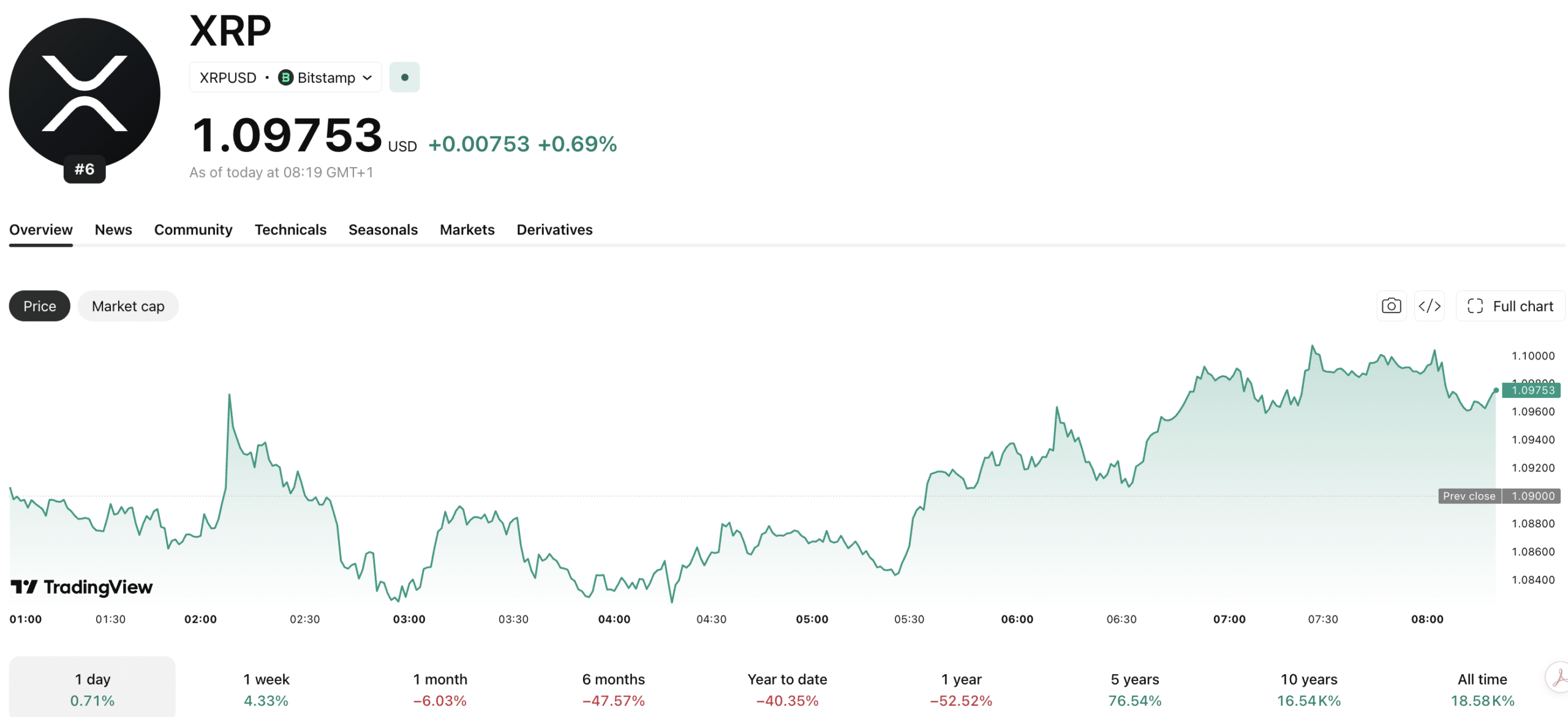
This XRP USD data drop came as XRP is trading down -3.5% over the past 24 hours, dropping under $1.10 once more, currently trading at $1.09 with a daily trading volume of $1.54Bn.
With this price drop, $1.10 has once more become resistance for XRP USD, and until this level can be flipped and closed above on the weekly chart, it will continue to act as a sticking point for any larger moves.
$XRP has formed a hidden bearish divergence on the daily timeframe; XRP needs to reclaim $1.15 soon, or things could get ugly with a journey back towards $1.00. pic.twitter.com/YXzlS0xDi5
— 🇬🇧 ChartNerd 📊 (@ChartNerdTA) July 8, 2026
XRPL Node Adoption: The UNL Threshold Has Already Been Cleared
The operationally significant figure is not the 43% overall adoption rate but the 89% of Unique Node List (UNL) validators, 31 of 35, already running v3.2.0.
The XRP Ledger requires 80% UNL participation to treat a software version as sufficiently adopted, meaning the network already considers xrpld v3.2.0 the de facto standard. Roughly 61% of validators running Ripple-versioned software have also upgraded, per the same data.
For non-UNL nodes, the upgrade remains voluntary for now, but the incentive structure sharpens once a related amendment is activated. Nodes that fall behind after activation risk losing network connectivity, a dynamic that pressured adoption during the v3.1.3 / Cleanup31_ cycle in late May 2026.
The v3.2.0 release formalizes the rebranding of the core server from rippled to xrpld per the XLS-0095 specification and delivers 30% to 40% lower memory usage across network nodes, a direct reduction in infrastructure costs for institutional operators.
The update also improves security, developer tooling, and network efficiency, building on bug fixes and improvements to permissioned domains and vaults introduced in the v3.1.3 maintenance release.
the XRP Ledger deployed its new v3.2.0 server software to cut costs and improve stability, but the critical on-chain amendment is stuck in the voting process
approximately 833 active nodes, only 43% have installed the June 15 update, while 51% are still running the older v3.1.3… pic.twitter.com/f1abBDD1ah
— NEWMANNI (@NEWMANNI_xyz) July 8, 2026
DISCOVER: Best Meme Coins to Buy in 2026
fixCleanup3_2_0 Amendment: The Vote Is Still Short of Activation
The companion XRPL amendment, fixCleanup3_2_0, is the more time-sensitive governance item. As of the report, it has collected only 17 of the 35 UNL validator votes required, 48.57% support against the 80% threshold (28 votes) needed for activation.
The amendment governance model also requires that support remain above 80% for a continuous two-week window; any drop resets the timer, which is worth noting when tracking activation data.
If fixCleanup3_2_0 clears that bar, it will deploy fixes for single-asset vaults, the native lending protocol, multi-purpose tokens, permissioned domains, and the permissioned DEX.
Those features arrived during XRPL’s 2026 amendment wave, which included XLS-81 (Permissioned DEX), XLS-85 (Token Escrow), Permissioned Domains (activated April 2, 2026), and XLS-65/66 (Vault Lending Protocol) – making fixCleanup3_2_0 a consolidation fix rather than a net-new capability.
What Ripple Node Operators and Institutional Participants Should Watch
The analytical question is no longer whether Ripple’s v3.2.0 rollout has sufficient validator support; it does. The question is whether the fixCleanup3_2_0 vote can build momentum from 48.57% to the 80% activation threshold, and whether the broader node population migrates before that amendment activates, thereby raising the stakes for connectivity.
We suspect the validator vote timeline is the more consequential signal for DeFi infrastructure participants on XRPL, since the fixes it carries touch every major protocol surface.
This includes vaults, the XRP Ledger’s native lending protocol, permissioned exchange rails, and token standards, activated over the past several months. Node operators who have not yet moved to xrpld v3.2.0 are running a narrowing window before the amendment pressure increases.
EXPLORE: Next Crypto to Explode in Q3
Disclaimer: Coinspeaker is committed to providing unbiased and transparent reporting. This article aims to deliver accurate and timely information but should not be taken as financial or investment advice. Since market conditions can change rapidly, we encourage you to verify information on your own and consult with a professional before making any decisions based on this content.

Neil is a professional cryptocurrency content writer with years of experience. He has written for various cryptocurrency websites to report on breaking news, and been hired by all sorts of cryptocurrency projects, to create content that would increase their exposure and attract more potential investors.