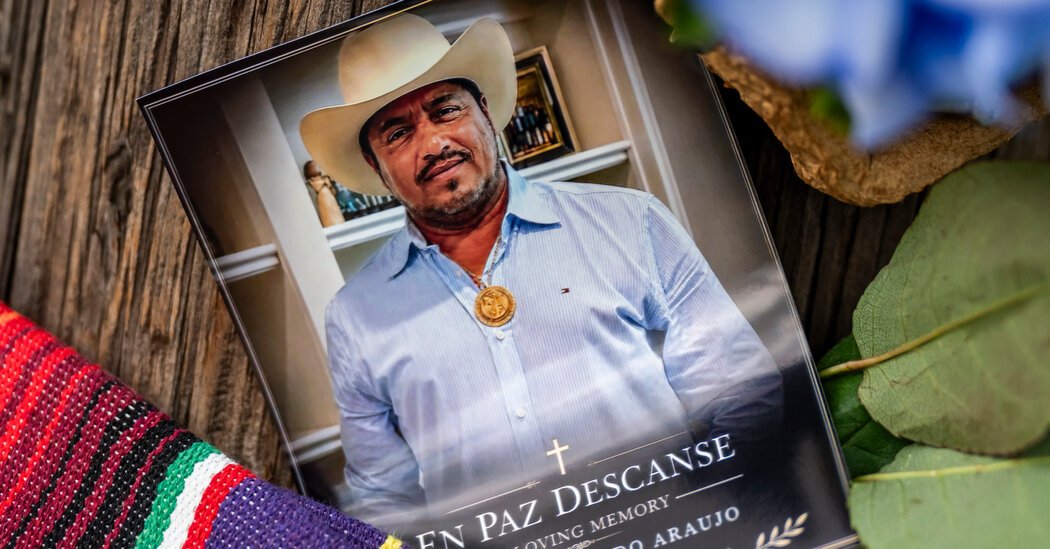
On Saturday morning Ronaldo Salgado glanced, his smile bittersweet, at a photo of his father projected on a large screen and found the courage to address dozens of people crammed at an indoor vigil in his native Houston.
Mr. Salgado and a younger brother moved the room to tears as they spoke about the love their father, Lorenzo Salgado Araujo, had for soccer, and the passion he had for the American dream. When the brothers renewed calls for accountability in the fatal shooting of their father at the hands of immigration agents, the crowd erupted in applause.
Mr. Salgado Araujo was a 52-year-old Mexican immigrant who had been living in Houston for 35 years. He was driving to work with three other men Tuesday morning when agents with Immigration and Customs Enforcement began following him and later shot him after they said he had failed to stop his vehicle.
“I just want to continue pressuring, continue the pressure, to continue obtaining a full independent investigation,” said Mr. Salgado, 29, a public-school teacher, as he addressed the crowd at an event organized by the Service Employees International Union. “To continue preserving the evidence, and for his van to be returned to us.”
“I’m still looking for answers,” he added.
Officials with ICE had said that Mr. Salgado Araujo had rammed an ICE vehicle during an operation Tuesday morning, had not followed orders and had tried to run over an officer. The agency said an agent had fired in self-defense. Mr. Salgado Araujo was shot in the abdomen.
On Thursday, a spokeswoman for the Department of Homeland Security, which oversees immigration agents, said that Mr. Salgado Araujo was not the intended target of the operation. Federal officers had been looking for a different man.
On Friday, the mayor of Houston, John Whitmire, said the city’s police department and the district attorney’s office would work to obtain all evidence and conduct their own investigation, independent of inquiries being done by the Department of Homeland Security and the F.B.I.
The move was a reversal of an earlier position that Mayor Whitmire had taken, saying that the city had no jurisdiction over the case. But that was before three witnesses, men who were inside Mr. Salgado Araujo’s van at the time of the shooting, disputed the account from the immigration agents.
So far, no video has emerged of the moment when Mr. Salgado Araujo was wounded.
Surveillance and witness videos obtained by The New York Times show two unmarked ICE vehicles tailing the white van and trying to cut it off. The van does a U-turn before stopping alongside the road, with several immigration agents running toward the vehicle as it comes to a halt. The ICE agents were not wearing body cameras and none of the vehicles had dashboard cameras.
Family members of Mr. Salgado Araujo’s said they had not been able to recover his belongings, including the lunchbox that contained the food cooked by his wife that they said he had looked forward to eating every day.
Mr. Salgado, a soccer coach, remembered his father as a hard-working man who was passionate about soccer. He rooted for the Mexican soccer team Las Chivas, a team from Guadalajara, and just days ago he had been cheering Mexico’s national soccer team on its historic run before its exit from the World Cup.
Mr. Salgado managed to muster a laugh from the crowd when he said with a sad smile that his father used to say, “Jugaron como nunca, pero perdieron como siempre,” translated as, “They played like they’ve never had, but they lose like they always do.”
His father, Mr. Salgado said, was a private man who would have been shocked to learn that his name had become well-known after immigration activists and a growing chorus of elected officials began demanding an independent inquiry.
“Being known by this many people was like a nightmare to him,” he said.
Mr. Salgado also compared his father’s death to those of two U.S. citizens in Minneapolis, Renee Good and Alex Pretti, who were fatally shot by federal immigration agents in January during an enforcement surge.
Mr. Salgado Araujo had three U.S.-born sons and was in the process of obtaining a work permit and legal status, his sons said, adding that he had made a career in the framing industry and was proud that he had built his own house.
Mr. Salgado said he had been thrust into the role of family leader since Mr. Salgado Araujo was killed, something he hoped would have made his father proud.
“I really hope that, you know, he’s proud of the big brother I’ve become, of the man that I’ve become today, and I will continue to keep fighting for him,” Mr. Salgado said through tears.
His comments prompted a man in the audience, Alain Cisneros, 48, to reassure him. “With all my heart, I see you as my son,” he said in Spanish. “Your father is looking at you and he is proud of you. I can tell you that.”
Mr. Salgado’s younger brother, Lorenzo Salgado Jr., evoked the words of one of the founding fathers, Thomas Jefferson, in remembering his father.
His father “had his liberty, though he couldn’t travel outside of the country due to, you know, not being able to get back to his life,” he said, referring to his unresolved immigration status. “The pursuit of happiness, he achieved that.”
Still, he added, “it’s a hard moment to be an American.”