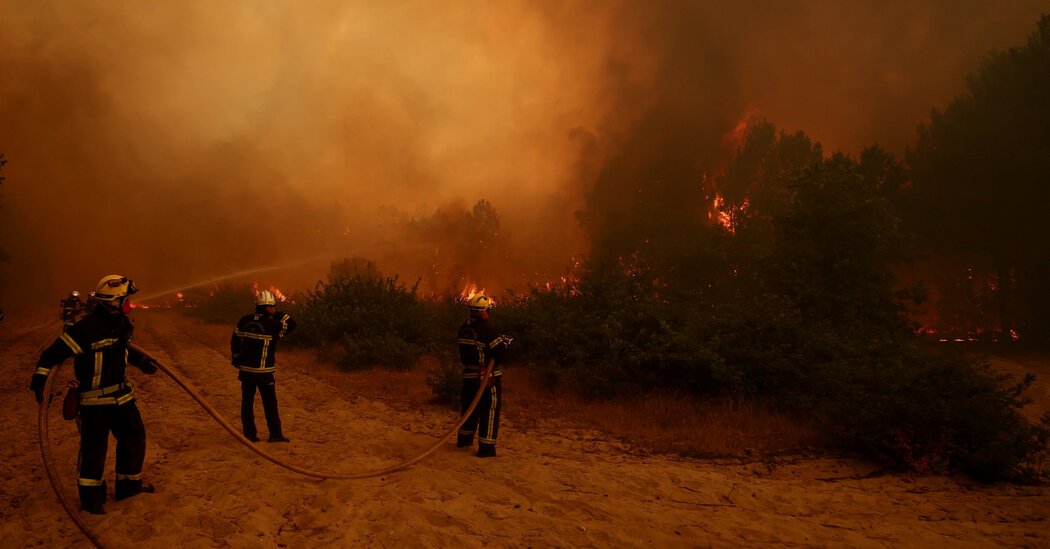
Fast-moving deadly wildfires fueled by extreme heat and strong winds have forced hundreds of thousands of people to evacuate or seek shelter this past week in France and Spain, and destroyed hundreds of thousands of acres of land.
Officials warned that conditions could worsen in the coming days, with a new heat wave forecast to hit large parts of the continent this week. “The situation remains highly unfavorable,” France’s interior minister, Laurent Nuñez, said on social media on Sunday.
The blazes have mainly hit southwestern France, near Bordeaux, and central Spain, near Madrid, the capital. At least two people in Spain have died, officials have said.
The fires have also injured dozens of firefighters, destroyed scores of homes and forced many vacationers to flee popular summertime spots.
The Spanish and French authorities have requested additional resources from the European Union and warned that high temperatures and erratic winds were making it difficult to stop the flames.
Where are the fires in France?
The authorities have reported dozens of wildfires in France, but the biggest blazes are near the Atlantic coast in the southwest of the country. Dozens of fires have burned about 100,000 hectares, or roughly 247,000 acres, Prime Minister Sébastien Lecornu said on social media.
One fire started on Wednesday in the Gironde area, which includes the city of Bordeaux, and the other started on Thursday in the Landes area, farther south, according to the local authorities.
Gironde, southwestern France
About 220,000 people have been evacuated from their homes in the region of southwestern France, Mr. Nuñez said.
Overnight, he added, the flames had spread “erratically” toward the Bordeaux area before settling down. Some 5,200 emergency personnel had been deployed to deal with the fire, he said, and roughly 42,000 hectares, or about 104,000 acres, had been burned.
Landes, southwestern France
About 36,000 people had been evacuated from the area, Mr. Nuñez said, and some 1,000 emergency personnel were battling the blaze. The fire has burned about 3,600 hectares, or roughly 9,000 acres, as of Sunday.
Var, southeastern France
The French authorities on Sunday were worried about the risk of high winds, which could worsen conditions, an area on the country’s Mediterranean coast that includes the French Riviera. Some 3,000 people had been evacuated as of Sunday, and the fire had burned some 4,500 hectares, or about 11,000 acres.
More than 1,000 firefighters were battling the blaze there, and roads in and around the area were closed. Officials said they were worried that strong winds could pick up and reignite fires.
Where are the fires in Spain?
Wildfires in the mountains west of Madrid have forced about 90,000 people to evacuate or take shelter.
Prime Minister Pedro Sánchez of Spain said on Sunday that some of the blazes were being brought under control, but that the situation remained dangerous and that more 150,000 hectares, or about 360,000 acres, had been burned.
How have the authorities responded?
The Spanish and French authorities have ordered hundreds of thousands of people to evacuate, set up emergency shelters, deployed firefighting planes and helicopters and sent security and military reinforcements to support firefighters.
On Saturday, the prefect for the Gironde area ordered the evacuation of several western suburbs of Bordeaux as a precautionary measure. Thousands of people had previously evacuated the Cap Ferret peninsula, a popular holiday destination. Hundreds fled by boat.
More than 5,000 emergency workers were deployed to fight the fires, protect civilians and secure evacuated areas, Prime Minister Lecornu said on social media on Saturday.
He also announced that France would distribute 2.5 million face masks to protect residents and emergency workers from toxic smoke caused by the fires.
Do we know what caused the fires?
The exact origins of the blazes in France and Spain were not immediately clear, but they are part of a broader surge of wildfires this summer across Europe fueled by repeated heat waves since late May.
The extreme temperatures have parched vegetation and melted glaciers and have been linked to thousands of excess deaths.
Last month was the hottest June on record in western Europe, according to Copernicus, a European Union monitoring agency.
Connecting a specific heat wave or fire to global warming is hard to do, but experts agree that human-caused climate change is behind the increasingly high temperatures that have made wildfires more destructive in general.
About two weeks ago, a wildfire in the southeastern Spanish province of Almería killed 13 people, making it one of the country’s deadliest fires on record. Two French firefighters died battling a previous fire near Bordeaux this week.
France has decades of experience with wildfires in the country’s south, but the blazes have increased in number and pushed north as summer temperatures rise. By mid-July, almost 11,000 fires had started across the country that have burned more acres than throughout the entirety of last summer.
Carlos Barragán contributed reporting from Madrid.