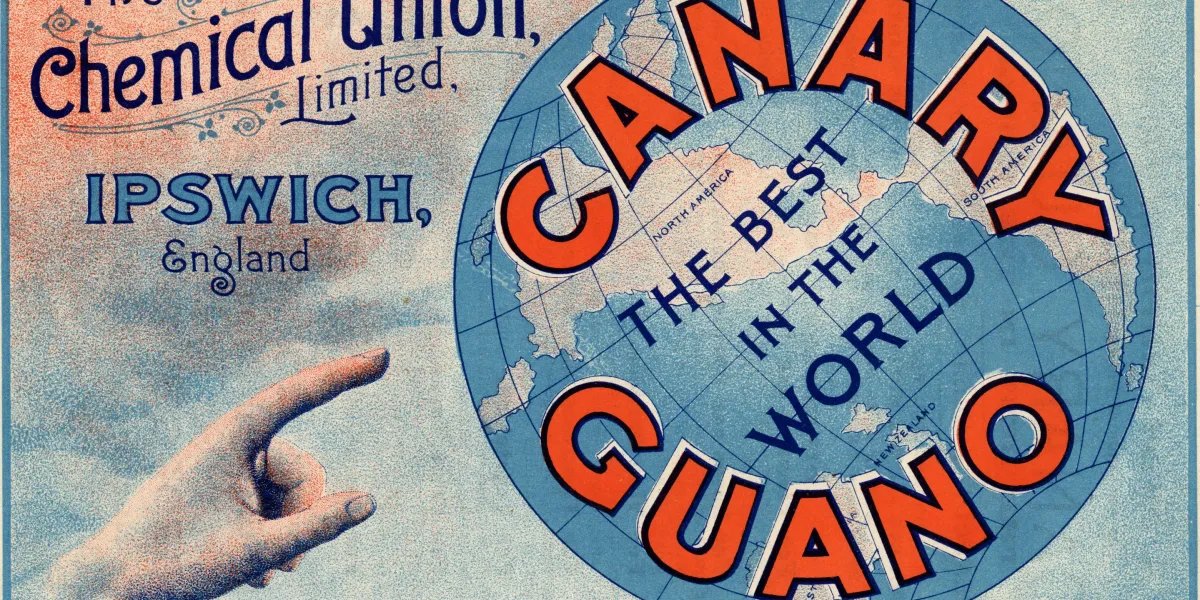
European and North American agricultural journals hailed guano as a miraculous remedy for exhausted soils. Wheat farmers in Britain, sugar beet growers in central Europe, tobacco planters in Virginia and cotton cultivators across the American South all embraced the new fertilizer. Farmers who had long relied primarily on local sources of fertilizer increasingly depended on nutrients transported thousands of miles across the world’s oceans.
This new global trade in agricultural nutrients marked the first Green Revolution. Decades before synthetic ammonia transformed agriculture, millions of tons of naturally accumulated nitrogen and phosphorus crossed oceans from remote ecosystems to the world’s farms. For the first time, agricultural fertility itself became a globally traded commodity, laying the foundations for the chemically intensive agriculture that emerged after World War II.

Contemporary observers commonly compared the guano deposits on the Chincha Islands to cliffs or small mountains. When commercial extraction began in the 1840s, workers were not simply shoveling loose bird droppings. Centuries of accumulated guano had been compressed by its own weight into a dense, cementlike mass that had to be hacked apart with picks, crowbars and iron bars before it could be shoveled into sacks.
As the global abolition movement brought the Atlantic slave trade to an end, employers increasingly turned to debt peonage and indentured labor, systems that occupied the uncertain terrain between slavery and freedom. Agricultural productivity in Europe and North America depended not only on the long-distance transfer of nutrients but also on the equally consequential transoceanic movement of workers around and across the Pacific Ocean.
Peru’s Chincha Islands became notorious for the brutal exploitation of Chinese indentured laborers recruited through the so-called “coolie trade.” Thousands worked beneath an unforgiving sun, hacking hardened guano into pieces while breathing caustic clouds of ammonia-laden dust that burned their eyes and lungs. In 1854, after British ship captains reported appalling conditions on the Chinchas, the British foreign secretary, the Earl of Clarendon, wrote: “I have read with horror and disgust the details therein contained of the cruelties practised on the unfortunate Chinese labourers employed in the export of guano.”
Guano and empire
Faced with increasing fertilizer demand, governments began to treat guano as a strategic resource. American policymakers worried about dependence on Peruvian supplies, prompting President Millard Fillmore to urge federal action to secure reliable access to fertilizer. Congress responded with the Guano Islands Act of 1856, authorizing U.S. citizens to claim unoccupied guano islands in the name of the United States. The law transformed a quest for fertilizer into a new mechanism of American territorial expansion.
Over subsequent decades, dozens of islands across the Caribbean and Pacific entered the expanding orbit of U.S. power because of their valuable fertilizer deposits.
Few places illustrate this history more clearly than Navassa Island, a remote limestone outcrop between Haiti and Jamaica and the subject of my upcoming book. From the 1860s onward, American companies transformed Navassa into an industrial mining colony that supplied guano to farms throughout the eastern United States.
Black workers, recruited primarily from Baltimore, excavated guano amid conditions of unrelenting heat, dust and isolation. Their rations consisted of little more than herring, maggot-infested biscuits and salted beef. The island’s hierarchy reflected the emerging racial order of the Jim Crow era. The miners were overwhelmingly Black, while their overseers were white men. To reconstruct the workers’ experiences, I draw on their diaries, correspondence with friends and relatives, and interviews with their descendants.
On Sept. 14, 1889, years of resentment erupted into violence. That day, 137 Black miners rebelled against the Navassa Phosphate Company’s 11 officers. By evening, five white supervisors were dead. The U.S. Navy dispatched the steam-powered warship USS Kearsarge, which carried 18 Black workers to Baltimore to stand trial for murder.
The following year, the case reached the U.S. Supreme Court. In Jones v. United States, the justices upheld the federal government’s authority to prosecute crimes committed on the island. The court reasoned that a nation could exercise legal authority over territory maintained through “actual, continuous, and useful possession,” even when that occupation served only a particular business, such as “working mines.” The ruling confirmed American jurisdiction over Navassa. Read in the context of the uprising that produced it, however, the decision illustrates how resource extraction, racialized labor and the expansion of federal power had become intertwined. Several defendants received death sentences, but pressure from Black civic organizations and other supporters helped persuade President Benjamin Harrison to commute those sentences in 1891. The case therefore tells a story not only of racial violence and exploitation, but also of Black legal activism and community mobilization during a period often remembered largely for racial repression. Agricultural abundance has long depended on far more than fertile soil. It has relied on distant nutrients, global shipping networks and the workers whose labor connected remote islands to farms around the world. Guano did more than fertilize fields. It created a global agricultural system whose supply chains stretched across oceans, depended on distant workers and were vulnerable to geopolitical disruption. From the Chincha Islands to the Strait of Hormuz, the history of fertilizer reminds us that the world’s food supply has long rested on fragile connections between remote places. Edward D. Melillo, William R. Kenan, Jr. Professor of History and Environmental Studies, Amherst College This article is republished from The Conversation under a Creative Commons license. Read the original article.
Lessons from the Guano Age