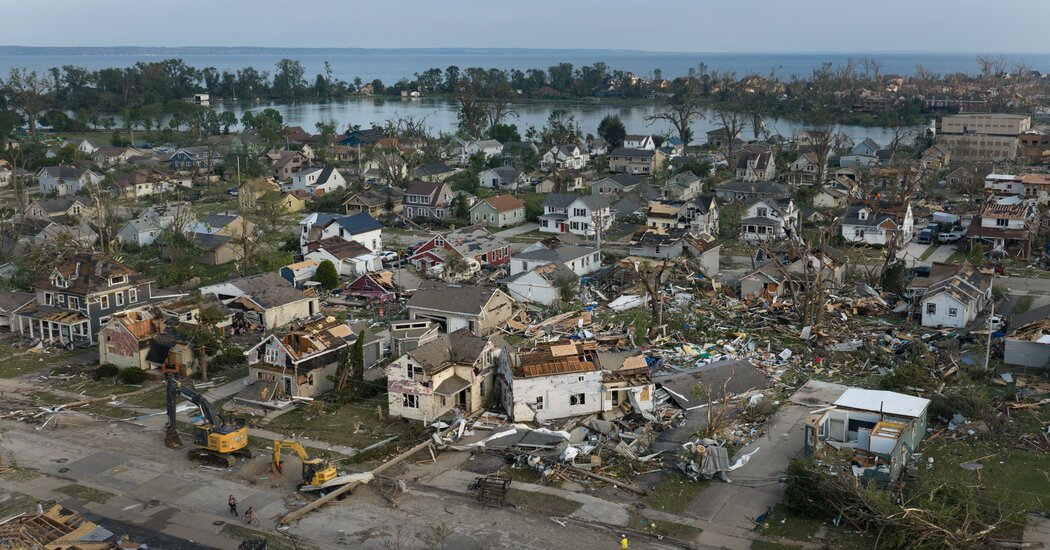
A tornado tore through northeastern Wisconsin on Monday, part of a system of severe storms that knocked out power to tens of thousands of residents, downed trees, leveled buildings, ripped roofs off homes and shut down at least one city as it tried to emerge from the damage.
Mayor Austin Hammond of Menasha, Wis., declared a local state of disaster on Monday, and the City of Menasha Police Department issued a curfew beginning at 10 p.m. Monday evening until 5 a.m. Tuesday. Downed power lines and debris devastated the area, and at least one emergency shelter was open for affected residents.
Traffic into Menasha was also temporarily suspended as crews cleaned up roadways for emergency and essential vehicles and warned drivers not to try to drive into the city’s limits, the police said.
According to the National Weather Service, radar confirmed a tornado hit Winnebago County just before 1 p.m. local time. Residents were urged to take cover. There were no immediate reports of fatalities or injuries.
Drone footage shown by TMJ4, an NBC News affiliate, showed buildings and homes in Menasha that were badly damaged or destroyed.
Gordon Hintz, the top elected official in Winnebago County, Wis., told The A.P. the authorities were watching for any deaths or injuries resulting from the storm. “Obviously, the footage looks devastating,” Mr. Hintz said. “Clearly some significant damage done with power lines down and things like that.” He also told The A.P. he had heard reports of destroyed buildings.
The storms were expected to last into the evening.
Damage assessments were being conducted in Appleton, Wis., where local officials said a severe thunderstorm had been upgraded to a tornado warning on Monday.
“The City of Appleton has sustained significant storm damage, and we are actively working to support residents as recovery efforts begin,” the city said in a statement on its website.
Photos and videos on social media appeared to show buildings damaged in areas around Appleton. The Appleton Police Department said there were several large tree limbs down throughout the city and that it was working with other nearby agencies to “respond to many storm related calls” on Monday afternoon.
More than a dozen hotels in the Fox Cities, a region that includes the communities of Menasha and Appleton, were offering discounted rates to displaced residents. Several were sold out on Monday evening, according to the Fox Cities website.
By early afternoon, the National Weather Service had already issued multiple tornado warnings as the storms began sweeping through, including at least one described as a “particularly dangerous situation,” the most severe warning.
The utility We Energies said it had about 35,000 customers without power in and around Appleton on Monday afternoon. “We have reports of broken power poles, downed lines and damaged equipment in the Appleton area,” said Brendan Conway, a company spokesman. “We have all available crews working to restore power as quickly and safely as possible as we also prepare for more storms throughout the day.”
The storms in Wisconsin were also producing large hail, with one preliminary report near Gresham noting that ice the size of a grapefruit had fallen from the sky.
As of 7 p.m. local time, over 500,000 homes and businesses were without power in Wisconsin, Illinois, Indiana and Michigan, according to Poweroutage.com, which tracks utilities. Flight delays piled up during the day at O’Hare and Midway airports in Chicago, according to FlightAware.
Powerful thunderstorms unleashed heavy rain and strong winds across the Upper Midwest region on Monday.
Thunderstorm watches were issued for most of eastern Wisconsin, down into Illinois and Indiana, across the Great Lakes and across the western shores of Michigan. In addition to tornadoes, the Weather Service warned that the storms could bring damaging winds, sometimes gusting as strong as a hurricane’s.
This system was likely to continue sweeping across Indiana through the afternoon and the evening. Flooding was becoming a threat as more storms formed over the same areas, and several flash-flood warnings were in place across the region.
The worst of the storms were more likely in the Midwest on Monday afternoon, but there was a chance a few thunderstorms would reach into in the Northeast, including New York City.
How to prepare
Johnny Diaz contributed reporting.